Commercial solar in Arizona in 2026: export rates, net metering, taxes and heat
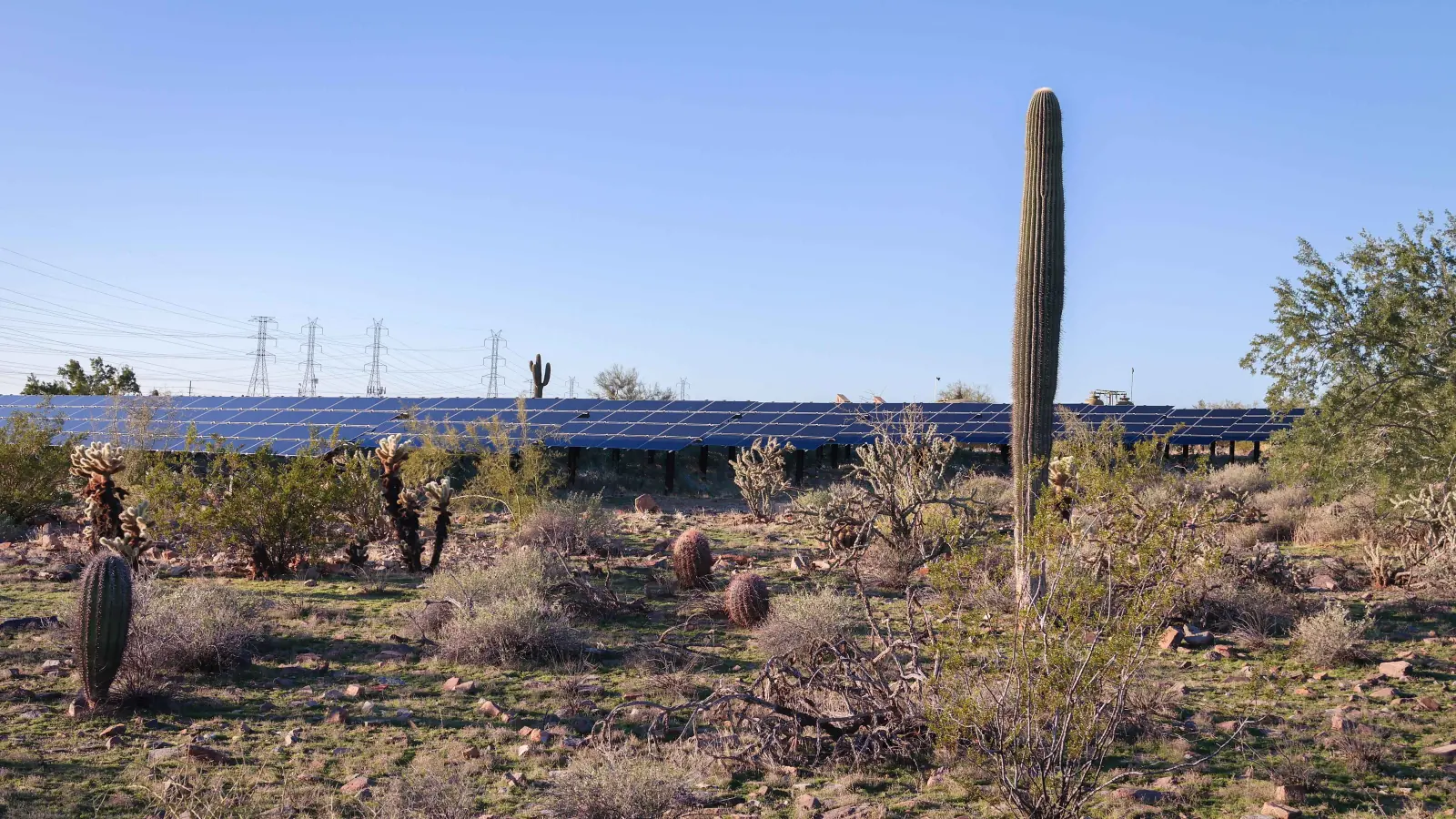

What an Arizona business plant earns for power sent to the grid depends on its utility. Businesses served by Arizona Public Service (APS), and medium and large ones served by Tucson Electric Power (TEP), can still net meter. Small TEP businesses get the Resource Comparison Proxy (RCP) export rate, which can drop up to 10 percent a year for new customers, and Salt River Project (SRP) sets its own rules.
In short
- APS businesses and larger TEP businesses can net meter; small TEP businesses get the RCP export rate; SRP credits exports at an hourly indexed price.
- Business rates carry large demand charges, so size the plant to daytime use and look at a battery for the peaks.
- Check your utility’s export rider and any pending rate case, ask the county assessor how the plant is classed, and plan for heat and dust.
What do businesses pay for electricity in Arizona?
In August 2026, businesses in Arizona paid an average of 13.05 cents per kWh, against 14.47 cents across the United States, according to preliminary data from the US Energy Information Administration (EIA). A year earlier the Arizona average was 12.98 cents. Industrial customers paid 9.73 cents, up from 8.88 cents in August 2025.
Demand charges weigh heavily on business bills. On APS’s large general service rate (E-32 L, for sites of 401 kW and more), the demand charge at secondary voltage is $29.422 per kW for the first 100 kW and $20.245 per kW above that, measured on the highest 15-minute period of the month. Energy costs 5.641 cents per kWh in summer and 3.800 cents in winter, before adjustments. A plant that cuts the kWh you buy saves the energy charge; a battery that discharges at your peak can also lower the demand charge.
APS’s rates are under review. The hearing in its rate case ended on July 7, 2026; the Arizona Corporation Commission (ACC), which regulates APS and TEP, expects a recommended order by late November 2026 and must vote by December 31, 2026, with new rates expected in early 2027. Ask for any savings estimate to be built on your current rate and on the new one once it is known.
| Area | August 2026 (¢/kWh) | August 2025 (¢/kWh) | Change |
|---|---|---|---|
| Arizona | 13.05 | 12.98 | +0.5% |
| California | 30.02 | 29.24 | +2.7% |
| Colorado | 13.94 | 13.13 | +6.2% |
| New Mexico | 12.14 | 12.02 | +1.0% |
| Utah | 10.39 | 10.82 | -4.0% |
| Nevada | 9.80 | 10.05 | -2.5% |
| United States | 14.47 | 13.87 | +4.3% |
Commercial sector. Changes are our calculation from EIA data. EIA’s next release is due November 24, 2026.
Does Arizona still have net metering for businesses?
For many businesses, yes. Under the ACC’s Value of Solar decision (Decision No. 75859), APS has paid new home solar customers the RCP export rate since 2017 instead of net metering them, and TEP applies the RCP to homes and small businesses that asked to connect since September 20, 2018. Net metering riders remain for other business customers.
APS’s net metering rider, EPR-6, is open to non-residential customers. Power the plant exports is netted against the kWh you buy in the billing month, or banked and netted on later bills; on time-of-use rates, on-peak and off-peak kWh are netted separately. Exports not netted by the December bill are bought at 2.895 cents per kWh, APS’s near-term avoided cost. The plant may not exceed 125 percent of the meter’s connected load, which APS defines as the maximum demand divided by 0.6. TEP’s Rider-4 works in a similar way for its other business customers: excess kWh reduce the kWh billed the next month, not the demand charge, and the balance is paid each October at TEP’s avoided cost.
The RCP is based on average market costs for solar energy over a recent five-year period. A new customer keeps the rate in force when it applied to connect for 10 years, and the rate for new customers may not drop more than 10 percent a year. For applications from September 1, 2026 to August 31, 2027, APS pays 5.554 cents per kWh; TEP pays 4.62 cents from October 1, 2026 to September 30, 2027.
Is it changing? On October 11, 2023, the ACC voted to open a docket to explore changes to the 10 percent cap and the 10-year lock for future rooftop solar customers, leaving cooperatives out. As of November 18, 2026, the RCP terms of APS and TEP still carried both. Get your utility’s export terms in writing before you size a plant, and size it to the power your site uses while the plant runs.
| Utility and customer | How exports are paid | Rate or rule |
|---|---|---|
| APS, business customers | Net metering under Rider EPR-6: exports netted against kWh bought, then banked | Exports left after the December bill paid at 2.895 cents per kWh |
| APS, homes | RCP export rate | 5.554 cents per kWh for applications from September 1, 2026, kept for 10 years |
| TEP, homes and small businesses | RCP export rate | 4.62 cents per kWh from October 1, 2026, kept for 10 years |
| TEP, medium and large businesses | Net metering under Rider-4 | Balance paid each October at TEP’s avoided cost |
| SRP, business customers | Buyback Service Rider | Hourly indexed energy price, less SRP’s scheduling and dispatch costs |
RCP rates for new customers are reset each year. APS’s rates are under review in a rate case.
How does Salt River Project treat solar at a business?
SRP, a community-based, not-for-profit utility, sets its own rules for solar at business sites. Business customers who sell excess power to SRP come under its Buyback Service Rider: when the plant produces more than the site uses in a given period, the excess is credited at the hourly indexed energy price, less SRP’s costs for scheduling, system control and dispatch. Plants of 100 kW AC or less may opt in to the SRP Renewable Export Program instead.
SRP reviews an application in 5 business days and a design in 5 more, with no fee. Plants of 301 to 999 kW AC get a 15 business day engineering review, also without a fee, and plants of 1 MW AC or more a 60 business day study with a $15,000 deposit, settled at actual cost. SRP makes a final review after the city clears the work, then commissions the plant.
SRP accepts leased plants, under lease terms it sets, such as a set term with no automatic renewal and a set monthly payment or prepayment. A power purchase and sale agreement, under which the customer buys all the plant’s power, is open only to public schools, not-for-profit charter schools, eligible government customers and 501(c)(3) organizations.
Can another company own a solar plant at an Arizona business?
Only in some cases. In a third-party power purchase agreement (PPA), another company owns the plant and sells you its power. DSIRE, a national database of state energy policies, marks such PPAs in Arizona as limited to certain sectors, citing ACC Decision 71795 and noting that they are limited to schools, governments and other non-profit entities. SRP applies a similar limit in its area, as described above.
Leasing is another route where your utility accepts it: the leasing company owns the plant and you pay a set amount, whatever it produces. If you buy the plant, with your own funds or a loan, the federal credit and depreciation stay with your business if the plant qualifies, as commercial solar in the United States explains. How each state treats these contracts is set out in third-party solar PPAs by state.
How does a plant connect to the grid in Arizona?
For utilities under the ACC’s jurisdiction, such as APS and TEP, the ACC’s interconnection rules (Arizona Administrative Code R14-2-2601 to R14-2-2628, in force since February 25, 2020) set three tracks by size. The utility must tell you within 7 calendar days whether an application is complete. It may charge an application fee only if the ACC has approved one in its tariff, and it may not require you to carry general liability insurance, unless the utility has financing from the federal Rural Utilities Service that requires it.
SRP runs its own process, described above. Whichever utility serves you, ask who files the application, how long the utility usually takes and who pays if it asks for grid upgrades.
| Track | Which plants | First review by the utility |
|---|---|---|
| Level 1, Super Fast Track | Inverter-based, 20 kW or less, using only certified equipment | 14 calendar days |
| Level 2, Fast Track | Less than 2 MW, other than Level 1 | 21 calendar days |
| Level 3, Study Track | 2 MW or more, or plants that fail the screens of the faster tracks | 30 calendar days, then any studies, with costs and timelines agreed in advance |
Days run from the notice that the application is complete. As of November 18, 2026.
Which tax breaks apply to a solar plant in Arizona?
Property tax. Under Arizona law, solar energy devices, grid-tied photovoltaic systems and any other system designed to produce solar energy primarily for use on site are considered to add no value to the property where they are installed (A.R.S. 42-11054). If the plant is classed as personal property, it is valued under a separate rule instead (A.R.S. 42-13056), so ask the county assessor how yours will be classed.
Transaction privilege tax. Arizona deducts the amount received from sales of solar energy devices from the retail tax base, and the retailer must register with the Arizona Department of Revenue as a solar energy retailer (A.R.S. 42-5061). How the tax applies to a contract that also covers installation depends on how it is written, so ask your builder.
Federal credit. A business that owns the plant may be able to claim the federal clean electricity investment credit, but for solar it now depends on when construction starts and when the plant is in service: see the US solar tax credit in 2026. Confirm each of these points with a CPA or tax adviser.
How do heat and dust affect a solar plant in Arizona?
Heat. Solar cells generally work best at low temperatures, says the US Department of Energy: higher temperatures raise their current slightly but cut their voltage much more, and extreme heat can damage cells and module materials and shorten their life. Ask for output estimates built on your site’s summer temperatures and the module’s temperature coefficient, and ask how the design manages heat.
Dust. Dust and dirt that settle on modules, known as soiling, cut output until rain or cleaning removes them. A 2017 conference paper published by the National Renewable Energy Laboratory notes earlier research finding that solar plants in the US Southwest had their lowest efficiencies in the summer dry season. Ask what soiling loss the yield estimate assumes, how often the modules will be cleaned, with what water and at whose cost.
Output. SRP says a solar plant in its area typically produces 1,700 kWh a year for each kW of capacity, so a 50 kW plant can produce up to 85,000 kWh a year. Your own figure depends on the equipment and on how the plant faces the sun.
How Aeternus helps
Aeternus Power is an independent energy company based in Madrid. We originate, qualify, structure and finance energy projects, solar-led and with storage, and bring in the builders and financing partners for each one. We never own the plants. A commission is paid by whoever builds or finances the project, never by you, and only if the project goes ahead.
Our office in California opens on December 1, 2026, and we have no office in Arizona. If you tell us about your site, with where it is, which utility serves it and how much power it uses in a year, we will say within two working days whether we can help there. How we work with businesses is on our business page.
Questions
Does APS still offer net metering for businesses?
Yes. APS’s Rider EPR-6 is open to non-residential customers: exported kWh are netted against the kWh you buy in the month or banked for later bills, and any left after the December bill are bought at 2.895 cents per kWh. Homes with solar get the RCP export rate instead.
What is the RCP export rate in Arizona for 2026?
For new customers it is 5.554 cents per kWh at APS, for applications from September 1, 2026 to August 31, 2027, and 4.62 cents at TEP from October 1, 2026 to September 30, 2027. Each customer keeps the rate in force when it applied for 10 years. At APS it covers homes; at TEP, homes and small businesses.
Can a business get a solar PPA in Arizona?
Only some can. DSIRE marks third-party solar PPAs in Arizona as limited to certain sectors, citing an ACC decision that limits them to schools, governments and other non-profit entities, and SRP applies a similar limit. What is a PPA? explains how they work.
Does commercial solar raise property taxes in Arizona?
A system designed to produce solar energy primarily for use on site is considered to add no value to the property where it is installed (A.R.S. 42-11054). If it is classed as personal property, a separate valuation rule applies. Ask your county assessor how yours will be classed.
How does SRP pay for excess solar power from a business?
Under its Buyback Service Rider, SRP credits the power your plant produces beyond what the site uses at an hourly indexed energy price, less its costs for scheduling, system control and dispatch. Plants of 100 kW AC or less may opt in to the SRP Renewable Export Program instead.
Is the federal solar tax credit still available for businesses in Arizona?
It depends on when construction starts and when the plant is in service, and the deadlines for solar are close. The US solar tax credit in 2026 explains who can claim what. Confirm your case with a CPA or tax adviser.
Sources
- EIA: Electric Power Monthly, Table 5.6.A, average price of electricity by sector and state, August 2026 and 2025 (released October 23, 2026): https://www.eia.gov/electricity/monthly/epm_table_grapher.php?t=epmt_5_6_a
- Arizona Public Service: Rate Rider RCP, Resource Comparison Proxy export rate (effective September 1, 2026, Decision No. 82122): https://www.aps.com/-/media/APS/APSCOM-PDFs/Utility/Regulatory-and-Legal/Regulatory-Plan-Details-Tariffs/Residential/Renewable-Plans-and-Riders/rcp_RateSchedule.pdf
- Arizona Public Service: Rate Rider EPR-6, net metering for on-site renewable generation (effective March 8, 2024, Decision No. 79293): https://www.aps.com/-/media/APS/APSCOM-PDFs/Utility/Regulatory-and-Legal/Regulatory-Plan-Details-Tariffs/Business/Rate-Riders/epr6_RenewableEnergyNetMetering.pdf
- Arizona Public Service: Rate Schedule E-32 L, large general service, 401 kW and above (effective March 8, 2024, Decision No. 79293): https://www.aps.com/-/media/APS/APSCOM-PDFs/Utility/Regulatory-and-Legal/Regulatory-Plan-Details-Tariffs/Business/Business-NonResidential-Plans/e32_Large.pdf
- Tucson Electric Power: Resource Comparison Proxy export rate (rate from October 1, 2026 to September 30, 2027): https://www.tep.com/rcp/
- Tucson Electric Power: Rider-4, net metering for certain partial requirements service (effective September 1, 2023, Decision No. 79065): https://docs.tep.com/wp-content/uploads/704-Rider-4-NM-PRS.pdf
- Arizona Corporation Commission: Commissioner Myers seeks to explore compensation for future rooftop solar customers (October 13, 2023): https://azcc.gov/news/home/2023/10/13/commissioner-myers-seeks-to-explore-compensation-for-future-rooftop-solar-customers
- Arizona Corporation Commission: What’s next in the APS rate case (July 10, 2026): https://azcc.gov/news/home/2026/07/10/what-s-next-in-the-aps-rate-case
- Salt River Project: Installing solar at your business, interconnection steps and fees, Buyback Service Rider: https://www.srpnet.com/energy-savings-rebates/business/renewable-energy-solutions/installing-solar-panels
- Salt River Project: Commercial distributed energy resource program requirements, leases and power purchase and sale agreements (March 2022): https://www.srpnet.com/v3/assets/bltefc1fc708dcc94e7/blte25e757906fdb0b0/solar-interconnection.pdf
- DSIRE, NC Clean Energy Technology Center: third-party solar PV power purchase agreement policies, map (May 2026): https://ncsolarcen-prod.s3.amazonaws.com/wp-content/uploads/2026/05/DSIRE_3rd-Party-PPA_May2026.pdf
- Arizona Administrative Code R14-2-2601 to R14-2-2628: interconnection of distributed generation facilities, in force since February 25, 2020 (Legal Information Institute): https://www.law.cornell.edu/regulations/arizona/Ariz-Admin-Code-SS-R14-2-2601
- Arizona Revised Statutes: section 42-11054, standard appraisal methods, solar energy devices (Arizona Legislature): https://www.azleg.gov/ars/42/11054.htm
- Arizona Revised Statutes: section 42-5061, retail classification, deduction for sales of solar energy devices (Arizona Legislature): https://www.azleg.gov/ars/42/05061.htm
- US Department of Energy: Solar photovoltaic performance and efficiency basics: https://www.energy.gov/cmei/systems/solar-photovoltaic-performance-and-efficiency-basics
- National Renewable Energy Laboratory: Seasonal trends of soiling on photovoltaic systems, conference paper NREL/CP-5J00-68673 (2017): https://docs.nlr.gov/docs/fy18osti/68673.pdf
Latest
Solar PPAs for businesses in California: how they work and what to check