Commercial solar in Texas in 2026: exports, batteries and taxes
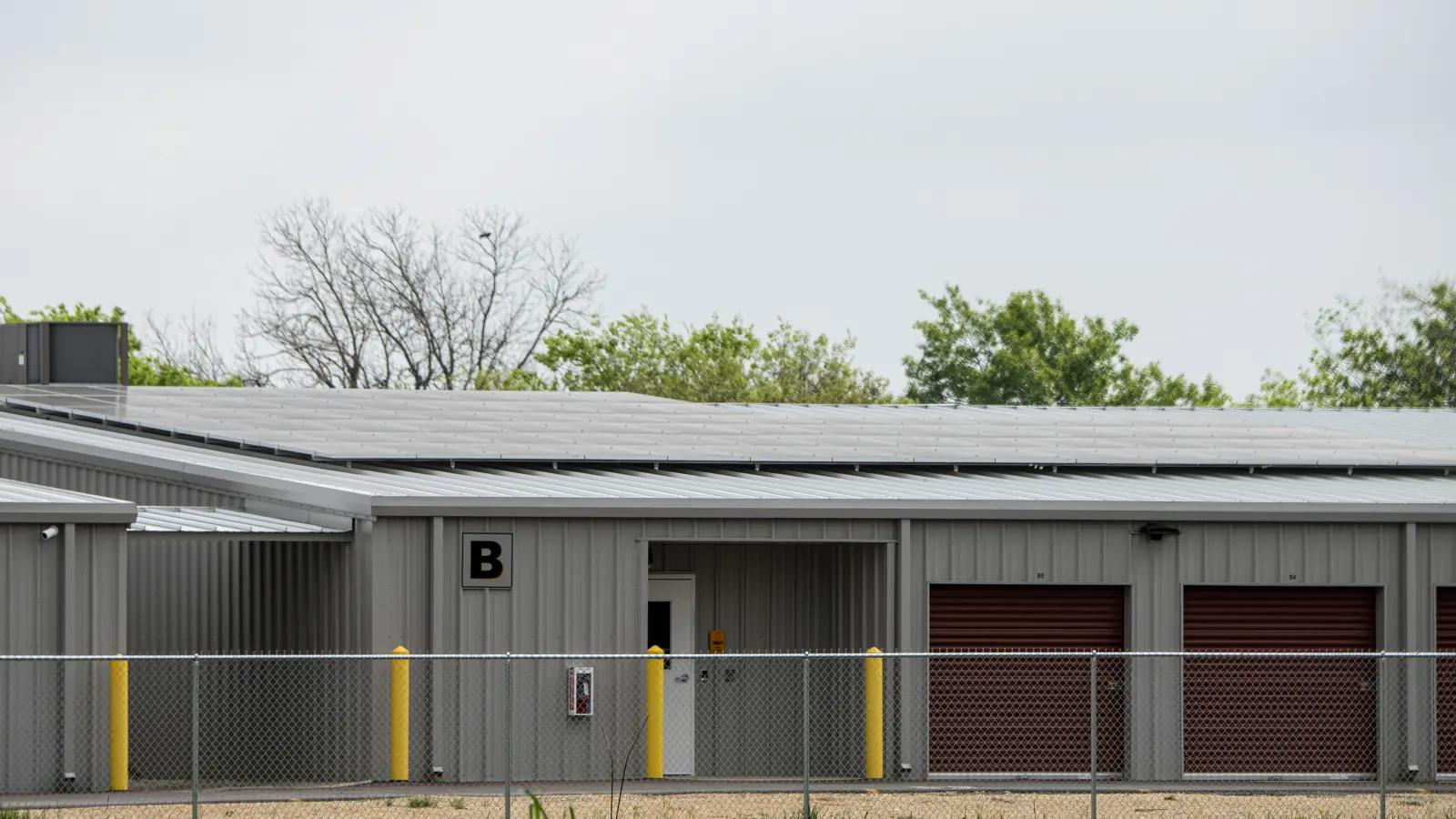

Texas has no statewide net metering rule for businesses. Where customers can choose their retail electric provider, that provider decides whether to buy the power your plant exports, at a value you agree; municipally owned utilities and cooperatives set their own terms. So size a plant to the power your site uses while the sun is up. Property tax relief is available too, but only if you apply.
In short
- Texas has no statewide net metering for businesses: your retail provider or local utility sets what exported power earns.
- So size a plant to daytime use, and consider a battery to cut demand charges and summer peak transmission costs.
- Check your export terms, apply for the property tax exemption between January 1 and April 30, and plan for hail and outages.
How is electricity sold to businesses in Texas?
Most of Texas runs on one grid, managed by the Electric Reliability Council of Texas (ERCOT). In 2021, the US Energy Information Administration (EIA) put its reach at about 75 percent of the state’s territory and 90 percent of its electric load. ERCOT has few connections to grids outside the state.
Customer choice began on January 1, 2002, but not everywhere. Under the Public Utility Regulatory Act (PURA), customers of municipally owned utilities and electric cooperatives that have not opted in to customer choice have none (section 39.102), and the law delays competition in some areas outside ERCOT. Where there is choice, your retail electric provider sells you power, while the utility that owns the wires connects a plant and supplies the meter. A municipally owned utility or a cooperative does both.
This decides three things for a plant: who pays for the power it exports, which connection rules apply, and whether another company may own it and sell you its power. For a renewable plant of up to 2,000 kW on your side of the meter that is expected to produce no more than you use in a year, state law says neither you nor the plant’s owner counts as a utility or a retail electric provider (section 39.916). Some utilities add their own limits: Austin Energy, the City of Austin’s utility, says third-party solar power purchase agreements (PPAs) are not allowed in its service territory. How these contracts are treated across the country is in third-party solar PPAs by state.
What do businesses pay for electricity in Texas?
In August 2026, businesses in Texas paid an average of 8.96 cents per kWh, against 14.47 cents across the United States, according to preliminary EIA data. A year earlier the Texas average was 8.76 cents. Industrial customers in Texas paid 7.21 cents, up from 6.42 cents in August 2025.
These are averages over all business customers. Your own price depends on your contract, your utility’s delivery charges and how evenly your site uses power. A low average also means each kWh a plant replaces saves less than in states such as California or New York, so demand charges, transmission costs and the tax relief described below weigh more in the case for a plant. Work from your own bills: ask your provider or utility for 12 months of interval data.
| Area | August 2026 (¢/kWh) | August 2025 (¢/kWh) | Change |
|---|---|---|---|
| Texas | 8.96 | 8.76 | +2.3% |
| Louisiana | 11.09 | 10.90 | +1.7% |
| Oklahoma | 10.90 | 10.00 | +9.0% |
| Arkansas | 11.73 | 10.75 | +9.1% |
| New Mexico | 12.14 | 12.02 | +1.0% |
| United States | 14.47 | 13.87 | +4.3% |
Commercial sector. Changes are our calculation from EIA data. EIA’s next release is due November 24, 2026.
Does Texas have net metering?
Not as a statewide rule for businesses. In areas with retail choice, state law says the owner of a plant sells its surplus to the retail electric provider that serves the site, at a value the two agree. The law gives two examples: a price based on the wholesale clearing price at the time the power is exported, or a credit on your account that carries over to later bills until it is used. It says a provider may offer such a contract, not that it must (PURA section 39.916).
The wires utility must make available a meter that measures the power you take from the grid and the power you send to it separately. You pay any extra cost of that meter unless it comes at no additional cost.
Municipally owned utilities and cooperatives set their own terms. Austin Energy, for example, credits all of a business plant’s output at its Value of Solar rate and bills all the power the site uses. From October 1, 2026, that rate is 12.89 cents per kWh for plants under 1 MW AC and 10.22 cents for larger ones, and Austin Energy says it is subject to change. Unused credit carries over from month to month but cannot be transferred.
So size the plant to the power your site uses while it runs. A kWh used on site replaces a kWh you would have bought; a kWh exported earns only what the buyback terms give. Get those terms in writing, with how long they last and whether credits expire.
| Where your site is | Who pays for exported power | What the rules say |
|---|---|---|
| Area with retail choice | Your retail electric provider, if it offers a buyback | A value agreed with the provider, which may offer a contract but is not required to |
| Municipally owned utility | The utility, under its own tariff | Its own rules; Austin Energy credits all output at its Value of Solar rate |
| Electric cooperative | The cooperative, under its own tariff | Its own rules; ask for its distributed generation tariff |
| Investor-owned utility area without retail choice | The utility, if it offers a contract | The utility may contract to credit the surplus; ask for its distributed generation tariff |
As of November 17, 2026. Check the current terms with your provider or utility before you size a plant.
What are demand charges and 4CP, and when does a battery help?
Many business rates charge for the highest demand your site reaches, in kW, as well as for the energy it uses. Pedernales Electric Cooperative’s large power rate, for example, applies to sites with a rolling 12-month average demand of 50 kW or more. Its peak capacity charge is $6.74 per kW, measured on the power delivered to the site or received from it in any 15-minute interval of the billing period.
In the ERCOT region, transmission costs are also shared out by demand at the grid’s peaks. Under the rules of the Public Utility Commission of Texas (PUCT), each utility pays according to its demand in the intervals of highest ERCOT demand in June, July, August and September, known as the four coincident peaks or 4CP. Some utilities pass this on to large customers by their own demand in those intervals. Pedernales, for instance, bills large power members $6.11 per kW of their 4CP demand from the previous summer, a rate it updates monthly, and says summer peaks typically fall between 4 and 6 p.m.
That method may change. In July 2026 the PUCT proposed replacing 4CP with 12 monthly peaks, from October to September, each measured over 30 minutes (Project No. 58000). A 2025 state law, Senate Bill 6, requires the PUCT to amend its rules on wholesale transmission charges by December 31, 2026. No final rule had been published in the Texas Register as of its November 13, 2026 issue.
A battery helps where a plant alone cannot: it can discharge in the intervals that set a demand charge or a summer peak, using power stored from the plant or bought in cheaper hours. At the rates Pedernales listed in November 2026, 100 kW less peak demand would save $674 a month, and 100 kW less 4CP demand about $7,300 in the following year if the rate stayed the same (our calculation). Ask how the battery would be controlled, who forecasts the peak days, and what it would save on your rate under both the current and the proposed method. Ask too whether power your plant exports can count toward your peak demand.
How does a plant connect to the grid in Texas?
If an investor-owned utility owns the wires at your site, the PUCT’s rules apply: 16 Texas Administrative Code (TAC) §25.211 and §25.212. They cover plants of up to 10 MW connected at less than 60 kV. Once the utility has a completed application, the connection should take place within four weeks for pre-certified equipment and within six weeks otherwise. If the grid needs substantial upgrades, the utility must first give you an estimate of the time and of your cost.
The utility may not charge a study fee for pre-certified units of up to 500 kW that export no more than 15 percent of the load on their feeder and stay within a limit on short-circuit current. It may not charge distribution, transmission or upkeep fees for the power you export. And the plant must have protection that stops it from connecting to a utility line that has lost power (§25.212).
Cooperatives and municipally owned utilities largely run their own procedures: most of §25.211 does not apply to cooperatives, and Austin Energy, for example, publishes its own interconnection guide. State law also bars your utility or provider from requiring extra liability insurance for a plant of up to 2,000 kW that meets the PUCT’s standards (PURA section 39.916).
Which tax breaks apply to a solar plant in Texas?
Property tax. Texas exempts from property tax the value a solar energy device adds to real property when the device is mainly for producing and distributing energy used on site (Tax Code §11.27). Since 2021 the owner of the device may claim the exemption even if it does not own the land or building, which matters when a financing partner owns the plant. The law’s definition includes equipment that stores the energy.
The exemption is not automatic. You apply to the appraisal district in each county where the property is, on Comptroller Form 50-123, between January 1 and April 30 of the tax year. Once it is granted, you do not need to reapply each year unless the chief appraiser asks.
Franchise tax. A business may deduct from its apportioned margin 10 percent of the amortized cost of a solar energy device, storage included, that it acquires and uses in Texas, if the cost is amortized over at least 60 months (Tax Code §171.107). The deduction cannot be taken under the simplified E-Z computation (§171.1016).
Federal credit. A business that owns the plant may be able to claim the federal clean electricity investment credit, but for solar it now depends on when construction starts and when the plant is in service: see the US solar tax credit in 2026. Confirm each of these points with a CPA or tax adviser.
Can a business finance a plant with PACE in Texas?
Yes, if your city or county has set up a program. The Property Assessed Clean Energy (PACE) Act, Local Government Code chapter 399, lets a local government arrange financing for permanent improvements that cut energy or water use, including equipment on the customer’s side of the meter that generates electricity. It covers commercial and industrial property and residential buildings with five or more units. You repay through an assessment on the property.
The assessment is a first lien on the property, with the same priority as a property tax lien. Any mortgage holder must receive written notice at least 30 days before the contract is signed and give its written consent. An independent third party reviews the expected savings before the work and the local government requires written verification once the project is complete.
The Texas PACE Authority, a nonprofit, administers TX-PACE programs with local governments. It says it closed 15 projects across 11 local programs in 2025, with more than $121 million in PACE investment.
How do hail, winter storms and outages affect a plant in Texas?
Hail. The Texas Department of Insurance notes that spring typically brings the most severe thunderstorms and hail to Texas. Before you sign, ask how the modules are rated for hail, and check with your insurer how the plant would be covered against wind and hail and at what deductible.
Winter storms. In February 2021, extreme cold raised demand and disrupted supply at the same time. ERCOT began rotating outages at midnight on February 15, and generation stayed below forecast demand through February 18, according to EIA. Customers across Texas lost power, especially in areas managed by ERCOT.
Backup. A plant connected to the grid must have protection that keeps it from connecting to a utility line that has lost power (16 TAC §25.212), so on its own it usually stops in an outage. To keep critical loads running, it needs a battery and equipment that separates your site from the grid. Decide which loads it must carry and for how long, and ask for this to be designed in from the start.
How Aeternus helps
Aeternus Power is an independent energy company based in Madrid. We originate, qualify, structure and finance energy projects, solar-led and with storage, and bring in the builders and financing partners for each one. We never own the plants. A commission is paid by whoever builds or finances the project, never by you, and only if the project goes ahead.
Our office in California opens on December 1, 2026, and we have no office in Texas. If you tell us about your site, with where it is, which utility or retail electric provider serves it and how much power it uses in a year, we will say within two working days whether we can help there. How we work with businesses is on our business page.
Questions
Will my electricity provider buy back excess solar power in Texas?
Only if it offers a buyback. In areas with retail choice, state law lets a retail electric provider buy surplus from a plant at a value agreed with the owner, but does not require it. Municipally owned utilities and cooperatives set their own terms, such as Austin Energy’s Value of Solar credit.
Is commercial solar exempt from property tax in Texas?
The value a solar device adds to real property can be exempt if the device mainly produces energy for use on site (Tax Code §11.27). The owner of the device can claim it even without owning the property. You apply to the county appraisal district on Form 50-123 between January 1 and April 30.
What is 4CP in ERCOT?
4CP stands for the four coincident peaks: the intervals of highest ERCOT demand in June, July, August and September. Transmission costs are shared out by demand in those intervals, and some utilities bill large customers on their own 4CP demand. In July 2026 the PUCT proposed moving to 12 monthly peaks.
Can a business sign a solar PPA in Texas?
State law makes room for it: for a renewable plant of up to 2,000 kW expected to produce no more than the site uses in a year, neither the customer nor the owner counts as a utility or retail provider. Some utilities restrict it; Austin Energy does not allow third-party solar PPAs in its territory. How a PPA works is explained in what is a PPA.
Does commercial solar work during a power outage in Texas?
Not on its own. A plant connected to the grid must be kept from feeding utility lines that have lost power, so it usually stops in an outage. To keep critical loads running, it needs a battery and equipment that separates your site from the grid.
Is the federal solar tax credit still available for businesses in Texas?
For a solar plant whose construction starts now, the owner can claim the federal credit only if the plant is in service by December 31, 2027; batteries are not bound by that date. The rules are in the US solar tax credit in 2026. Confirm your case with a CPA or tax adviser.
Sources
- EIA: Electric Power Monthly, Table 5.6.A, average price of electricity by sector and state, August 2026 and 2025 (released October 23, 2026): https://www.eia.gov/electricity/monthly/epm_table_grapher.php?t=epmt_5_6_a
- EIA: Today in Energy, Extreme winter weather is disrupting energy supply and demand, particularly in Texas (February 19, 2021): https://www.eia.gov/todayinenergy/detail.php?id=46836
- Texas Legislature: Utilities Code, chapter 39 (PURA sections 39.102 and 39.916, retail choice and distributed renewable generation): https://statutes.capitol.texas.gov/Docs/UT/htm/UT.39.htm
- Texas Legislature: Senate Bill 6, 89th Legislature, enrolled version, section 6 (review of the 4CP method, rules due by December 31, 2026): https://capitol.texas.gov/tlodocs/89R/billtext/html/SB00006F.htm
- Texas Register: PUCT proposed amendments to 16 TAC §25.192 and §25.193, Project No. 58000, replacing 4CP with 12CP (July 24, 2026): https://www.sos.texas.gov/texreg/archive/July242026/Proposed%20Rules/16.ECONOMIC%20REGULATION.html
- 16 TAC §25.211: Interconnection of on-site distributed generation (Legal Information Institute): https://www.law.cornell.edu/regulations/texas/16-Tex-Admin-Code-SS-25-211
- 16 TAC §25.212: Technical requirements for interconnection and parallel operation of on-site distributed generation (Legal Information Institute): https://www.law.cornell.edu/regulations/texas/16-Tex-Admin-Code-SS-25-212
- Texas Legislature: Tax Code, chapter 11, section 11.27 (solar and wind-powered energy devices): https://statutes.capitol.texas.gov/Docs/TX/htm/TX.11.htm
- Texas Legislature: Tax Code, chapter 171, sections 171.107 and 171.1016 (solar energy device deduction, E-Z computation): https://statutes.capitol.texas.gov/Docs/TX/htm/TX.171.htm
- Texas Comptroller: Form 50-123, Exemption application for solar or wind-powered energy devices: https://comptroller.texas.gov/forms/50-123.pdf
- Texas Legislature: Local Government Code, chapter 399, Property Assessed Clean Energy Act: https://statutes.capitol.texas.gov/Docs/LG/htm/LG.399.htm
- Texas PACE Authority: About us (nonprofit administrator of TX-PACE, 2025 results): https://www.texaspaceauthority.org/about-us/
- Austin Energy: Value of Solar rate for commercial customers (effective October 1, 2026): https://austinenergy.com/rates/commercial-rates/value-of-solar-rate
- Austin Energy: Solar incentives for your business (third-party solar PPAs not allowed in its service territory): https://austinenergy.com/green-power/solar-solutions/for-your-business
- Pedernales Electric Cooperative: Large power rates (peak capacity charge and 4CP transmission charge): https://mypec.com/large-power-rates/
- Texas Department of Insurance: Insurance tips for spring storms (April 16, 2026): https://tdi.texas.gov/news/2026/tdi04162026.html
Latest
Solar PPAs for businesses in California: how they work and what to check