Commercial solar in New Jersey in 2026: SREC-IIs, net metering and taxes
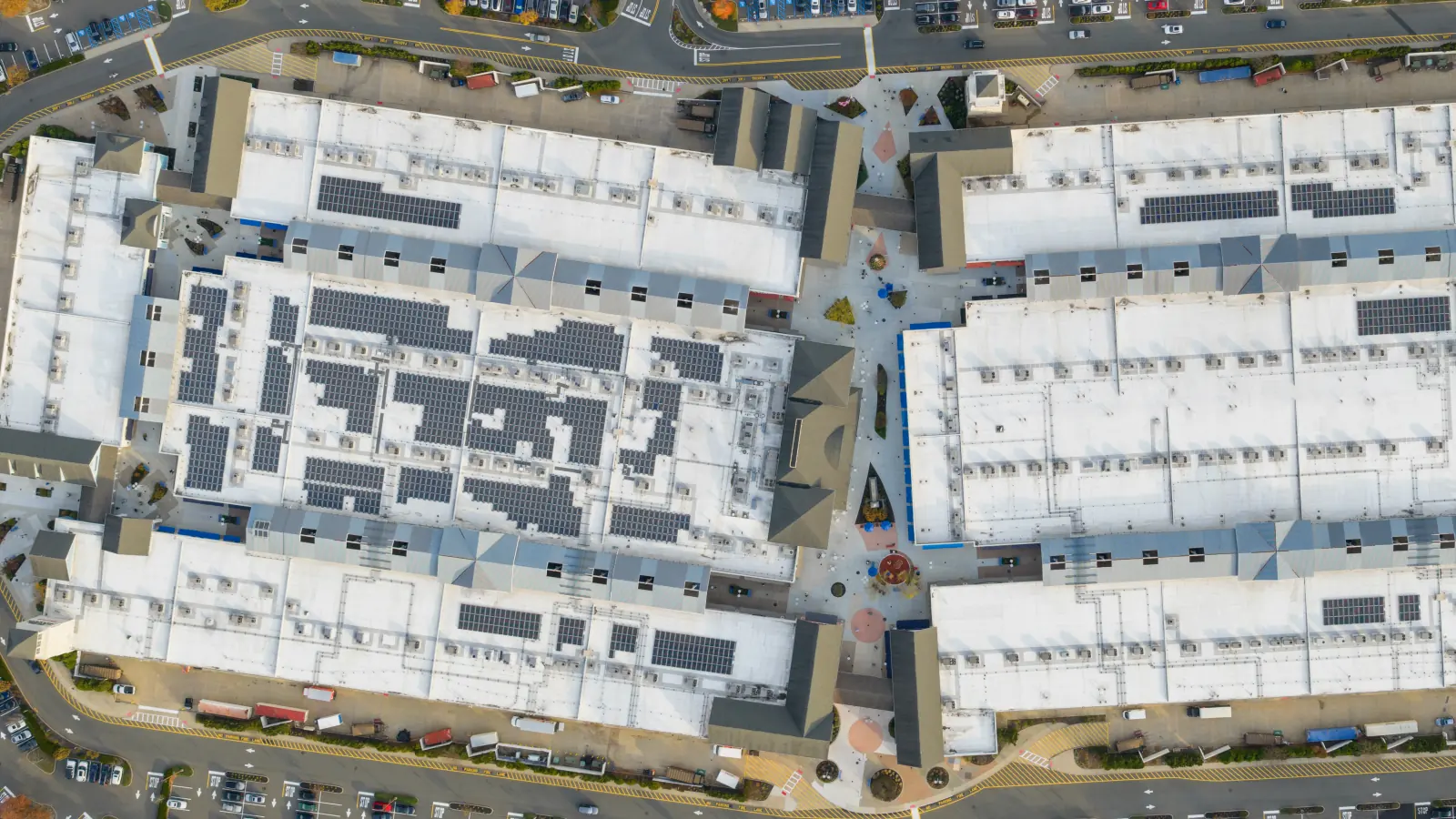

New Jersey pays for business solar in three ways. A registered plant earns one solar renewable energy certificate, an SREC-II, per MWh for 15 years, worth $110 for a net-metered plant under 1 MW on a rooftop or carport, as set by the Board of Public Utilities. Net metering credits the power it exports, and the value it adds to your property can be exempt from tax.
In short
- New Jersey pays business solar through SREC-IIs for 15 years, net metering credits and a property tax exemption for the plant’s added value.
- For 2026, a net-metered business plant under 1 MW on a rooftop or carport earns $110 per SREC-II; larger and ground-mounted plants earn less.
- Check the capacity left in your segment, size the plant to your yearly use, and have the system certified for the tax exemption.
What do businesses pay for electricity in New Jersey?
In August 2026, businesses in New Jersey paid an average of 18.71 cents per kWh, against 14.47 cents across the United States, according to preliminary data from the US Energy Information Administration (EIA). A year earlier the New Jersey average was 18.52 cents. Industrial customers paid 16.24 cents, up from 15.06 cents in August 2025.
Many business rates also charge for demand: the highest power your site draws, in kW. Jersey Central Power & Light (JCP&L), for example, bills its general service customers $9.00 per kW of maximum demand above 10 kW from June to September and $8.38 the rest of the year, measured over 15 minutes, at rates in effect since July 15, 2026. That charge never falls below $4.08 per kW of the highest demand of the past 12 months, so a single spike can raise your bills for a year.
A solar plant cuts the energy you buy, but in its May 2026 review the New Jersey Board of Public Utilities (NJBPU) noted that more of a business customer’s bill depends on demand charges, which solar does not directly address. At JCP&L’s rates, 100 kW less peak demand would save $900 in a summer month and $838 in other months (our calculation). To lower the peak, you need a battery or control of your largest loads, not only a plant.
| Area | August 2026 (¢/kWh) | August 2025 (¢/kWh) | Change |
|---|---|---|---|
| New Jersey | 18.71 | 18.52 | +1.0% |
| New York | 23.06 | 22.33 | +3.3% |
| Maryland | 17.00 | 15.06 | +12.9% |
| Delaware | 14.50 | 12.68 | +14.4% |
| Pennsylvania | 13.93 | 12.68 | +9.9% |
| United States | 14.47 | 13.87 | +4.3% |
Commercial sector. Changes are our calculation from EIA data. EIA’s next release is due November 24, 2026.
How does the Successor Solar Incentive (SuSI) program pay a business plant?
The Solar Act of 2021 told the NJBPU to create a new solar incentive, which it set up by order on July 28, 2021: the Successor Solar Incentive (SuSI) program. A registered plant earns one solar renewable energy certificate, an SREC-II, for each MWh it produces, for 15 years from the start of commercial operation. Each SREC-II has a set value in dollars per MWh, and the state’s electric distribution companies buy them jointly, through an SREC-II administrator.
SuSI has two parts. The Administratively Determined Incentive (ADI) program, open since August 28, 2021, sets values for net-metered plants of up to 5 MW (dc), community solar and remote net metering. Net-metered business plants over 5 MW (dc), and plants that sell their power into the wholesale market, compete for incentives in the Competitive Solar Incentive (CSI) program.
In its 2026 review, the NJBPU modeled a typical business plant of 250 kW on a rooftop, producing 1,282 kWh per kW in its first year. At $110 per SREC-II, its 320 MWh would earn about $35,000 that year (our calculation). The Board adds $20 per MWh for net-metered plants serving public entities, and plants of 1 MW (dc) or more must pay prevailing wages.
| Market segment | Size (dc) | Value per SREC-II |
|---|---|---|
| Small, on a rooftop, carport or canopy, or floating | Under 1 MW | $110 |
| Small, ground-mounted | Under 1 MW | $90 |
| Large, on a rooftop, carport or canopy, or floating | 1 MW to 5 MW | $100 |
| Large, ground-mounted | 1 MW to 5 MW | $85 |
As of November 18, 2026. One SREC-II per MWh, for 15 years. Residential plants registered from July 27, 2026 get $77. The Board resets values at least every three years; a reset does not change the value of a plant that already holds conditional registration.
How do you register a business plant for SREC-IIs?
Registration comes before construction. The plant’s developer or installer files a complete registration package on the SuSI portal, with your utility bill and, for plants of 25 kW or more, the building and electrical permits or proof that they were applied for. Plants from 25 kW up to 1 MW add proof that the interconnection application was submitted to your utility; plants of 1 MW or more need the utility’s conditional approval to construct and a milestone reporting form.
The registration manager reviews packages first come, first served, and issues a notice of conditional registration; under the rules, construction should start only after it, unless the Board grants a waiver. A net-metered plant then has one year to receive permission to operate from the utility and file its post-construction certification package, with one possible six-month extension. Once the package is accepted, and an inspection passed or waived, the plant receives a New Jersey certification number and can start creating SREC-IIs.
Capacity is rationed in yearly blocks. For the energy year that began on June 1, 2026, the Board allocated 150 MW (dc) to net-metered business plants of 5 MW or less, open until the block is full or until June 1, 2027. In the previous energy year, registrations in this segment averaged about 1.8 MW a week, as of April 27, 2026. Check the capacity left on the New Jersey Clean Energy Program website before you count on it.
Does New Jersey have net metering for businesses?
Yes. Under the NJBPU’s rules (N.J.A.C. 14:8-4), every electric distribution company and electricity supplier must offer net metering to customers who generate Class I renewable energy, such as solar, on their side of the meter. The plant must stand on the property where the power is used, or on a contiguous one, and its capacity may not exceed the electricity supplied to the site over a past 12-month period that you choose. In practice, says the New Jersey Clean Energy Program, a system cannot be larger than the customer’s annual electric needs.
When the plant produces more than the site uses in a month, the excess becomes a credit on the next bill, at the full retail value of each kWh, and credits carry over from month to month. At the end of a 12-month annualized period, whose start you choose, any excess left is paid at the avoided cost of wholesale power: the average locational marginal price of energy in your utility’s transmission zone, published by PJM Interconnection, the regional grid operator.
The utility must provide a meter that measures power in both directions, at its own cost if your existing meter cannot, and may not charge you extra fees or require extra equipment or insurance unless the rules allow it. You own the plant’s renewable attributes unless a contract assigns them. And the whole load the plant will be netted against must be installed and working before the plant is allowed to switch on.
| When | What happens | Rule |
|---|---|---|
| Excess in a month | A credit on the next bill, carried over from month to month | N.J.A.C. 14:8-4.3(c) and (d) |
| Excess left at the end of the annualized period | Paid at the average wholesale price of energy in your utility’s zone | N.J.A.C. 14:8-4.3(e) |
| You change electricity supplier | Treated as the end of the annualized period | N.J.A.C. 14:8-4.3(j) |
As of November 18, 2026. Check your utility’s net metering tariff for the details that apply to your account.
Which tax breaks apply to a solar plant in New Jersey?
Property tax. New Jersey exempts the value a certified renewable energy system adds to real property (N.J.S.A. 54:4-3.113a and following). The law covers equipment that is part of, or added to, a residential, commercial, industrial or mixed-use building and produces energy on site for all or part of that building’s needs. The exemption is the assessed value with the system minus the assessed value without it, and it applies from the tax year after the system is certified.
It is not automatic. The owner and the installer file Form CRES; the municipal construction official, as the local enforcing agency, certifies the system, and the tax assessor accepts or rejects the claim. Because the law speaks of equipment added to a building, ask your assessor early how a ground-mounted plant on your site would be treated.
Sales tax. Under the Division of Taxation’s rules (N.J.A.C. 18:24-26), buying, renting or leasing solar energy equipment that provides electric power, including equipment that stores solar-generated energy, is exempt from sales and use tax. The buyer gives the seller an Exempt Use Certificate, Form ST-4, marked as a solar energy exemption and showing the address where the plant will be installed. Equipment that would be needed whatever the energy source does not qualify.
Federal credit. A business that owns the plant may be able to claim the federal clean electricity investment credit, but for solar it now depends on when construction starts and when the plant is in service: see the US solar tax credit in 2026. Confirm each of these points with a CPA or tax adviser.
Can another company own the plant at your site?
Yes. DSIRE, the database of state energy policies run by the NC Clean Energy Technology Center, lists New Jersey among the states where third-party solar power purchase agreements (PPAs) are authorized or in use, citing the state’s utility law (N.J.S.A. 48:3-51) and its net metering rules. Under a PPA, another company owns the plant at your site and sells you its power, at a price set in the contract, with any yearly increase written into the contract from the start.
The net metering rules allow for this: the owner of the plant, which they call the net metering generator, may be a different entity from the customer whose meter it serves. The SREC-II rules also let a plant’s owner assign its certificates to a third party by contract. So ask who will own the SREC-IIs and claim the federal credit, and how that shows in your price. What is a PPA explains how such contracts work, and third-party solar PPAs by state compares the rules across the country.
How does a plant connect to the grid in New Jersey?
Your utility reviews the connection under the NJBPU’s interconnection rules (N.J.A.C. 14:8-5), as amended from January 5, 2026. Level 1 covers certified inverter-based plants with a nameplate rating of up to 50 kW (ac) that export no more than 25 kW. Level 2 covers certified plants that export up to 2 MW (ac). Level 3 covers everything else.
The utility must let you limit what the plant sends to the grid below its nameplate rating, and the studies are then based on that export capacity. The Board has also required the utilities to set up a common interconnection application portal. In its 2026 review, several developers told the Board of long delays in utility reviews, so ask your utility how long applications are taking and who pays if it asks for grid upgrades.
How Aeternus helps
Aeternus Power is an independent energy company based in Madrid. We originate, qualify, structure and finance energy projects, solar-led and with storage, and bring in the builders and financing partners for each one. We never own the plants. A commission is paid by whoever builds or finances the project, never by you, and only if the project goes ahead.
Our office in California opens on December 1, 2026, and we have no office in New Jersey. If you tell us about your site, with where it is, which utility serves it and how much power it uses in a year, we will say within two working days whether we can help there. How we work with businesses is on our business page.
Questions
How much is an SREC-II worth for commercial solar in New Jersey in 2026?
It depends on the plant’s size and where it sits. A net-metered business plant under 1 MW (dc) on a rooftop, carport or canopy earns $110 per SREC-II, and $90 if it is ground-mounted; from 1 to 5 MW the values are $100 and $85. Each MWh earns one SREC-II for 15 years, and a later reset does not change the value once the plant is conditionally registered.
What happens to excess solar credits in New Jersey at the end of the year?
Credits for excess power carry over from month to month until the end of your 12-month annualized period, whose start you choose. What is left then is paid at the avoided cost of wholesale power, the average locational marginal price of energy in your utility’s zone, not at the retail rate.
Do I have to pay property tax on commercial solar in New Jersey?
Not on the value a certified system adds, if it qualifies. The law exempts that added value from the tax year after certification: you file Form CRES, the municipal construction official certifies the system and the tax assessor accepts or rejects the claim. Confirm how it applies to your property with a CPA or tax adviser.
Is solar equipment exempt from sales tax in New Jersey?
Yes, solar energy equipment that provides electric power, storage for solar energy included, is exempt from sales and use tax under the Division of Taxation’s rules. The buyer gives the seller Form ST-4, marked as a solar energy exemption, with the installation address.
Can a business get a solar PPA in New Jersey?
Yes. DSIRE lists New Jersey among the states where third-party solar PPAs are authorized or in use, and the net metering rules let the plant’s owner be a different entity from the customer it serves. What is a PPA explains how such a contract works.
Is the federal solar tax credit still available for businesses in New Jersey?
For a solar plant whose construction starts now, the owner can claim the federal credit only if the plant is in service by December 31, 2027; batteries are not bound by that date. The rules are in the US solar tax credit in 2026. Confirm your case with a CPA or tax adviser.
Sources
- EIA: Electric Power Monthly, Table 5.6.A, average price of electricity by sector and state, August 2026 and 2025 (released October 23, 2026): https://www.eia.gov/electricity/monthly/epm_table_grapher.php?t=epmt_5_6_a
- NJBPU: Order regarding the three-year review of the ADI program and EY 2027 megawatt blocks, Docket Nos. QO20020184 and QO26030096 (May 21, 2026): https://www.nj.gov/bpu/pdf/boardorders/2026/20260521/8C%20ORDER%20ADI%203%20Year%20Review%20Cost%20Cap.pdf
- N.J.A.C. 14:8-11.5: Successor Solar Incentive Program registration process (Legal Information Institute): https://www.law.cornell.edu/regulations/new-jersey/N-J-A-C-14-8-11-5
- N.J.A.C. 14:8-11.6: New Jersey SREC-II value and 15-year qualification life (Legal Information Institute): https://www.law.cornell.edu/regulations/new-jersey/N-J-A-C-14-8-11-6
- N.J.A.C. 14:8-4.1: Net metering scope, plants on the same or a contiguous property (Legal Information Institute): https://www.law.cornell.edu/regulations/new-jersey/N-J-A-C-14-8-4-1
- N.J.A.C. 14:8-4.3: Net metering general provisions and the annualized period (Legal Information Institute): https://www.law.cornell.edu/regulations/new-jersey/N-J-A-C-14-8-4-3
- New Jersey Clean Energy Program: Net metering and interconnection: https://cleanenergy.nj.gov/resources/net-metering-and-interconnection
- NJBPU: Adopted amendments to N.J.A.C. 14:8-5, interconnection, R.2026 d.010, 58 N.J.R. 72(a) (effective January 5, 2026): https://www.nj.gov/bpu/pdf/rules/R.2026%20d.010%20(58%20N.J.R.%2072(a)).pdf
- New Jersey Division of Taxation: Property tax abatements and exemptions, renewable energy system exemption: https://www.nj.gov/treasury/taxation/lpt/lpt-abatements.shtml
- New Jersey Division of Taxation: Form CRES, application for certification of renewable energy systems, with N.J.S.A. 54:4-3.113a to 3.113f (September 2018): https://nj.gov/treasury/taxation/pdf/other_forms/lpt/cres.pdf
- N.J.A.C. 18:24-26.4: Sales and use tax, procedure for the solar energy exemption (Legal Information Institute): https://www.law.cornell.edu/regulations/new-jersey/N-J-A-C-18-24-26-4
- JCP&L: Tariff BPU No. 14, Part III, Service Classification GS, general service secondary (rates effective July 15, 2026): https://www.firstenergycorp.com/content/dam/customer/Customer%20Choice/Files/New%20Jersey/tariffs/BPU-14-Part-III-Eff-9-1-2026.pdf
- DSIRE, NC Clean Energy Technology Center: third-party solar PV power purchase agreement policies, map with authorities (May 2026): https://ncsolarcen-prod.s3.amazonaws.com/wp-content/uploads/2026/05/DSIRE_3rd-Party-PPA_May2026.pdf
- IRS: Instructions for Form 3468 (2025), termination of the credit for solar placed in service after 2027 (updated August 28, 2026): https://www.irs.gov/instructions/i3468
Latest
Solar PPAs for businesses in California: how they work and what to check