Commercial solar in Illinois in 2026: net metering, rebates, Illinois Shines and taxes
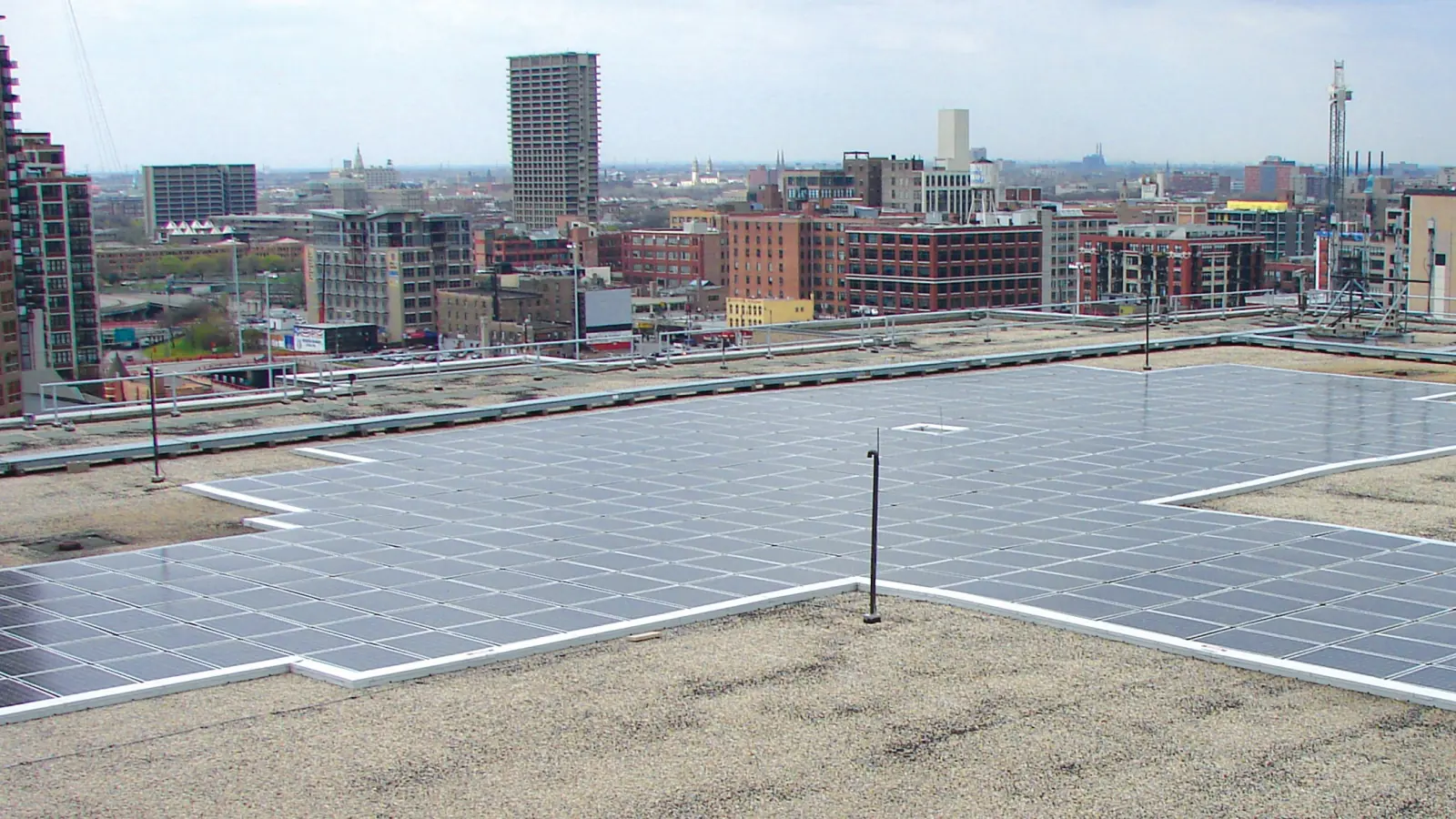

A solar plant at an Illinois business can bring in value four ways: power used on site replaces power you would buy, exports earn credits on the supply part of the bill, ComEd or Ameren Illinois pays a one-time rebate of $250 or $300 per kW, and Illinois Shines pays for 15 years of its renewable energy credits. Its added value can also stay off your property tax assessment.
In short
- Illinois values business solar through power used on site, supply-only credits for exports, a utility rebate per kW and Illinois Shines REC payments.
- Since 2025 new plants earn credits only for supply charges, so a plant whose output the site uses as it produces is worth the most.
- Check your supply contract and capacity charges, the rebate’s trade-offs, the Illinois Shines block, and file your property tax claim with the county.
What do businesses pay for electricity in Illinois?
In August 2026, businesses in Illinois paid an average of 14.67 cents per kWh, against 14.47 cents across the United States, according to preliminary data from the US Energy Information Administration (EIA). A year earlier the Illinois average was 13.94 cents, so it rose 5.2 percent (our calculation). Industrial customers paid 11.33 cents, up from 10.18 cents in August 2025.
An Illinois bill has two parts. Your utility charges for delivery, while supply, which covers the energy itself plus capacity and transmission, can come from the utility or from a retail supplier. The split matters for solar: power your plant uses on site avoids the charges billed per kWh in both parts, while power it sends to the grid is now credited against supply only, as explained below. Work from your own bills, not from averages.
| Area | August 2026 (¢/kWh) | August 2025 (¢/kWh) | Change |
|---|---|---|---|
| Illinois | 14.67 | 13.94 | +5.2% |
| Indiana | 13.29 | 13.86 | -4.1% |
| Wisconsin | 14.19 | 13.60 | +4.3% |
| Missouri | 12.63 | 12.26 | +3.0% |
| Iowa | 14.15 | 12.87 | +9.9% |
| Michigan | 16.21 | 14.85 | +9.2% |
| United States | 14.47 | 13.87 | +4.3% |
Commercial sector. Changes are our calculation from EIA data. EIA’s next release is due November 24, 2026.
How do capacity prices reach a business electricity bill in Illinois?
Two grids run through Illinois, says the Illinois Power Agency (IPA): in the north, ComEd delivers the power and PJM Interconnection runs the grid; in most of central and southern Illinois, Ameren Illinois delivers it and the Midcontinent Independent System Operator (MISO) runs the grid. In both areas you can buy supply from a retail supplier instead of the utility and still pay the same delivery charges, says Plug In Illinois, run by the Illinois Commerce Commission (ICC).
Part of the supply price pays for capacity: the cost of keeping enough power plants, batteries and customers who can cut demand ready for each year’s peak, with a margin. PJM and MISO price it in auctions for years that start in June. PJM’s price rose from $269.92 per MW per day for the year from June 2025 to its cap of $329.17 for the year from June 2026, and the next two auctions also cleared at their caps. MISO’s summer price was $666.50 per MW per day in 2025 and $424.30 in 2026; its other seasons cleared far lower.
How much of this reaches you depends on how your supplier buys capacity: MISO says about 92 percent of its customers had bought ahead or supplied their own for 2026/27, which makes them less exposed to the auction price. In ComEd’s area, your share of capacity for each year from June is set mainly from your demand in the five hours of the previous summer when the PJM system peaked (PJM tariff, Attachment M-2). Ask your supplier whether your contract passes capacity costs through on that share.
A plant on site can help here: power you do not draw from the grid in those hours lowers next year’s share, and the tariff lets net-metered generation count in it. The peak hours are known only after the summer; if they fall late in the day, when solar output is lower, a battery that discharges then does more. What you save depends on your contract and on when the peaks fall.
| Auction and period | Price ($/MW-day) | Note |
|---|---|---|
| PJM, June 2025 to May 2026 | $269.92 | ComEd zone |
| PJM, June 2026 to May 2027 | $329.17 | ComEd zone, at the auction’s cap |
| PJM, June 2027 to May 2028 | $333.44 | ComEd zone, at the cap |
| PJM, June 2028 to May 2029 | $325.00 | ComEd zone, at the cap |
| MISO, summer 2025 | $666.50 | Zone 4, which includes Illinois; June to August |
| MISO, summer 2026 | $424.30 | Zone 4; fall, winter and spring of 2026/27 cleared from $7.61 to $35.97 |
At $329.17 per MW per day, a capacity share of 1 MW costs about $120,000 over a year, or about $120 per kW, before any adjustments in your supplier’s charges (our calculation).
Does Illinois still have net metering for businesses?
Yes, but since January 1, 2025 it is worth less for new plants. Under section 16-107.5 of the Public Utilities Act, plants registered for net metering before that date keep the earlier terms for the lifetime of the system. Customers who apply from January 1, 2025 are credited only for the supply charges billed per kWh: energy, capacity, transmission and, where it applies, the purchased energy adjustment. They still pay delivery charges on all the power they draw from the grid.
ComEd says customers interconnected from 2025 receive credits against the supply section of the bill, that these credits do not expire, and that business customers over 100 kW, whose supply service was declared competitive, already received supply-only credits. Ameren Illinois told its renewable energy partners that new net metering customers would receive only supply and transmission credits for power sent to the grid. If a retail supplier sells you power, ask it how it credits net metering.
The law sets no size limit in kW for a plant at your own site, but it must be on your premises or your side of the meter and intended mainly to offset your own current or future use. As exports now earn only the supply value, size the plant to what the site uses while it produces.
Batteries can be net metered too since the 2026 law described below: a battery of up to 5,000 kW energized after June 1, 2026 qualifies if the business buys its supply on an hourly or time-of-use rate or contract (section 16-107.5(l-10)).
| Your situation | What exported power earns | Rule |
|---|---|---|
| Smaller customer, registered before January 1, 2025 | Credits that also offset delivery charges, taxes and fees, for the life of the system | Section 16-107.5(d), (e) and (j) |
| Applied from January 1, 2025, supply not priced by the hour | A credit for supply charges billed per kWh, carried over to later bills | Section 16-107.5(n)(1) |
| Applied from January 1, 2025, hourly pricing | A credit in dollars at the hourly energy price, plus capacity and transmission values | Section 16-107.5(n)(2) |
| Took the utility’s rebate for the plant | Supply credits only, from the date of the rebate | Section 16-107.6(c)(3) |
As of November 18, 2026. Ask your utility, or your retail supplier, how your account is credited.
How much is the Illinois distributed generation rebate for a business?
ComEd and Ameren Illinois pay a one-time rebate to the owner or operator of a solar plant or battery at a customer’s site, third-party owned systems included (section 16-107.6). The plant must be no larger than 5,000 kW AC, sit on your side of the meter for your own use, and connect through a smart inverter that supports the grid with settings approved by the ICC. Each utility recovers the cost from all its customers.
The amount depends on your customer group. Larger business customers whose supply service was declared competitive, which at ComEd means those over 100 kW, receive $250 per kW of solar capacity, measured in DC, and $250 per kWh of battery capacity. Other customers receive $300 per kW and $300 per kWh until December 31, 2029; from 2030 the solar rebate falls to $250 per kW. For a 500 kW plant at a larger business, the rebate would be $125,000 (our calculation).
Taking it has a cost for plants on the earlier net metering terms: once a rebate for the plant is approved, the site gets no more delivery credits for exported power and moves to supply-only credits. A rebate for a battery alone leaves net metering as it was. The ICC may change rebate levels for new customers.
The Clean and Reliable Grid Affordability Act, Public Act 104-0458, signed on January 8, 2026 and in force since June 1, 2026 (IPA), turned this into a distributed generation and storage rebate, open to batteries without solar. As amended again in 2026, the law caps a battery’s rebate at 25,000 kWh and 5 kWh per kW of power, unless its interconnection agreement was signed by June 1, 2026. A battery that takes it must join a scheduled dispatch program for five years: behind the meter, it discharges on weekdays from June to September, 4 to 6 p.m., unless the ICC approves another schedule, for at least $10 per kW of average dispatch a year. You can apply when you sign the interconnection agreement, keep that day’s rebate value, and are paid within 60 days after the battery is energized.
| What is installed | Larger customers, supply declared competitive | Other customers |
|---|---|---|
| Solar plant, per kW of DC capacity | $250 | $300 until December 31, 2029, then $250 |
| Battery, per kWh of capacity | $250 | $300 until December 31, 2029 |
As of November 18, 2026. At ComEd, business customers over 100 kW are in the competitively declared group. Battery rebates are capped and require the scheduled dispatch program.
How does Illinois Shines pay for a business solar plant?
Illinois Shines, the Adjustable Block Program run for the IPA, pays for renewable energy credits (RECs): one REC for each MWh a plant produces, carrying that power’s environmental attributes. A business plant above 25 kW AC and up to 5 MW AC is Large Distributed Generation (Large DG), and its construction must pay prevailing wages, with a few exceptions. An Approved Vendor applies and holds the REC contract with a utility; a business that owns its one plant can be a Single Project Approved Vendor. Otherwise the vendor receives the payments, so ask in writing how much reaches you.
Under the contracts used from June 1, 2026, a Large DG plant is paid for 15 years of expected RECs, based on its AC size and approved capacity factor: 15 percent when it is energized and the rest in equal parts over six years. As most of the money comes first, the program checks deliveries each year and a shortfall can cost the vendor collateral, so ask who carries that risk.
Prices depend on size and on the group your site is in. Group A covers Ameren Illinois, MidAmerican, Mt. Carmel, and cooperatives and municipal utilities in MISO; Group B covers ComEd and cooperatives and municipal utilities in PJM.
Capacity is rationed by program year, from June to May. The Large DG block for the year that began on June 1, 2026 opened with 236.71 MW, and as of November 18, 2026 the program listed no waitlist for it. When a block fills, new applications wait for the next program year and its price, so check the Block Capacity Dashboard before you count on one.
Nonprofits and public bodies can also look at Illinois Solar for All, another IPA program, which has a sub-program for non-profit and public facilities. The 2026 law opened it to critical service providers next to income-eligible and environmental justice communities, if they serve those communities.
| Plant size (AC) | Group A, Ameren Illinois area ($/REC) | Group B, ComEd area ($/REC) |
|---|---|---|
| More than 25 kW, up to 100 kW | $59.53 | $69.65 |
| More than 100 kW, up to 200 kW | $55.63 | $65.09 |
| More than 200 kW, up to 500 kW | $45.64 | $53.40 |
| More than 500 kW, up to 2,000 kW | $42.37 | $49.57 |
| More than 2,000 kW, up to 5,000 kW | $31.96 | $37.39 |
As of November 18, 2026. Prices for the Large DG category were unchanged from the previous program year.
Can another company own the solar plant at your business?
Yes. Under a power purchase agreement (PPA), another company owns the plant on your site and sells you its power, at a price set in the contract, with any yearly increase written into the contract from the start. Illinois law provides for this: the net metering law covers a customer that hosts a plant owned by a third party, and the rebate goes to the owner or operator, third-party owned systems included (sections 16-107.5 and 16-107.6).
DSIRE, the database of state energy policies run by the NC Clean Energy Technology Center, lists Illinois among the states where third-party solar PPAs are authorized or in use, citing the Public Utilities Act’s definitions of a public utility and of an alternative retail electric supplier. Illinois Shines accepts a sales contract, a lease or a PPA as the customer contract. Ask who receives the rebate and the Illinois Shines payments, and how each shows in your price. What is a PPA? explains these contracts, and third-party solar PPAs by state sets out the rules in each state.
How does a solar plant connect to the grid in Illinois?
Your utility reviews the connection under the ICC’s interconnection standard, 83 Ill. Adm. Code Part 466, which covers plants and batteries of up to 10 MVA; larger ones follow a separate rule, Part 467. The review level depends on the plant’s size, on whether it exports and on the voltage of the line it connects to.
Levels 1 to 3 are expedited reviews with deadlines. A plant that fails a screen can ask for a supplemental review or go to Level 4, where studies set the grid upgrades it needs, and the applicant pays for them. Ask your utility how long reviews are taking and whether the line near your site has room before the plant is designed.
| Level | Which plants | Review |
|---|---|---|
| Level 1 | Inverter-based, lab-certified equipment; export of 25 kW or less and nameplate of 50 kW or less, or 25 kW if export is not limited | Completeness checked within 7 business days, screens within 15 more |
| Level 2 | Lab-certified equipment; inverter-based plants of up to 500 kW on lines below 5 kV, 3 MW on lines from 5 to under 15 kV, 4 MW from 15 to under 30 kV and 5 MW from 30 to 69 kV | Completeness checked within 10 business days, screens within 20 more |
| Level 3 | Plants that do not export: up to 50 kW on area networks, or on radial circuits whose generators export 10 MVA or less in total | Expedited review using the Level 2 screens |
| Level 4 | Everything else up to 10 MVA, and requests that fail the screens | Studies of feasibility, system impact and facilities |
As of November 18, 2026, in the version amended with effect from May 26, 2022.
Which taxes apply to a solar plant at an Illinois business?
Property tax. A plant whose power is mainly used on the property where it stands is a solar energy system under the Property Tax Code. So is a plant owned by a third party under a PPA or lease behind your meter, if it is expected to produce no more than 110 percent of what you used at that meter in the 12 months before it starts. For these, you can file a claim for an alternate valuation with your county’s chief assessment officer once the plant is installed; the Illinois Department of Revenue (IDOR) explains that the value the plant adds should then not raise the assessed value. Tell the assessor within 30 days if the plant stops being used.
Ground-mounted plants built mainly to sell power, such as a solar farm on land you lease out, are commercial solar energy systems instead. Outside Cook County their value is set at $218,000 per MW of nameplate capacity, adjusted each year for inflation with a trending factor and reduced for depreciation, and they are assessed at one third of that value.
Federal credit. A business that owns the plant may be able to claim the federal clean electricity investment credit, but for solar it now depends on when construction starts and when the plant is in service: see the US solar tax credit in 2026. Confirm each of these points with a CPA or tax adviser.
How Aeternus helps
Aeternus Power is an independent energy company based in Madrid. We originate, qualify, structure and finance energy projects, solar-led and with storage, and bring in the builders and financing partners for each one. We never own the plants. A commission is paid by whoever builds or finances the project, never by you, and only if the project goes ahead.
Our office in California opens on December 1, 2026, and we have no office in Illinois. If you tell us about your site, with where it is, which utility serves it and how much power it uses in a year, we will say within two working days whether we can help there. How we work with businesses is on our business page.
Questions
What solar incentives are available for businesses in Illinois in 2026?
The main ones come from state law: ComEd or Ameren Illinois pays a one-time rebate of $250 or $300 per kW of solar capacity, Illinois Shines pays for 15 years of the plant’s renewable energy credits, and net metering credits exported power against supply charges. The value a plant adds to your property can also be kept off the tax assessment if you file a claim with your county. The federal credit depends on dates, as the US solar tax credit in 2026 explains.
How much does Illinois Shines pay per REC for commercial solar?
For business plants larger than 25 kW AC, prices in the program year that began on June 1, 2026 run from $31.96 to $69.65 per REC, depending on size and on whether the site is in the Ameren Illinois or the ComEd area. One REC stands for one MWh. Under the 15-year contracts, 15 percent of the total is paid when the plant is energized and the rest over six years.
Does ComEd pay businesses for excess solar power?
Yes, as bill credits. For plants interconnected from January 1, 2025, ComEd credits power sent to the grid against the supply section of the bill, and the credits do not expire. They do not reduce delivery charges, the customer charge or meter charges.
Does commercial solar raise property taxes in Illinois?
Not if the plant mainly serves your own property and you claim the alternate valuation. File with your county’s chief assessment officer once the plant is installed; IDOR explains that the value the plant adds should then not raise the assessed value. Ground-mounted plants built to sell power are valued per MW instead.
Are solar power purchase agreements allowed in Illinois?
Yes. Illinois net metering law covers plants owned by a third party at the customer’s site, and DSIRE lists Illinois among the states where third-party solar PPAs are authorized or in use. What is a PPA? explains how such contracts work.
Is there a rebate for commercial battery storage in Illinois?
Yes, within limits. ComEd and Ameren Illinois pay $250 or $300 per kWh of battery capacity, and since June 1, 2026 a battery that takes the rebate must join a five-year program that discharges it on weekday afternoons from June to September, for at least $10 per kW of average dispatch each program year. Batteries of up to 5,000 kW can also be net metered if the business buys its supply on an hourly or time-of-use rate or contract.
Sources
- EIA: Electric Power Monthly, Table 5.6.A, average price of electricity by sector and state, August 2026 and 2025 (released October 23, 2026): https://www.eia.gov/electricity/monthly/epm_table_grapher.php?t=epmt_5_6_a
- Illinois General Assembly: Public Utilities Act, section 16-107.5, net electricity metering, with the changes of Public Act 104-0458 (220 ILCS 5/16-107.5): https://www.ilga.gov/documents/legislation/ilcs/documents/022000050K16-107.5.htm
- Illinois General Assembly: Public Utilities Act, section 16-107.6, distributed generation and storage rebate, as amended by Public Acts 104-458 and 104-477 (220 ILCS 5/16-107.6): https://www.ilga.gov/documents/legislation/ilcs/documents/022000050K16-107.6.htm
- Illinois Power Agency: Public Act 104-0458, the Clean and Reliable Grid Affordability Act, implementation page: https://ipa.illinois.gov/crga.html
- Illinois Commerce Commission, Plug In Illinois: Electric choice basics: https://plugin.illinois.gov/electric-choice-basics.html
- Illinois Power Agency: Draft 2027 Electricity Procurement Plan, grid operators and capacity for ComEd and Ameren Illinois (August 17, 2026): https://ipa.illinois.gov/content/dam/soi/en/web/ipa/documents/20260817-draft-2027-electricity-procurement-plan-ipa.pdf
- PJM: Capacity market (RPM), base residual auction reports for 2026/2027 (July 22, 2025), 2027/2028 (December 17, 2025) and 2028/2029 (July 14, 2026): https://www.pjm.com/markets-and-operations/rpm
- MISO: Planning Resource Auction results for planning year 2026/27 (April 2026, updated May 22, 2026): https://cdn.misoenergy.org/2026%20PRA%20Results%20Posting%2020260522%20-%20Corrections754715.pdf
- PJM Open Access Transmission Tariff: Attachment M-2 (ComEd), capacity peak load contributions (effective September 1, 2022): https://agreements.pjm.com/eTariff/transformedTariffs/oatt/Sections/18111.html
- ComEd: Net metering, frequently asked questions (2026): https://www.comed.com/cdn/assets/v3/assets/blt3ebb3fed6084be2a/bltceb8d9495434223b/6a3eb57c41c29aeee5636a03/20099-1_Net_Metering_FAQ_2026_0616A.pdf
- Ameren Illinois: Changes to Illinois’ net metering program, letter to renewable energy partners (issued before January 1, 2025): https://www.ameren.com/-/media/illinois-site/files/electricchoice/changes-to-aic-net-metering.ashx
- Illinois Shines: Program Guidebook for the 2026/27 program year, REC prices, contracts and payments (released April 17, 2026): https://illinoisshines.com/wp-content/uploads/2026/04/Illinois-Shines-2026-27-Program-Guidebook.pdf
- Illinois Shines: Block Capacity Dashboard, final block sizes for 2026/27 and current waitlists: https://illinoisshines.com/project-status-and-capacity-dashboard/
- Illinois Administrative Code: 83 Ill. Adm. Code 466, Illinois Distributed Energy Resources Interconnection Standard (Legal Information Institute): https://www.law.cornell.edu/regulations/illinois/title-83/part-466
- Illinois Department of Revenue: FY 2026 Property Tax Study, behind the meter and commercial solar energy systems: https://tax.illinois.gov/content/dam/soi/en/web/tax/research/publications/documents/localgovernment/ptax-1500.pdf
- DSIRE, NC Clean Energy Technology Center: third-party solar PV power purchase agreement policies, map with authorities (May 2026): https://ncsolarcen-prod.s3.amazonaws.com/wp-content/uploads/2026/05/DSIRE_3rd-Party-PPA_May2026.pdf
Latest
Solar PPAs for businesses in California: how they work and what to check