Commercial solar in New York in 2026: incentives, credits and city rules
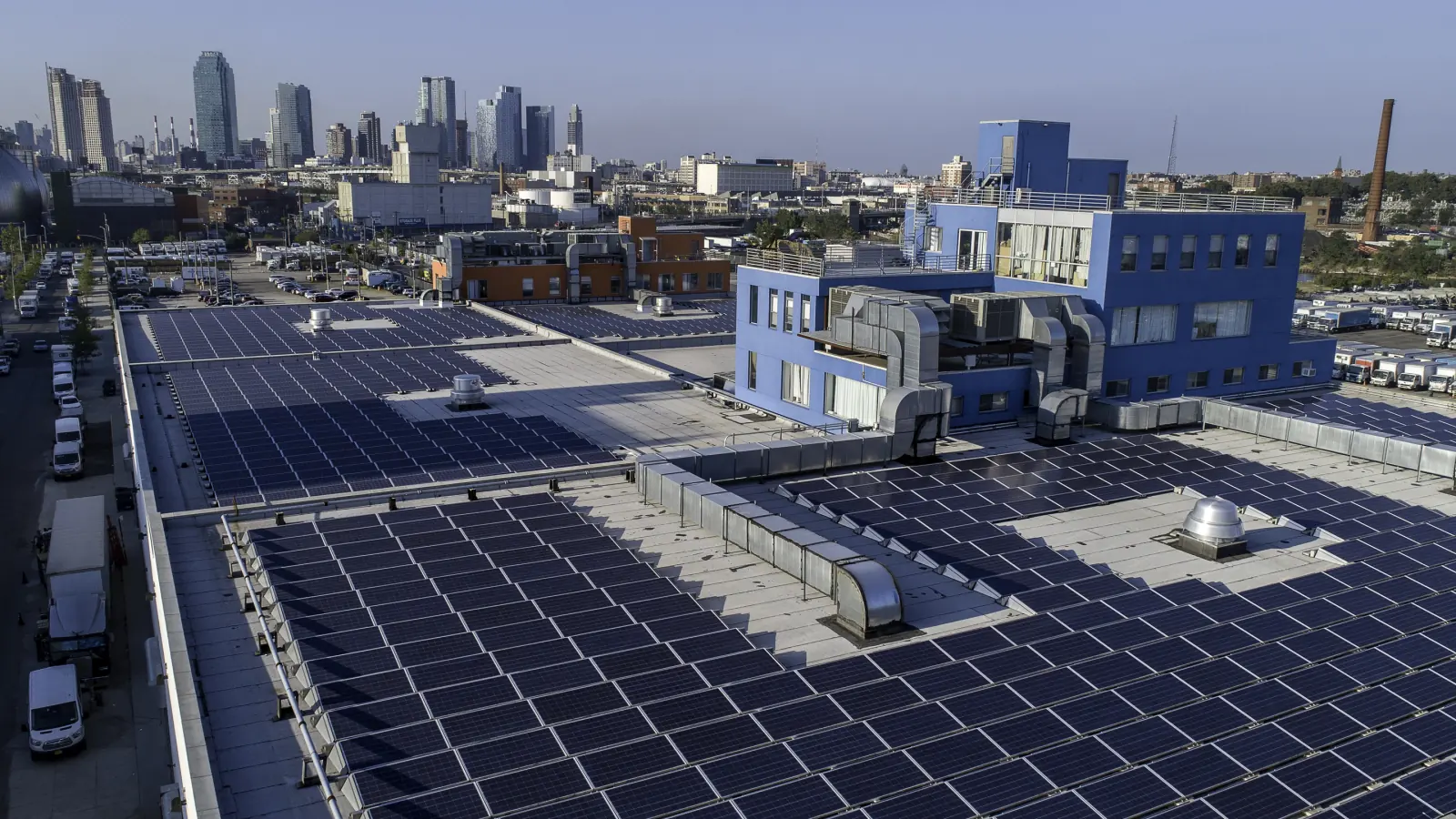

New York supports solar at businesses in three ways: an upfront NY-Sun incentive per watt, bill credits for power sent to the grid, and property tax relief. Most non-residential on-site projects that applied in 2026 were awarded $0.45 per watt in Con Edison’s area and $0.25 upstate, before adders. New York City adds its own tax abatement, emissions limits and fire rules for batteries.
In short
- New York supports business solar with NY-Sun incentives per watt, bill credits for exported power and property tax relief.
- Most non-residential on-site projects that applied in 2026 were awarded $0.45 per watt in Con Edison’s area and $0.25 upstate.
- Check the open NY-Sun block, whether you qualify for net metering, your town’s tax opt-out and, in the city, FDNY rules.
What do businesses pay for electricity in New York?
In August 2026, businesses in New York paid an average of 23.06 cents per kWh, up from 22.33 cents in August 2025, according to preliminary data from the US Energy Information Administration (EIA). The US average was 14.47 cents. Industrial customers in New York paid 10.54 cents, against 10.20 cents a year earlier.
Many business bills also carry demand charges, priced per kW of the highest demand your site reaches. Con Edison, for example, measures demand as the average over each 15-minute interval and bills on the average of the two highest consecutive intervals in the period its rate sets: the month on a conventional rate, set hours on a time-of-day rate. A solar plant cuts the energy you buy, but the demand charge follows your highest period of use, so to cut it you may need a battery or control of your largest loads.
| Area | August 2026 (¢/kWh) | August 2025 (¢/kWh) | Change |
|---|---|---|---|
| New York | 23.06 | 22.33 | +3.3% |
| Massachusetts | 24.11 | 23.15 | +4.1% |
| Vermont | 20.47 | 19.05 | +7.5% |
| Connecticut | 19.29 | 23.47 | -17.8% |
| New Jersey | 18.71 | 18.52 | +1.0% |
| Pennsylvania | 13.93 | 12.68 | +9.9% |
| United States | 14.47 | 13.87 | +4.3% |
Commercial sector. Changes are our calculation from EIA data. EIA’s next release is due November 24, 2026.
Which NY-Sun incentives can a business get?
NY-Sun, the solar program of the New York State Energy Research and Development Authority (NYSERDA), pays an incentive per watt for plants at businesses. It reaches you through your contractor, who usually takes it off your price, and the amount the contractor receives must be disclosed in your contract. NYSERDA splits the money among three regions, Con Edison’s area, Long Island and the rest of the state, called Upstate, and splits each region into blocks of capacity. Incentives remain available until a region’s blocks are fully subscribed, and NYSERDA says it intends to phase them out as the market becomes self-sustaining.
NYSERDA’s project data, updated November 4, 2026, show the rates actually awarded. Of the non-residential on-site projects that applied from January to October 2026, 256 of 285 in Con Edison’s area were awarded a base incentive of $0.45 per watt, and 215 of 221 upstate were awarded $0.25 per watt (our calculation, before adders). Only two such projects applied on Long Island, where NY-Sun works alongside the Long Island Power Authority and PSEG Long Island. Most of these plants were bought: 270 of 285 in Con Edison’s area and 184 of 221 upstate. The rest were leases or power purchase agreements (PPAs); under a PPA another company owns the plant and you buy its power, as what is a PPA explains.
Adders can raise the total. In August 2026, NYSERDA listed an extra $0.20 per watt in Con Edison’s area for new solar parking canopies, and $0.20 per watt for the first 25 kW of rooftop canopies. Plants of 1 MW AC or more generally must pay prevailing wages, or work under a project labor agreement, to qualify for NY-Sun, and in Con Edison’s area they receive an adder of $0.20 per watt DC for it.
Blocks close as they fill, so ask your contractor which block your plant would fall in, and check it on NYSERDA’s dashboard on the day you apply. Whoever owns the plant may also claim federal tax credits: see the US solar tax credit in 2026.
| Region | Most common base incentive | Projects |
|---|---|---|
| Con Edison’s area | $0.45 per watt | 256 of 285 at that rate |
| Upstate | $0.25 per watt | 215 of 221 at that rate |
| Long Island | Too few projects to show a rate | 2 applied |
Includes projects not yet built; excludes community solar. Rates change as blocks fill, so check NYSERDA’s dashboard for your region.
How is power you send to the grid paid: net metering or the Value Stack?
Since 2017, New York has been moving from net metering to the Value of Distributed Energy Resources, known as the Value Stack. The Public Service Commission (PSC) required new community solar, remote crediting and large on-site projects to move to the Value Stack at once. Under it, the utility credits your bill in dollars for the power you export, according to when and where it reaches the grid, based on its energy, capacity, environmental and distribution system values.
Smaller on-site plants can still choose Phase One net metering, which credits exported power in kWh against power you buy for 20 years from connection, with no cash payment for credits left over. It is open to residential and small non-demand customers, and to business customers on demand rates whose on-site plant is under 750 kW. Those customers may take the Value Stack instead.
Plants connected since January 1, 2022 may also pay a monthly Customer Benefit Contribution, which depends on the compensation chosen, the customer class and the utility. On Long Island, the Long Island Power Authority’s tariff brings its Value Stack close to the rest of the state’s. Ask your contractor to model both options with NYSERDA’s Value Stack calculator, and get in writing which one the plant will use.
| Option | Who can use it | How exports are credited |
|---|---|---|
| Phase One net metering | Residential and small non-demand customers, and business customers on demand rates with an on-site plant under 750 kW | In kWh against power you buy, for 20 years, with no cash-out of leftover credits |
| Value Stack | Required for community solar, remote crediting and larger on-site plants; open to the others by choice | In dollars, by when and where the power reaches the grid |
As of November 17, 2026, under the Public Service Commission’s orders in Case 15-E-0751. Long Island follows its own tariff.
How does a solar plant affect your property taxes?
Real Property Tax Law §487 exempts, for 15 years, the increase in a property’s value from a solar system built before January 1, 2030, and from energy storage built after January 1, 2018 and before that date. But a county, city, town or village may opt out by local law, and a school district by resolution, so the exemption may cover only part of your tax bill. Where a jurisdiction has not opted out, it may require the owner of a solar system to sign a payment in lieu of taxes (PILOT) agreement for up to 15 years.
In New York City, the solar electric generating system abatement applies instead. For systems that start service between January 1, 2024 and January 1, 2035, it takes 7.5 percent of the installation cost off the property tax in each of four years, capped at the lower of $62,500 or the year’s tax. That is up to 30 percent of the cost over four years, and the $62,500 cap starts to bite on systems costing more than about $833,000 (our calculation). It is open to tax class 1, 2 and 4 properties, but not to those receiving ICAP, 421-a, 421-b or 421-g benefits or paying PILOTs. The Department of Buildings approves it, and the Department of Finance applies it from the July 1 after approval.
Confirm how this applies to your property with a CPA or tax adviser, and ask your assessor whether your town, county or school district has opted out.
What do New York City’s building laws require?
Local Law 97 of 2019 sets yearly greenhouse gas emissions limits for buildings over 25,000 gross square feet, and for two or more buildings on one tax lot that together exceed 50,000 square feet. The limits began in 2024 and become stricter in 2030. The goal is to cut emissions from the city’s largest buildings 40 percent by 2030 and to net zero by 2050; the first reports were due by May 1, 2025.
Solar is one way to meet the limits: the Department of Buildings lists on-site and off-site solar and storage among the distributed energy resources an owner can deduct. Check its guidance on how the deduction is counted before you rely on it.
Local Laws 92 and 94 of 2019 require new buildings, new roofs from enlargements, and existing buildings replacing an entire roof deck or roof assembly to cover 100 percent of the sustainable roofing zone with solar, a green roof or both. Some areas are excluded, such as required setbacks, rooftop equipment and steep roofs that would hold less than 4 kW of solar.
What support and approvals apply to batteries?
NYSERDA’s retail energy storage incentive, as its program page set it out in June 2026, covers new commercial batteries of up to 5 MW, behind the meter or connected directly to the distribution grid. It pays a set amount per kWh of storage capacity, which varies by region and block, first come, first served, through NYSERDA-approved contractors. The battery must earn value under an investor-owned utility’s rate, for example by cutting demand charges, joining a utility demand response program or earning Value Stack credits.
In New York City, the fire department must approve each battery product with a Certificate of Approval and review the installation at your site. Every indoor system, and every outdoor system above 20 kWh, must also be inspected and permitted by the FDNY, and all systems need Department of Buildings approval and a work permit.
Elsewhere in the state, local officials review and permit battery systems. Under the 2025 state fire code, systems above set capacity thresholds must be peer reviewed, and projects in NYSERDA’s storage programs go through NYSERDA’s own peer review.
What if your business has no space for a plant?
Community solar lets a business subscribe to part of an off-site solar project and receive credits on its electric bill for its share of the power produced each month, usually with little or no upfront cost. These projects are paid under the Value Stack, and some also earn a community credit locked in for 25 years. Before you subscribe, read the terms: the discount on the credits, how long the subscription runs and what leaving early costs.
How Aeternus helps
Aeternus Power is an independent energy company based in Madrid. We originate, qualify, structure and finance energy projects, solar-led and with storage, and bring in the builders and financing partners for each one. We never own the plants. A commission is paid by whoever builds or finances the project, never by you, and only if the project goes ahead.
Our office in California opens on December 1, 2026, and we have no office in New York. If you tell us about your site, with where it is, which utility serves it and how much power it uses in a year, we will say within two working days whether we can help there. How we work with businesses is on our business page.
Questions
How much is the NY-Sun incentive for commercial solar in 2026?
It depends on the region and on the block open when you apply. Of the non-residential on-site projects that applied from January to October 2026, most were awarded $0.45 per watt in Con Edison’s area and $0.25 per watt upstate, before adders (our calculation from NYSERDA data). Check NYSERDA’s dashboard for the current block.
Can a business still get net metering in New York?
In some cases. A business on a demand rate can choose Phase One net metering for an on-site plant under 750 kW, and so can small non-demand customers; credits run for 20 years with no cash-out. Larger on-site plants, community solar and remote crediting are paid under the Value Stack.
Does solar raise property taxes in New York?
It can, unless relief applies. Real Property Tax Law §487 exempts the added value for 15 years, but counties, cities, towns, villages and school districts may opt out. In New York City, the solar abatement takes 7.5 percent of the installation cost off property tax in each of four years, within caps.
Does Local Law 97 require solar?
Not as such. Local Law 97 sets emissions limits for buildings over 25,000 square feet, and on-site solar and storage are among the deductions an owner can claim against them. Local Laws 92 and 94 are the ones that require solar or a green roof, on new buildings and when an entire roof deck is replaced.
Do commercial batteries need FDNY approval in New York City?
Yes. Each battery product needs an FDNY Certificate of Approval and the installation needs FDNY review; indoor systems, and outdoor systems above 20 kWh, also need an FDNY inspection and permit. The Department of Buildings must approve every system too.
Is the federal solar tax credit still available for businesses in New York?
For a solar plant whose construction starts now, the owner can claim it only if the plant is in service by December 31, 2027; batteries are not bound by that date. The rules are in the US solar tax credit in 2026. Confirm your case with a CPA or tax adviser.
Sources
- EIA: Electric Power Monthly, Table 5.6.A, average price of electricity by sector and state, August 2026 and 2025 (released October 23, 2026): https://www.eia.gov/electricity/monthly/epm_table_grapher.php?t=epmt_5_6_a
- NYSERDA: Solar Electric Programs Reported by NYSERDA, project data on data.ny.gov (updated November 4, 2026): https://data.ny.gov/Energy-Environment/Solar-Electric-Programs-Reported-by-NYSERDA-Beginn/3x8r-34rs
- NYSERDA: NY-Sun dashboards and incentives, regions and blocks (August 2026): https://www.nyserda.ny.gov/All-Programs/NY-Sun/Contractors/Dashboards-and-incentives
- NYSERDA: NY-Sun Con Edison dashboard, canopy and prevailing wage adders (August 2026): https://www.nyserda.ny.gov/All-Programs/NY-Sun/Contractors/Dashboards-and-incentives/ConEd-Dashboard
- NYSERDA: Paying for solar, businesses (incentive through the contractor, property tax relief) (August 2026): https://www.nyserda.ny.gov/All-Programs/NY-Sun/On-site-Solar/Businesses/Paying-For-Solar
- NYSERDA: The Value Stack, Value of Distributed Energy Resources (November 2026): https://www.nyserda.ny.gov/All-Programs/NY-Sun/Contractors/Value-of-Distributed-Energy-Resources
- New York PSC: Order Adopting Net Metering Successor Tariff Filings with Modifications, Case 15-E-0751 (August 13, 2021): https://documents.dps.ny.gov/public/Common/ViewDoc.aspx?DocRefId=%7B8E4FAF00-6CE5-460F-B0F6-CF67E3D04B3B%7D
- New York PSC: Order Addressing Customer Benefit Contribution Charges, Case 15-E-0751 (June 21, 2024): https://documents.dps.ny.gov/public/Common/ViewDoc.aspx?DocRefId=%7B90F93B90-0000-C011-8684-FC73CCCC0C4F%7D
- New York State Senate: Real Property Tax Law §487, exemption for certain energy systems: https://www.nysenate.gov/legislation/laws/RPT/487
- NYC Department of Finance: Solar Electric Generating System (SEGS) Tax Abatement: https://www.nyc.gov/site/finance/property/landlords-solar-roof.page
- NYC Department of Buildings: LL97 greenhouse gas emissions reductions: https://www.nyc.gov/site/buildings/codes/ll97-greenhouse-gas-emissions-reductions.page
- NYC Department of Buildings: Local Laws 92 and 94, solar and green roofs: https://www.nyc.gov/site/buildings/codes/ll92-solar-green-roofs.page
- NYSERDA: Residential and retail energy storage incentives (June 2026): https://www.nyserda.ny.gov/All-Programs/Energy-Storage-Program/Developers-and-Contractors/Residential-and-Retail-Storage-Incentives
- FDNY: Energy storage system equipment approval and installation guide (April 25, 2025): https://www.nyc.gov/assets/fdny/downloads/pdf/business/ess-equipment-approval-installation-guide.pdf
- Con Edison: How demand is measured on conventional, time-of-day and standby rates (EV charging rates FAQ): https://www.coned.com/en/our-energy-future/electric-vehicles/best-electric-delivery-rate-for-your-charging-station/faqs
- NYSERDA: Community solar, how it works (August 2026): https://www.nyserda.ny.gov/All-Programs/NY-Sun/Community-Solar/How-It-Works
Latest
Solar PPAs for businesses in California: how they work and what to check