Commercial solar in Florida in 2026: net metering, leases, taxes and hurricanes
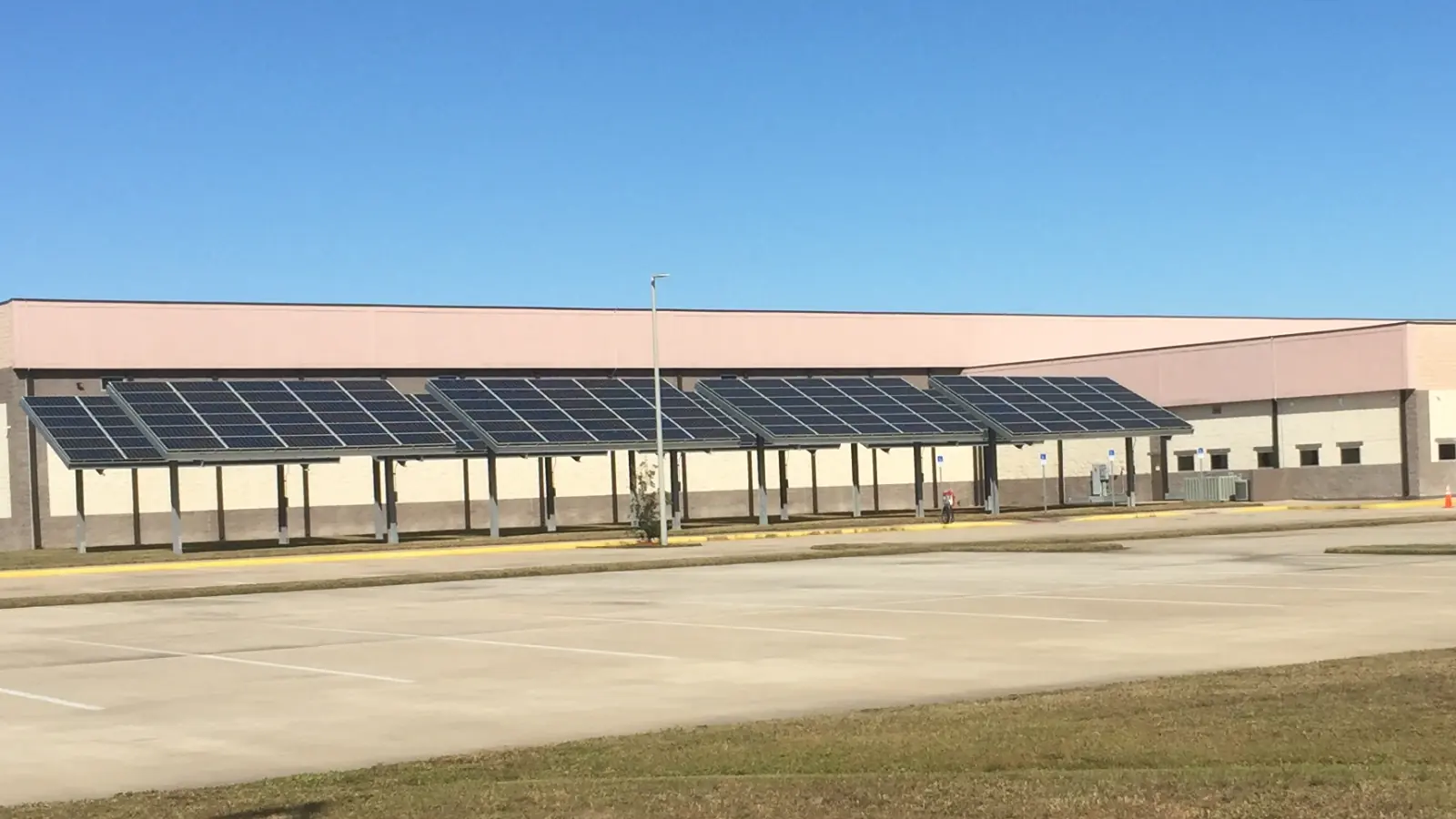

A Florida business served by an investor-owned utility can net meter a solar plant of up to 2 MW: exports are credited against later bills for up to 12 months, and credits left at year end are paid out. A company selling you the plant’s power would be regulated as a utility, but leases can work, and most of the value a plant adds is exempt from property tax.
In short
- Businesses served by investor-owned utilities can net meter plants of up to 2 MW, with credits carried forward for up to 12 months.
- A company selling you a plant’s power would be regulated as a utility; buying the plant, or a lease that fits the rules, can work.
- Check your utility’s tier and fees, claim the property tax exemption, and have the plant designed for Florida’s hurricane wind loads.
What do businesses pay for electricity in Florida?
In August 2026, businesses in Florida paid an average of 11.35 cents per kWh, against 14.47 cents across the United States, according to preliminary data from the US Energy Information Administration (EIA). A year earlier the Florida average was 11.43 cents. Industrial customers paid 8.93 cents, down from 9.01 cents in August 2025.
Most business bills also carry a demand charge, set by the highest demand your site reaches in the month. In the example bill that Florida Power & Light (FPL) publishes for October 2026, a business with 500 kW of demand that uses 200,000 kWh in a month pays $20,668.94, of which $7,560 is the demand charge. With the other charges billed per kW, about 42 percent of that bill depends on demand, and the charges billed per kWh come to about 5.6 cents per kWh (our calculation, before the gross receipts tax).
Under Florida’s net metering rule you keep paying the demand charge on the highest demand measured, so a plant saves mainly the charges billed per kWh. A battery that discharges at your peak can lower the demand charge too. Work from your own bills, and ask your utility for 12 months of interval data.
| Area | August 2026 (¢/kWh) | August 2025 (¢/kWh) | Change |
|---|---|---|---|
| Florida | 11.35 | 11.43 | -0.7% |
| Georgia | 13.81 | 11.16 | +23.7% |
| Alabama | 14.98 | 14.53 | +3.1% |
| Mississippi | 13.45 | 12.88 | +4.4% |
| South Carolina | 11.76 | 11.00 | +6.9% |
| United States | 14.47 | 13.87 | +4.3% |
Commercial sector. Changes are our calculation from EIA data. EIA’s next release is due November 24, 2026.
Does Florida have net metering for businesses?
Yes, for customers of investor-owned utilities. Rule 25-6.065 of the Florida Administrative Code, set by the Florida Public Service Commission (PSC), requires each of them to let a customer’s renewable plant net meter. The three largest, FPL, Duke Energy Florida and Tampa Electric, all investor-owned, sold about 78 percent of the power used by Florida businesses in 2024 (our calculation from EIA data). Municipal utilities and electric cooperatives must run their own interconnection and net metering programs, on terms their governing bodies set (section 366.91 of the Florida Statutes).
The plant’s gross power rating may not exceed 2 MW, nor 90 percent of your utility distribution service rating. The rating is in AC; for a plant with inverters, it is the DC nameplate capacity multiplied by 0.85.
Billing works month by month. Power the plant sends to the grid is credited against the energy you use in the next billing cycle, and credits carry forward to offset your use for up to 12 months. At the end of each calendar year, the utility pays you for any credits left, at an average annual rate based on its as-available energy tariff, known as COG-1. You keep paying the customer charge and the demand charge on the highest demand measured, and you keep any renewable energy certificates.
So size the plant to the power your site uses in a year: output beyond that is paid only at the year-end rate. As of November 18, 2026, the rule had last been amended on April 7, 2008, and the Florida Administrative Register listed no proposal to change it.
Check your utility’s current net metering terms before you size a plant.
Can a third party own a solar plant at a Florida business?
Not under a power purchase agreement (PPA), in which another company owns the plant and sells you its power. Section 366.02 of the Florida Statutes defines a public utility as anyone supplying electricity to or for the public, and in 1988 the Florida Supreme Court upheld the PSC’s view that selling electricity to a single customer counts (PW Ventures v. Nichols). A company selling you a plant’s power would therefore be regulated as a public utility. The court also noted that the law limits competition in selling electricity, not generating your own.
A lease is different. The PSC’s rule lets you contract with a third party to buy, lease, operate or maintain a plant at your site, as long as the terms do not include buying electricity from that third party at retail. In 2019, for example, the PSC declared that a residential solar equipment lease described to it was not a sale of electricity, and that its lessees could net meter if they met the rule. Such rulings cover the facts of each petition, so have a lawyer check a business lease against the rule. How each state treats these contracts is set out in third-party solar PPAs by state.
You can also buy the plant, with your own funds, a loan or commercial property assessed clean energy (PACE) financing. Florida law lets a county or city authorize a PACE program for commercial property, which can pay for solar and other renewable energy improvements. You repay through an assessment collected with your property tax bill, recorded as a lien equal in rank to county taxes. The program needs the written consent of your mortgage holders, the term may not exceed the improvements’ useful life or 30 years, and the total must be at least $2,500 (section 163.082).
How does a plant connect to the grid in Florida?
For customers of investor-owned utilities, the PSC’s rule sets three tiers by gross power rating, each with its own fees and insurance. The plant must be certified to the IEEE 1547 and UL 1741 standards, and it must disconnect itself automatically when the grid loses power. Local code officials must inspect and approve it before it runs connected to the grid.
The utility must tell you within 10 business days whether your application is complete, and sign the interconnection agreement within 30 calendar days of a complete application, or 90 days if a Tier 3 plant needs a study. It may require a manual disconnect switch next to the meter at your expense, except for inverter-based Tier 1 plants.
Fees vary by utility and need PSC approval. FPL, for example, charges $400 to apply for Tier 2 and $1,000 for Tier 3, plus $2,000 for a study if a Tier 3 plant fails its initial screens, with any unused part refunded. FPL’s agreements in force since January 1, 2026 also tie the plant’s size to the kWh the site used in the previous 12 months, so ask your utility for its current agreement before the plant is designed.
| Tier | Gross power rating | Fees | Liability insurance the utility may require |
|---|---|---|---|
| Tier 1 | 10 kW or less | None beyond those of customers without a plant, and no application fee | None |
| Tier 2 | More than 10 kW, up to 100 kW | A standard application fee approved by the PSC | Up to $1 million, or proof of self-insurance |
| Tier 3 | More than 100 kW, up to 2 MW | An application fee and, if needed, a study charge, both approved by the PSC | Up to $2 million, or proof of self-insurance |
As of November 18, 2026. Municipal utilities and cooperatives set their own requirements.
Which tax breaks apply to a solar plant in Florida?
Property tax. For property used for nonresidential purposes, 80 percent of the value that a renewable energy source device adds is not counted when the real property is assessed (section 193.624 of the Florida Statutes). Where the device counts as tangible personal property, 80 percent of its assessed value is exempt (section 196.182). Both apply to devices installed on or after January 1, 2018, and both end on December 31, 2037. The law’s definition covers photovoltaic modules, inverters and storage systems. Ask your county property appraiser how your plant will be classed and how to claim the exemption.
Sales tax. Solar energy systems and their components are exempt from Florida sales and use tax (section 212.08(7)(hh)). The Florida Solar Energy Center certifies the list of eligible equipment, and the list published by the Florida Department of Revenue includes photovoltaic modules, inverters, batteries and mounting hardware. The buyer certifies to the seller that the equipment is for use only in a solar energy system; ordinary AC wiring in the building does not qualify.
Federal credit. A business that owns the plant may be able to claim the federal clean electricity investment credit, but for solar it now depends on when construction starts and when the plant is in service: see the US solar tax credit in 2026. Confirm each of these points with a CPA or tax adviser.
How do hurricanes affect a solar plant in Florida?
Wind loads. The Florida Building Code sets the wind criteria for buildings and structures, and its eighth edition (2023) refers to the ASCE 7-22 standard of the American Society of Civil Engineers to determine wind loads. The Florida Building Commission notes that design wind speeds on the peninsula are effectively unchanged since the 2010 code, that they rose in the western panhandle, and that ASCE 7-22 adds wind load provisions for ground-mounted solar. Site-specific wind speeds can be taken from the ASCE hazard tool.
Mounting. Wind is the most common damaging weather element for solar plants, says a 2021 guide from the US Department of Energy, and mounting fasteners of inadequate strength can fail even at low wind speeds. The guide recommends that a structural engineer experienced with wind and solar evaluate any array on a low-slope rooftop. Ask how the racking and fasteners are rated for your site’s design wind speed, and check how your insurance covers wind damage and at what deductible.
Outages. A plant connected under the PSC’s rule must isolate itself automatically when the grid loses power, so on its own it stops during an outage. To keep critical loads running after a storm, it needs a battery and equipment that separates your site from the grid. Decide which loads it must carry and for how long, and have this designed in from the start.
How Aeternus helps
Aeternus Power is an independent energy company based in Madrid. We originate, qualify, structure and finance energy projects, solar-led and with storage, and bring in the builders and financing partners for each one. We never own the plants. A commission is paid by whoever builds or finances the project, never by you, and only if the project goes ahead.
Our office in California opens on December 1, 2026, and we have no office in Florida. If you tell us about your site, with where it is, which utility serves it and how much power it uses in a year, we will say within two working days whether we can help there. How we work with businesses is on our business page.
Questions
Does FPL pay businesses for excess solar power?
Under the PSC’s net metering rule, power your plant sends to the grid is credited against your energy use in later months, for up to 12 months. At the end of each calendar year, FPL and the other investor-owned utilities pay for any credits left, at an average annual rate based on their as-available energy tariff. You keep paying the demand charge.
Are solar power purchase agreements legal in Florida?
Not with a third party selling you the power. In 1988 the Florida Supreme Court upheld the PSC’s view that selling electricity to even one customer makes the seller a public utility. The PSC’s rule allows leases and service contracts that do not include buying electricity at retail; third-party solar PPAs by state explains the wider picture.
Does commercial solar raise property taxes in Florida?
Mostly not, for devices installed since January 1, 2018. On nonresidential property, 80 percent of the value a renewable energy source device adds is not counted, and 80 percent of a device taxed as tangible personal property is exempt, until December 31, 2037. Ask your county property appraiser how to claim it.
Is commercial solar equipment exempt from sales tax in Florida?
Yes, if it qualifies. Solar energy systems and their components are exempt from sales and use tax, and the Department of Revenue’s list includes modules, inverters, batteries and mounting hardware. The buyer gives the seller a written certificate that the equipment is for a solar energy system.
Is Florida ending net metering?
Not as of November 18, 2026. The PSC’s net metering rule had last been amended in 2008, and the Florida Administrative Register listed no proposal to change it. Rules can change, so check your utility’s current terms before you size a plant.
Is the federal solar tax credit still available for businesses in Florida?
It depends on when construction starts and when the plant is in service, and the deadlines for solar are close. The US solar tax credit in 2026 explains who can claim what. Confirm your case with a CPA or tax adviser.
Sources
- EIA: Electric Power Monthly, Table 5.6.A, average price of electricity by sector and state, August 2026 and 2025 (released October 23, 2026): https://www.eia.gov/electricity/monthly/epm_table_grapher.php?t=epmt_5_6_a
- EIA: Florida electricity profile 2024, Table 3, top five retailers of electricity (released November 10, 2025): https://www.eia.gov/electricity/state/florida/
- Florida Administrative Code: Rule 25-6.065, Interconnection and Net Metering of Customer-Owned Renewable Generation (effective April 7, 2008): https://www.flrules.org/gateway/ruleNo.asp?id=25-6.065
- Florida Statutes (2026): section 366.02, definitions, public utility (Online Sunshine, Florida Legislature): http://www.leg.state.fl.us/statutes/index.cfm?App_mode=Display_Statute&URL=0300-0399/0366/Sections/0366.02.html
- Florida Statutes (2026): section 366.91, renewable energy, net metering by municipal utilities and cooperatives (Online Sunshine, Florida Legislature): http://www.leg.state.fl.us/statutes/index.cfm?App_mode=Display_Statute&URL=0300-0399/0366/Sections/0366.91.html
- Florida Supreme Court: PW Ventures, Inc. v. Nichols, 533 So. 2d 281 (October 27, 1988), Caselaw Access Project: https://static.case.law/so2d/533/html/0281-01.html
- Florida Administrative Register: notice of the PSC declaratory statement on a residential solar equipment lease, Order No. PSC-2019-0144-DS-EQ (April 2019): https://www.flrules.org/Gateway/View_notice.asp?id=21775547
- Florida Statutes (2026): section 193.624, assessment of renewable energy source devices (Online Sunshine, Florida Legislature): http://www.leg.state.fl.us/statutes/index.cfm?App_mode=Display_Statute&URL=0100-0199/0193/Sections/0193.624.html
- Florida Statutes (2026): section 196.182, exemption of renewable energy source devices (Online Sunshine, Florida Legislature): http://www.leg.state.fl.us/statutes/index.cfm?App_mode=Display_Statute&URL=0100-0199/0196/Sections/0196.182.html
- Florida Statutes (2026): section 212.08, sales tax exemptions, paragraph (7)(hh), solar energy systems (Online Sunshine, Florida Legislature): http://www.leg.state.fl.us/statutes/index.cfm?App_mode=Display_Statute&URL=0200-0299/0212/Sections/0212.08.html
- Florida Department of Revenue: Tax Information Publication 19A01-09, solar energy systems sales and use tax exemption, with the list of eligible equipment (August 9, 2019): https://floridarevenue.com/taxes/tips/documents/TIP_19A01-09.pdf
- Florida Statutes (2026): section 163.082, financing qualifying improvements to commercial property (Online Sunshine, Florida Legislature): http://www.leg.state.fl.us/statutes/index.cfm?App_mode=Display_Statute&URL=0100-0199/0163/Sections/0163.082.html
- Florida Power & Light: Understanding your bill, business customers with demand charge, typical bill for October 2026: https://www.fpl.com/content/dam/fplgp/us/en/rates/pdf/demand-explanation.pdf
- Florida Power & Light: Electric tariff, section 9, interconnection agreements for customer-owned renewable generation, Tiers 2 and 3 (effective January 1, 2026): https://www.fpl.com/content/dam/fplgp/us/en/rates/pdf/electric-tariff-section9.pdf
- Florida Building Commission: Wind loads, impacts from ASCE 7-22 in the 8th Edition (2023) Florida Building Code (June 2024): https://www.floridabuilding.org/fbc/thecode/2023_Code_Development/2023_Code_Resources/ASCE-7-22_Wind_Loads_Fact_Sheet.pdf
- US Department of Energy, Federal Energy Management Program: PV system owner’s guide to identifying, assessing, and addressing weather vulnerabilities, risks, and impacts (September 2021): https://www.energy.gov/sites/default/files/2021-09/pv-system-owners-guide-to-weather-vulnerabilities.pdf
Latest
Solar PPAs for businesses in California: how they work and what to check