Solar for water treatment and desalination: pumps, aeration, reverse osmosis and the hours that matter
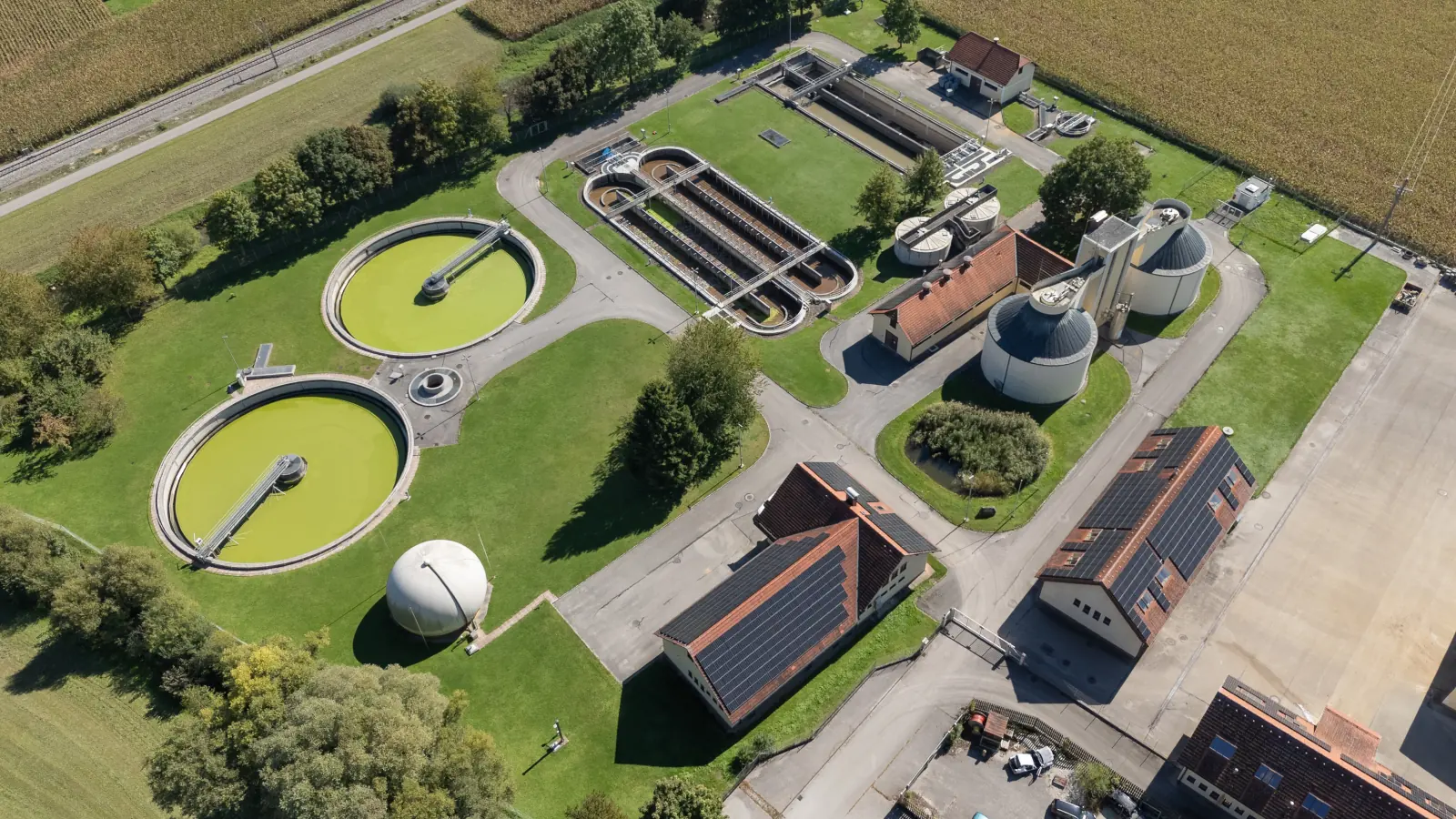

Water plants pump, aerate and filter day and night, and desalinating seawater takes more than ten times the energy that fresh water from rivers or wells typically needs. A ground-mounted solar plant on spare land covers part of that use in daylight. Tanks that let pumps run at midday, batteries and biogas from sludge cover more; your electricity contract decides the mix.
In short
- Pumping, aeration and reverse osmosis drive the bill; the best seawater desalination plants used about 3.5 to 4 kWh per cubic metre in 2016.
- A ground plant on spare land, pumping moved to sunny hours and biogas from sludge cut what a plant buys from the grid.
- Check land and permits, tank margins, hourly prices in your contract, procurement rules and, in the EU, the energy neutrality targets.
How much electricity do water and wastewater plants use?
A lot, mostly for pumps and air. The International Energy Agency (IEA) estimated that extracting, distributing and treating water and wastewater took about 4% of the world’s electricity in 2014, and that pumping took 80% to 85% of the electricity used to treat drinking water. For many US local governments, drinking water and wastewater plants are the largest energy users, often 30% to 40% of all the energy they use, and energy can be as much as 40% of a drinking water system’s operating costs, says the US Environmental Protection Agency (EPA).
In wastewater plants the biological stage uses the most: blowers and aerators supply the oxygen that bacteria need to break down the waste. Aeration takes from 25% to as much as 60% of a plant’s energy, according to an EPA report (2010), and the IEA puts secondary treatment, where it happens, at about half (table below). It follows the inflow: the oxygen needed dips in the middle of the night and peaks in the morning and evening, the EPA report notes.
Desalination uses the most per cubic metre. The best seawater reverse osmosis plants used about 3.5 to 4.0 kWh per m³ in 2016, and less efficient ones more, against 0.2 kWh per m³ or less for typical fresh water supplies, according to the World Bank (2019). Brackish water needs about a tenth of the electricity of seawater, says the IEA.
| Stage | Share of energy use |
|---|---|
| Secondary treatment (biological, with aeration) | 51% |
| Pumping | 16% |
| Sludge treatment | 15% |
| Tertiary treatment | 10% |
| Primary treatment | 8% |
Where can a solar plant go at a water site?
Mostly on the ground. To produce over a year what a load running day and night uses, a ground plant needs about 5 to 6.5 kWp of modules for each kW of that load near Fresno in California, Madrid, Lisbon or Milan, by our calculation from PVGIS, the EU Joint Research Centre’s solar data tool (kWp, kilowatts peak, is a plant’s rated power). Unless the buildings and tank covers are large, that takes land around the plant or nearby. The EU’s recast wastewater directive itself points to the surfaces available at treatment plants for solar power.
EU law also asks member states to designate renewables acceleration areas, giving priority to built and artificial surfaces such as industrial sites, artificial inland water bodies, lakes or reservoirs and, where appropriate, urban wastewater treatment sites. Inside them, permits must take no more than 12 months, and no more than six months for plants under 150 kW (articles 15c and 16a of the Renewable Energy Directive). Member states had to adopt these plans by 21 February 2026: ask your authority whether your site lies in one.
On reservoirs and treatment ponds, a floating plant uses no land. The World Bank notes that most floating plants so far sit on industrial basins, drinking water reservoirs and irrigation ponds, that their shade reduces evaporation, and that some countries treat drinking water reservoirs as national-security sites, which makes permits more complex (2019).
Can pumping move to the middle of the day?
Where tanks and reservoirs have room, yes. Water pumped up while the solar plant produces is stored for the evening, so an existing tank does the job of a battery you already own. The EPA lists storing water to avoid pumping when energy costs peak, and shifting energy use to hours when electricity is cheaper, among the ways utilities cut energy costs (2013).
How far you can go depends on how much the tanks hold above the minimum the network must keep, and on what operators and water quality rules allow. A wastewater plant has less choice, since aeration has to follow the inflow.
Your electricity contract decides the mix. If power costs much more in the evening than at midday, or the bill charges for peak demand, moving pumps and adding a battery are worth studying; if prices barely change by the hour, the priority is a plant whose output the site uses as it is produced.
What can biogas from sludge add?
Power and heat at any hour. Larger wastewater plants increasingly digest their sludge and turn the biogas into electricity and heat, and the IEA notes that the energy recovered generally far outweighs the energy put into treating the sludge (2016). The EPA calls such combined heat and power (CHP) a reliable, cost-effective option for plants that have, or plan, anaerobic digesters.
Size matters: the IEA puts the threshold for cost-effective recovery at about 5 million litres a day, and estimated in 2016 that sludge covered only about 4% of the electricity used by municipal wastewater plants worldwide. Biogas and solar work together, since a CHP unit can run whenever there is gas and a solar plant only in daylight.
What does the EU’s recast wastewater directive ask on energy?
Directive (EU) 2024/3019 makes energy part of the job. Member states must have the energy use of urban wastewater plants and their sewers audited every four years, with a focus on biogas and waste heat: the first audits by 31 December 2028 for plants treating a load of 100,000 p.e. and above, and by 31 December 2032 for those from 10,000 to 100,000 p.e. (p.e., population equivalent, is a unit of organic load: 60 grams of oxygen demand a day).
At national level, the renewable energy that owners or operators of plants of 10,000 p.e. and above generate, or have generated for them, on site or elsewhere, must equal at least 20% of the energy those plants use by 31 December 2030, 40% by 2035, 70% by 2040 and 100% by 2045 (article 11). Purchased renewable energy does not count; from 2040 a country may, under conditions, cover part of any gap with non-fossil energy bought in.
The directive counts energy generated by or on behalf of the owners or operators, so ask your national authority how it will treat a plant on your site that a financing partner owns and sells you power from, under a power purchase agreement (PPA). Countries must write the directive into their law by 31 July 2027, and the Commission may set the methods for checking the targets, so these rules can still move as of 18 November 2026.
How do public utilities buy, and what should they check?
A public owner usually has to follow procurement rules, which can mean a public tender for the plant, the builder or a PPA. In the EU, bodies that run drinking water networks follow the procurement directive for utilities, which also covers their contracts for sewage treatment (Directive 2014/25/EU, article 10).
In the United States, public bodies, including water districts, may receive the federal clean electricity investment credit as a payment from the IRS, called elective pay, for a plant they own and if it meets the credit’s rules. The deadlines for solar fall in 2026 and 2027: see the US solar tax credit in 2026, and confirm with a CPA or tax adviser.
Before the tender, settle these points:
- A year of consumption by the hour or quarter hour, for the plant and each pumping station.
- The land: who owns it, what planning allows, flood risk and room for the grid connection.
- How much the tanks and reservoirs can hold above the minimum the network needs.
- Your contract’s prices by hour and any charge for peak demand.
- How a PPA or a lease fits the term of any concession or operating contract, and what happens to the plant when it ends.
- In the EU, how your country will count the plant towards the energy neutrality targets.
Buying and leasing work at any size; a PPA, where a financing partner owns the plant and you pay for its power at a price per kWh set in the contract, needs at least 50 kWp. What is a PPA? explains it.
Your market
Rules on self-consumption, exports and grants are set by each country, and in the United States by each state. Read the page for your market:
- Spain: autoconsumo en tratamiento de agua y desalación, in Spanish.
- Portugal: commercial solar in Portugal, with the rules, the registration and what surplus earns.
- United States: commercial solar in the United States, with prices, export rules and tax, state by state.
- Colombia: commercial solar in Colombia, with the self-generation rules, surplus credits and tax incentives.
- Prices across Europe: business electricity prices in the EU in 2026.
How Aeternus helps
Aeternus Power is an independent energy company. We originate, qualify, structure and finance energy projects, solar-led and with storage: we study a year of your consumption, your land and your tanks, size the plant and any battery to the hours your pumps run, and bring in a vetted builder and the financing partner. We never own the plants. A commission is paid by whoever builds or finances the project, never by you, and only when the project goes ahead.
We work with businesses in Spain, Portugal and Colombia today; in Spain and Portugal you can buy the plant, lease it or, from 50 kWp, take a PPA. Our office in California opens on 1 December 2026, and we cannot yet say which of these we will arrange there. For a first figure, use the preview on our business page, or tell us about your plant: we reply within two working days.
Questions
How much energy does desalination use per cubic metre?
The best seawater reverse osmosis plants used about 3.5 to 4.0 kWh per m³ in 2016, and the newest as little as 1.8 kWh per m³, according to the World Bank (2019). Brackish water needs about a tenth of that, says the IEA, and typical fresh water supplies 0.2 kWh per m³ or less.
Can a desalination plant run on solar power alone?
Not around the clock. A solar plant produces only in daylight, and matching a year of a load that never stops takes about 5 to 6.5 kWp of modules for each kW, with large surpluses at midday. The grid, batteries, stored water and long-term contracts with other plants cover the rest.
What uses the most electricity in a wastewater treatment plant?
Usually aeration: the blowers that supply oxygen to the biological stage take from 25% to as much as 60% of a plant’s energy, according to the EPA (2010). Pumping, sludge treatment and filtering take most of the rest.
What is energy neutrality for wastewater treatment plants?
It is a target in the EU’s recast Urban Wastewater Treatment Directive. At national level, renewable energy generated by or for the owners or operators of plants of 10,000 p.e. and above must equal the energy those plants use by 31 December 2045, with steps of 20% by 2030, 40% by 2035 and 70% by 2040. Purchased renewable energy does not count.
Can a public water utility get the US solar tax credit?
It may. Public bodies, including water districts, can receive the clean electricity investment credit as a payment from the IRS, called elective pay, for a plant they own that meets the credit’s rules and deadlines. See the US solar tax credit in 2026, and confirm with a CPA or tax adviser.
Sources
- EUR-Lex: Directive (EU) 2024/3019 concerning urban wastewater treatment (recast), article 11 and recital 24 (27 November 2024): https://eur-lex.europa.eu/eli/dir/2024/3019/oj
- EUR-Lex: Directive (EU) 2018/2001 on renewable energy, consolidated text of 16 July 2024, articles 15c and 16a: https://eur-lex.europa.eu/legal-content/EN/TXT/HTML/?uri=CELEX:02018L2001-20240716
- EUR-Lex: Directive 2014/25/EU on procurement by entities in the water, energy, transport and postal services sectors, article 10: https://eur-lex.europa.eu/legal-content/EN/TXT/?uri=CELEX:32014L0025
- US Environmental Protection Agency: energy efficiency for water utilities (last updated 20 May 2026): https://www.epa.gov/sustainable-water-infrastructure/energy-efficiency-water-utilities
- US Environmental Protection Agency: Energy Efficiency in Water and Wastewater Facilities, local government climate and energy strategy guide (2013): https://www.epa.gov/sites/default/files/2015-08/documents/wastewater-guide.pdf
- US Environmental Protection Agency: Evaluation of Energy Conservation Measures for Wastewater Treatment Facilities, EPA 832-R-10-005 (September 2010): https://19january2021snapshot.epa.gov/sites/static/files/2016-01/documents/p1008sbm.pdf
- IRS: elective pay and transferability, frequently asked questions on elective pay (updated 7 March 2026): https://www.irs.gov/credits-deductions/elective-pay-and-transferability-frequently-asked-questions-elective-pay
- IRS: instructions for Form 3468, investment credit, termination for solar facilities under Public Law 119-21 (2025): https://www.irs.gov/pub/irs-pdf/i3468.pdf
- International Energy Agency: World Energy Outlook 2016, water-energy nexus excerpt (November 2016): https://www.iea.org/reports/water-energy-nexus
- World Bank: The Role of Desalination in an Increasingly Water-Scarce World (March 2019): https://openknowledge.worldbank.org/handle/10986/31416
- World Bank: Where Sun Meets Water, floating solar market report (2019): https://openknowledge.worldbank.org/handle/10986/31880
- EU Joint Research Centre: PVGIS 5.3, yearly output of a solar plant at the optimal fixed angle (averages for 2005 to 2023): https://re.jrc.ec.europa.eu/pvg_tools/en/
Latest
Europe’s power prices in early November 2026: from €184/MWh in Spain to €347/MWh in Ireland