Solar for farms and food processing: irrigation, cold rooms, harvests and land that stays in use
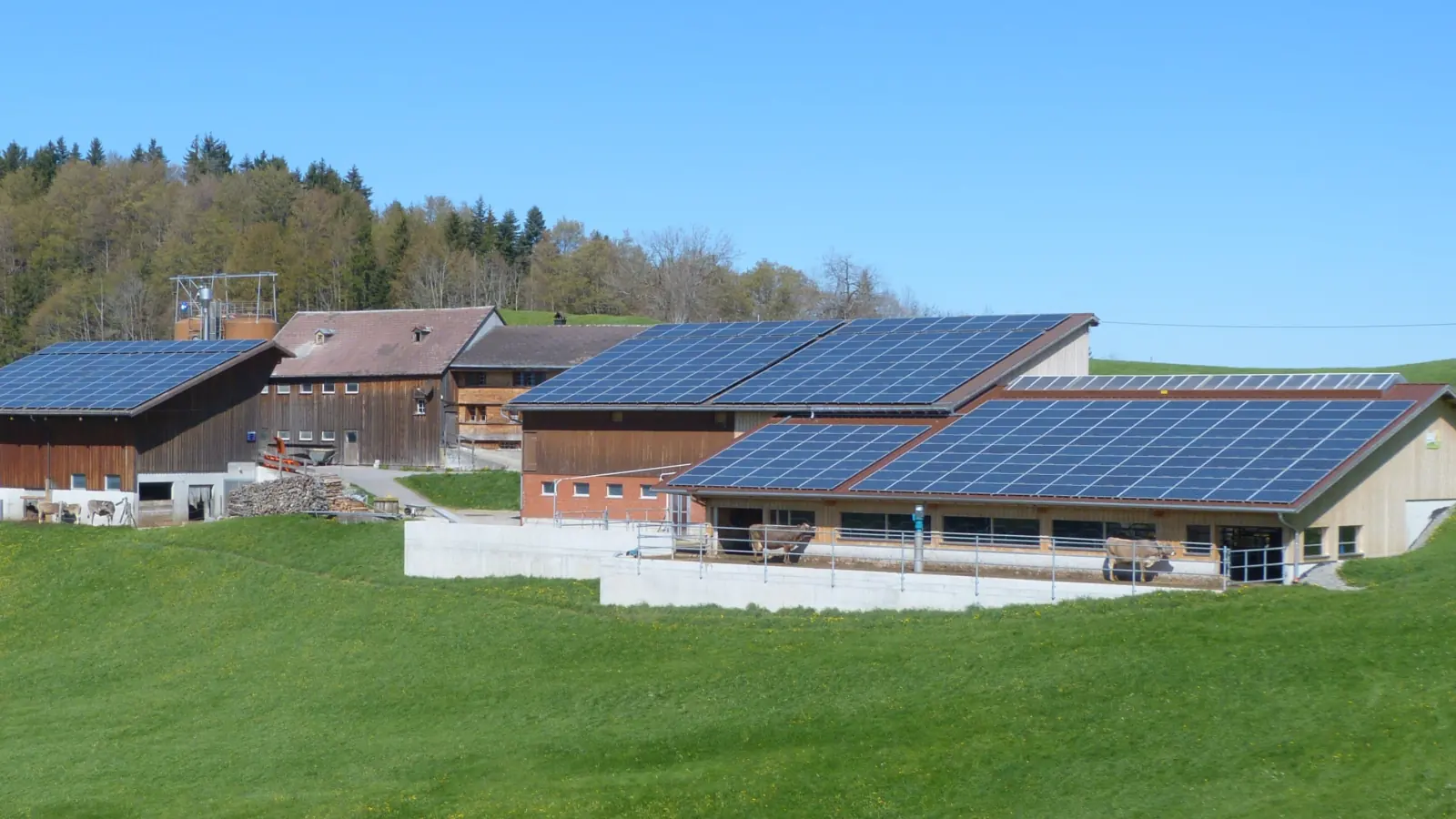

Farms and food processors use power by season and by hour: irrigation pumps in the growing months, milk cooling around each milking, cold rooms and processing lines at harvest. A solar plant fits best where that use falls in sunny hours and months. Size it to the whole year, plan for the months when pumps stand idle, and keep farmland in use where you can.
In short
- Irrigation and summer processing fall in the sunniest months, but pumps stand idle for much of the year.
- Size the plant to a full year of use, with a plan for surplus power, stored water or a battery.
- Check land and planning rules, water rights, the grid connection and, over livestock, modules tested against ammonia.
How do farms and food processors use electricity?
On irrigated farms, pumping water is a large cost that follows the season. In the United States in 2023, farms spent about $3.3 billion on energy to pump irrigation water, and electricity made up about $2.5 billion of it, more than three quarters, by our calculation from the US Department of Agriculture’s irrigation survey.
Livestock farms use power every day. A study of 22 Irish dairy farms found that milk cooling took 31% of their electricity, water heating 23% and milking 20%, and that use is centred on milking (Teagasc, 2013).
Food processing adds cold and motors: in US food manufacturing in 2022, cooling and refrigeration took 27% of the electricity and motors 43% (table below). Packing houses and processing lines run hardest at harvest. In the EU, agriculture and forestry used 50 TWh of electricity in 2024, 7.2% more than in 2023, according to Eurostat.
| Industry | Process cooling and refrigeration | Motors driving machinery |
|---|---|---|
| All food manufacturing | 27% | 43% |
| Fruit and vegetable preserving and specialty foods | 36% | 29% |
| Dairy products | 29% | 37% |
| Animal slaughtering and processing | 41% | 32% |
| Beverages | 25% | 46% |
When does a solar plant fit a farm’s calendar?
Irrigation needs water in the sunniest months, which suits solar. Our calculation from PVGIS, the EU Joint Research Centre’s solar data tool, for 2005 to 2023 shows that a ground plant tilted for the most output over the year, near Madrid, Lisbon, Milan or Fresno in California, produces between 56% and 62% of its output from April to September.
But pumps run for only part of that time. A single crop needs irrigation on 70 to 120 days a year, and two crops on about 200, according to the UN Food and Agriculture Organization (FAO, 2018). A plant built only for the pumps produces on many days when they stand idle.
So size the plant to the whole year, not to the peak of the season. Cold rooms and packing lines on the same connection use more of the output; the rest flows to the grid, and each market pays for it in its own way (see the region pages below). Work that falls in winter or after dark gets the least from solar.
Where can the plant go on a farm?
A farm can use its buildings, open land or water:
- On barns, sheds, packing houses and cold stores, if the structure can carry the weight. Over livestock, ammonia in damp air can corrode module parts, so ask for modules tested to IEC 62716, the international test of resistance to ammonia.
- On the ground, next to the pumps or the farm buildings, on land the farm can spare. Ask the local authority early what permits a ground plant on farmland needs.
- Over crops or pasture, as agrivoltaics: the modules are placed so that farming remains the main use of the land and machines or animals can still pass. The EU Joint Research Centre notes that they can shade crops from heat stress and protect them from severe weather (2023).
- On irrigation reservoirs and ponds, as floating plants that use no land, where the rules allow (FAO, 2018).
Two cautions. The Joint Research Centre warned in 2023 that, with no common EU definition of agrivoltaics, a plant may change how the land is classified, which could affect farm subsidies and tax: check both first. And dust from farming can dirty modules fast: the International Energy Agency’s solar programme cites US sites where losses from dirt grew by up to 11.5% a month in heavily farmed areas (2022). Plan cleaning from the start.
Does a farm need a battery, or can stored water do the job?
The most common solar irrigation system in the world is direct pumping: the modules feed the pump, with or without a tank or reservoir, according to the FAO. With a tank or reservoir, pump while the sun shines and irrigate when the crop needs it, so the stored water does the job of a battery. The FAO notes that a tank filled every day by a smaller pump can cost less than a larger pump used once a week.
Cheap pumping brings a risk. Once a solar pump is installed, each extra cubic metre costs almost nothing to lift, and the FAO warns that this can lead to wasteful water use and over-abstraction of groundwater. Water rights and abstraction limits still apply, whatever powers the pump.
A battery suits work that runs into the evening, such as milking, cooling or a packing line, where evening power costs much more than midday power. Where the process allows, moving water heating or pre-cooling into the middle of the day uses the plant’s output with no battery at all.
How can a farm pay for the plant?
There are three ways, and the plant can be the same in each:
- Buy it, from your own funds or with a loan, and keep the whole saving.
- Lease it, for a set instalment, often with maintenance included.
- Sign a power purchase agreement (PPA), from 50 kWp (kilowatts peak, the plant’s rated power). A financing partner pays for, owns and maintains the plant, and you pay only for the power it supplies, at a price per kWh set in the contract. It starts below what you pay for grid power when you sign, and any yearly increase is written into the contract from the start. If your use is seasonal, check how the contract treats output in the months you need little, and any minimum purchase. What is a PPA? explains the contract.
Buying and leasing work at any size, down to a single pump. Grants exist in some markets but are never certain: a public body decides each application, and calls close when the money runs out. As of 17 November 2026, for example, Croatia’s €30 million call for solar plants and batteries on farms and in food processing takes proposals until 31 January 2027, or until the money runs out. Tax rules differ by country: see tax benefits of a solar PPA, and confirm with your tax adviser.
What should you check before signing?
Settle these points before you commit:
- A full year of consumption by the hour or quarter-hour, across irrigation, harvest and quiet months.
- Who owns the land and for how long, and whether the contract passes to a buyer if you sell: a land lease should outlast the contract for the plant.
- Permits for a ground plant, and whether the land keeps its farm subsidies and tax status.
- Water rights and abstraction limits, if the plant will run pumps.
- The grid connection: how much the local line can take, how long approval takes and whether exports are limited.
- Modules suited to the site, tested against ammonia over livestock, and a cleaning plan for dust.
Your market
Rules on self-consumption, exports and grants are set by each country, and in the United States by each state. Read the page for your market:
- Spain: autoconsumo en agricultura y agroindustria, in Spanish.
- Portugal: commercial solar in Portugal, with the rules, the registration and what surplus earns.
- United States: commercial solar in the United States, with prices, export rules and tax, state by state.
- Colombia: commercial solar in Colombia, with the self-generation rules, surplus credits and tax incentives.
- Prices across Europe: business electricity prices in the EU in 2026.
How Aeternus helps
Aeternus Power is an independent energy company. We originate, qualify, structure and finance energy projects, solar-led and with storage: we study a full year of your consumption, your land and your buildings, size the plant to your seasons, and bring in a vetted builder and the financing partner. We never own the plants. A commission is paid by whoever builds or finances the project, never by you, and only when the project goes ahead.
In Spain, one project we are studying, an agri-food business in Castilla-La Mancha that pays the grid about €0.15 per kWh, would pay about €0.11 per kWh for the power of its plant under a PPA. We work with businesses in Spain, Portugal and Colombia today; in Spain and Portugal you can buy the plant, lease it or, from 50 kWp, take a PPA. Our office in California opens on 1 December 2026, and we cannot yet say which of these we will arrange there. For a first figure, use the preview on our business page, or tell us about your farm: we reply within two working days.
Questions
Can solar power an irrigation pump directly?
Yes. Direct pumping, with the modules feeding the pump, is the most common solar irrigation system in the world, according to the FAO. A tank or reservoir stores the water for when the crop needs it, and where the grid is available, a connected plant can send its output to the grid when irrigation stops.
Can crops grow under a solar plant?
Yes, with agrivoltaics: the modules are placed so that crops, grass or fruit keep growing and machines or animals can pass. The modules can shade crops from heat stress and protect them from severe weather. Yields, permits and farm subsidies depend on the crop and the country, so check them first.
Can I put solar on a barn with animals?
Yes, if the structure can carry it and the modules suit the air around the barn. Ammonia from livestock can corrode module parts in damp conditions, so ask for modules tested to IEC 62716. Leave access for cleaning, maintenance and firefighting.
Do farms get grants for solar?
In some markets, for a time. A public body decides each application, and calls close when the money runs out, so never count on a grant until it is awarded. Check the current call in your country before you plan around one.
Is solar worth it on a dairy farm?
It can be, because a dairy uses power every day of the year, mostly for milk cooling, water heating and milking. How much of the output it uses depends on when it milks and whether water heating can move into the middle of the day. A year of meter readings settles it.
Sources
- US Department of Agriculture, NASS: 2023 Irrigation and Water Management Survey, table 16, energy expenses for pumps by type of energy (October 2024): https://www.nass.usda.gov/sites/default/files/publications/agcensus/2022/Online_Resources/Farm_and_Ranch_Irrigation_Survey/fris_1_016_016.pdf
- US Energy Information Administration: 2022 Manufacturing Energy Consumption Survey, table 5.1, end uses of fuel consumption (August 2025): https://www.eia.gov/consumption/manufacturing/data/2022/
- Eurostat: electricity and heat statistics, consumption by sector in 2024 (data extracted September 2026): https://ec.europa.eu/eurostat/statistics-explained/index.php?title=Electricity_and_heat_statistics
- EU Joint Research Centre: PVGIS 5.3, monthly output of a solar plant (averages for 2005 to 2023): https://re.jrc.ec.europa.eu/pvg_tools/en/
- EU Joint Research Centre: agrivoltaics alone could surpass EU photovoltaic 2030 goals (12 October 2023): https://joint-research-centre.ec.europa.eu/jrc-news-and-updates/agrivoltaics-alone-could-surpass-eu-photovoltaic-2030-goals-2023-10-12_en
- FAO and GIZ: the benefits and risks of solar-powered irrigation, a global overview (2018): https://www.fao.org/3/i9047en/I9047EN.pdf
- Croatian Environmental Protection and Energy Efficiency Fund (FZOEU): call MF-2026-6-1, renewable energy in primary agriculture and food processing (opened 8 October 2026, in Croatian): https://www.fzoeu.hr/hr/natjecaj/7539?nid=274
- IEC: IEC 62716:2013, photovoltaic modules, ammonia corrosion testing: https://webstore.iec.ch/en/publication/7392
- IEA PVPS: soiling losses, impact on the performance of photovoltaic power plants, report T13-21:2022: https://iea-pvps.org/wp-content/uploads/2023/01/IEA-PVPS-T13-21-2022-REPORT-Soiling-Losses-PV-Plants.pdf
- Journal of Dairy Science (Teagasc): energy demand on dairy farms in Ireland, Upton and others (2013): https://pubmed.ncbi.nlm.nih.gov/23910548/
Latest
Europe’s power prices in early November 2026: from €184/MWh in Spain to €347/MWh in Ireland