Solar for factories: how a plant on site fits your shifts, weekends and shutdowns
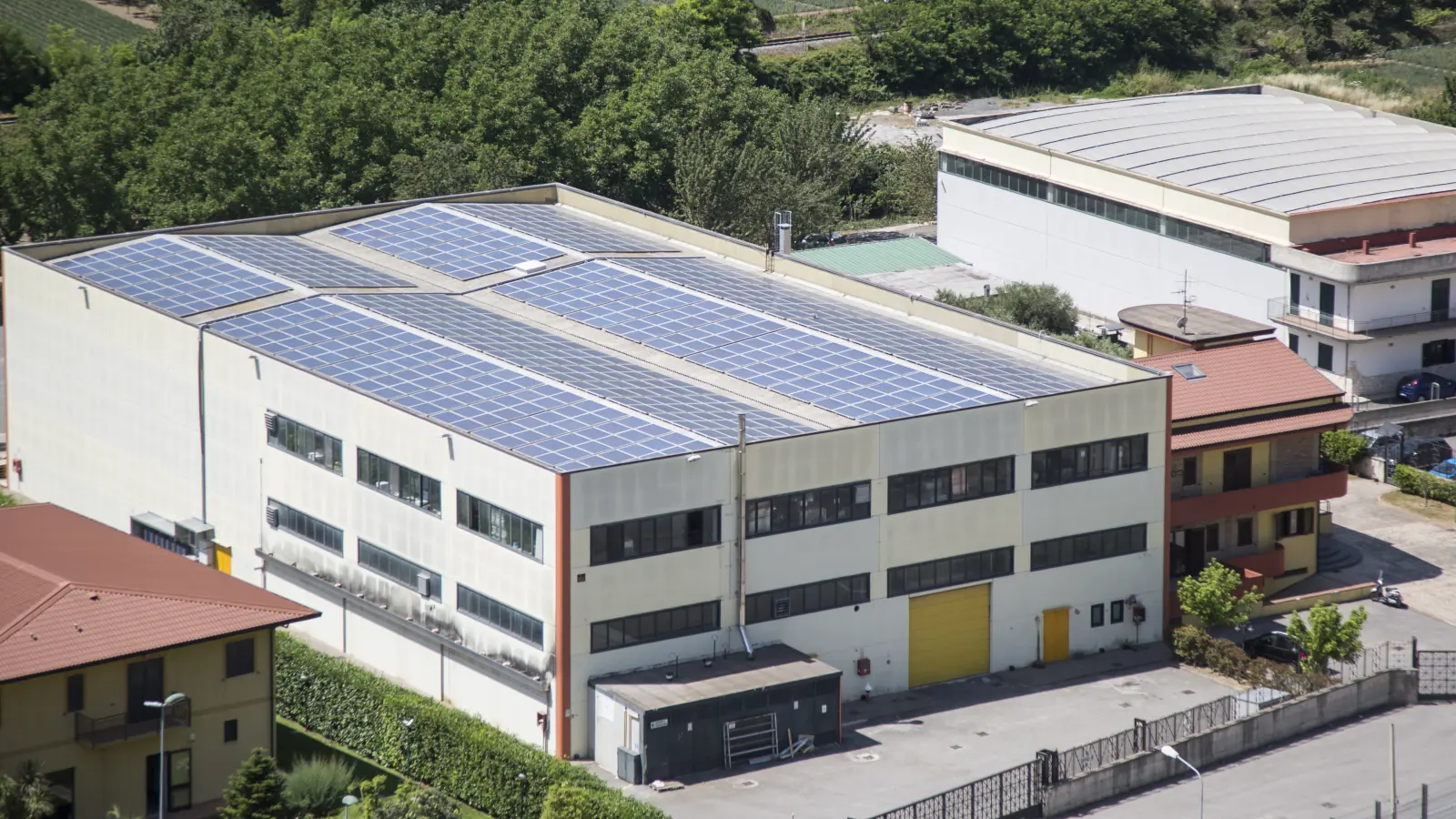

A factory uses most of its power on working days, in daytime shifts, for motors, heat, cooling, ventilation and light. A solar plant on site saves the most when it is sized to that weekday daytime use: weekends, holidays and summer shutdowns decide how much is left over. A battery pays where evening power or peak demand costs much more.
In short
- A solar plant saves a factory the most when it is sized to the power used in daytime shifts on working days.
- Weekends and a two-week summer shutdown can carry about a third of a year’s solar output, so plan what happens to it.
- Before signing, check the structure, the grid connection, who maintains the plant and what happens if the business moves.
How does a factory use electricity?
Mostly to turn motors. In US manufacturing in 2022, motors driving machinery took about half of all the electricity used. Heating, ventilation and air conditioning took about a tenth, process heat 9%, process cooling and refrigeration 8% and lighting 6%, by our calculation from the US Energy Information Administration’s (EIA) survey of manufacturers. In the EU, industry used 825 TWh of electricity in 2024, more than households or services, according to Eurostat.
Over the day, use follows the shifts. With one shift, most power is used in daylight on working days; with two or three, use stretches into the evening and the night. Some loads often run around the clock, such as compressors keeping air lines under pressure, cooling, ventilation and IT. Peaks come when large motors and furnaces start or run together, and business tariffs often charge for capacity too, such as the US demand charge on the highest power drawn in the billing period.
| End use | All manufacturing | Plastics and rubber | Fabricated metal | Transport equipment |
|---|---|---|---|---|
| Motors driving machinery | 51% | 47% | 41% | 42% |
| Heating, ventilation and air conditioning | 10% | 13% | 20% | 19% |
| Process heat | 9% | 9% | 5% | 7% |
| Process cooling and refrigeration | 8% | 10% | 3% | 6% |
| Lighting | 6% | 9% | 10% | 12% |
Motors inside cooling equipment are counted under cooling, not under motors. The figures describe the United States.
How much of the plant’s output can a factory use?
A solar plant produces every day of the week, most of all around midday. A factory on one shift uses power only on working days. Our calculation from data in PVGIS, the EU Joint Research Centre’s solar tool, shows how much: in 2023, for a plant tilted at 10 degrees and facing south near Madrid, Lisbon, Milan or Fresno in California, Saturdays and Sundays carried between 28% and 30% of the year’s output. A two-week shutdown in August took another 3% to 4%, and public holidays add more.
So size the plant to what the factory uses in daylight on working days. Two or three shifts, or a process that runs seven days a week, use more of the output and can justify a larger plant.
Power you do not use flows to the grid, and each market pays for it in its own way. In the EU, the law entitles you to payment that reflects its market value, and each country sets how; in the United States, it differs by state and utility. The region pages below explain the rules.
Where can the plant go on a factory site?
Most factory plants sit on the building itself. Talk to your insurer before the design is final: the UK code of practice for commercial rooftop plants, written with insurers (RC62, 2023), recommends roofing that does not burn, a structural survey, clear access routes for maintenance and firefighting, and regular cleaning. A UK government study found that fires involving solar plants are very rare, and that the most common cause was the DC isolator, the switch that cuts power from the modules, where most of the faults identified came from poor installation (BRE, 2018). Who builds the plant matters.
On a factory site, the plant can go in three places:
- On the building, if the structure can carry the extra weight. A planning guide from the US National Renewable Energy Laboratory (NREL) puts modules and frames at about 15 kg per square metre of module area, and 20 to 30 kg where added weights, called ballast, hold them down on a flat surface (2009, our conversion from pounds per square foot). Old or lightweight buildings need a survey by a structural engineer.
- On the ground, on spare land within or next to the site, when the building is too small or cannot carry the load.
- Over the car park, on canopies that also shade the cars, without touching the building. The Spanish guide to car-park canopies covers their structure and permits.
When does a battery pay in a factory?
A battery stores power and gives it back later, with some loss: across the large batteries on the US grid in 2019, about 82% of the power stored came back out, according to the EIA. In a factory, it can pay in three cases.
- The plant produces more at midday than the factory uses, that surplus earns little, and power for the evening shift costs much more.
- The bill charges for capacity, and the battery trims the peaks when large machines start. In US research, high demand charges are often cited as a critical factor in whether a battery pays (NREL, 2017).
- Part of the process must keep running in a power cut. A plant connected to the grid switches off when the grid fails, for safety, so backup needs a battery and equipment designed to run isolated from the grid.
A battery rarely pays when the factory already uses nearly all of the plant’s output as it is produced, when evening and midday power cost about the same, or when there are no sharp peaks. The guide to battery storage for businesses in Spain works through the sums.
How can a factory pay for the plant?
The plant can be the same whichever way you pay. What changes is who invests, who owns it and who looks after it.
- Buy it, from your own funds or with a loan. You keep the whole saving and carry the investment, the upkeep and the risk of lower output.
- Lease it. A leasing company owns the plant and you pay a set instalment, often with maintenance included.
- Sign a power purchase agreement (PPA), from 50 kWp (kilowatts peak, the plant’s rated power). A financing partner pays for, owns and maintains the plant, and you pay only for the power it supplies, at a price per kWh set in the contract. That price starts below what you pay for grid power when you sign, and any yearly increase is written into the contract from the start. What is a PPA? explains the contract.
Buying and leasing work at any size. The tax treatment differs between the three and from country to country: tax benefits of a solar PPA sets out the main rules, and your tax adviser should confirm them for your company.
What should you check before signing?
Settle these points before you commit:
- A full year of consumption by the hour or quarter-hour, so the plant is sized to real use, not to the size of the building.
- A structural survey, and how many years the roofing has left: moving the plant later to repair the building costs money.
- The grid connection: how much the local network can take, how long approval takes and whether exports are limited.
- Who maintains, cleans and insures the plant, and how fast faults are repaired.
- What happens if the business moves, sells the building or drops a shift: whether the contract passes to a new owner, what ending early costs, and whether a PPA sets a minimum purchase.
- Fire safety: an isolation switch that firefighters can reach, signs showing that the building carries a plant, and a design your insurer has seen.
Your market
Rules on self-consumption, exports and grants are set by each country, and in the United States by each state. Read the page for your market:
- Spain: autoconsumo en la industria manufacturera, in Spanish.
- Portugal: commercial solar in Portugal, with the rules, the registration and what surplus earns.
- United States: commercial solar in the United States, with prices, export rules and tax, state by state.
- Colombia: commercial solar in Colombia, with the self-generation rules, surplus credits and tax incentives.
- Prices across Europe: business electricity prices in the EU in 2026.
How Aeternus helps
Aeternus Power is an independent energy company. We originate, qualify, structure and finance energy projects, solar-led and with storage: we study a year of your consumption and your site, size the plant to your shifts, and bring in a vetted builder and the financing partner. We never own the plants. A commission is paid by whoever builds or finances the project, never by you, and only when the project goes ahead.
We work with businesses in Spain, Portugal and Colombia today; in Spain and Portugal you can buy the plant, lease it or, from 50 kWp, take a PPA. Our office in California opens on 1 December 2026, and we cannot yet say which of these we will arrange there. For a first figure, use the preview on our business page, or tell us about your factory: we reply within two working days.
Questions
How much of a factory’s electricity can solar cover?
Only the power used while the plant produces: in daylight, and most of all on sunny days. Night shifts, winter evenings and cloudy days still need the grid, or a battery for part of the evening. The share over a year depends on your shifts and the space available, so it has to come from your own meter readings.
Is my factory building strong enough for solar?
It depends on the structure, so it has to be checked. Modules and frames add about 15 kg per square metre, more with ballast on a flat surface, and they also catch wind and hold snow. A structural engineer should survey older or lightweight buildings before the design is fixed.
What happens to the solar power a factory does not use at weekends?
It flows to the grid, and each market pays for it in its own way, by country and, in the United States, by state. Weekends, holidays and shutdowns add to that surplus, so the size of the plant is chosen with them in mind. The Spanish guide to surplus power explains one market in detail.
Will solar keep my factory running in a power cut?
Not on its own. A plant connected to the grid switches off when the grid fails, for safety. Keeping a line, servers or cold rooms running needs a battery and equipment designed to run isolated from the grid, sized for those loads.
Can I put solar on a factory I rent?
Yes, with the owner’s written consent. Agree who owns the plant, who pays to remove and refit it if the building needs repairs, and what happens when your lease ends. A PPA or a lease of the plant should not run past your lease without a plan for that day.
Sources
- US Energy Information Administration: 2022 Manufacturing Energy Consumption Survey, table 5.1, end uses of fuel consumption (August 2025): https://www.eia.gov/consumption/manufacturing/data/2022/
- Eurostat: electricity and heat statistics, consumption by sector in 2024 (data extracted September 2026): https://ec.europa.eu/eurostat/statistics-explained/index.php?title=Electricity_and_heat_statistics
- EU Joint Research Centre: PVGIS 5.3, hourly and monthly output of a solar plant (data for 2005 to 2023): https://re.jrc.ec.europa.eu/pvg_tools/en/
- EUR-Lex: Directive (EU) 2018/2001 on renewable energy, consolidated text of 16 July 2024, article 21 on renewables self-consumers: https://eur-lex.europa.eu/legal-content/EN/TXT/HTML/?uri=CELEX:02018L2001-20240716
- US Energy Information Administration: glossary, demand charge: https://www.eia.gov/tools/glossary/index.php?id=D
- US Energy Information Administration: utility-scale batteries and pumped storage return about 80% of the electricity they store (12 February 2021): https://www.eia.gov/todayinenergy/detail.php?id=46756
- UK Department for Energy Security and Net Zero: fire incidents involving solar panels, BRE study and final report (last updated 19 March 2019): https://www.gov.uk/government/publications/fire-incidents-involving-solar-panels
- US National Renewable Energy Laboratory: Solar Ready Buildings Planning Guide, NREL/TP-7A2-46078 (December 2009): https://www1.eere.energy.gov/femp/pdfs/46078.pdf
- NREL and Clean Energy Group: identifying potential markets for behind-the-meter battery storage, a survey of US demand charges (August 2017): https://www.osti.gov/biblio/1374803
- DSIRE, NC Clean Energy Technology Center: net metering policies for investor-owned utilities, state by state (November 2026): https://www.dsireusa.org/resources/detailed-summary-maps/
- Fire Protection Association and RISCAuthority: RC62, joint code of practice for fire safety with photovoltaic installations on commercial buildings, version 2 (2023): https://solarenergyuk.org/wp-content/uploads/2023/02/RC62-Recommendations-for-fire-safety-with-PV-panel-installations-3.pdf
- Southern California Edison: solar technology FAQs, outages and grid-tied systems: https://www.sce.com/customer-service-center/help-center/solar/getting-started-with-solar/solar-technology-faqs
Latest
Europe’s power prices in early November 2026: from €184/MWh in Spain to €347/MWh in Ireland