Solar for data centres: what a plant on site covers, and where the rest of the power comes from
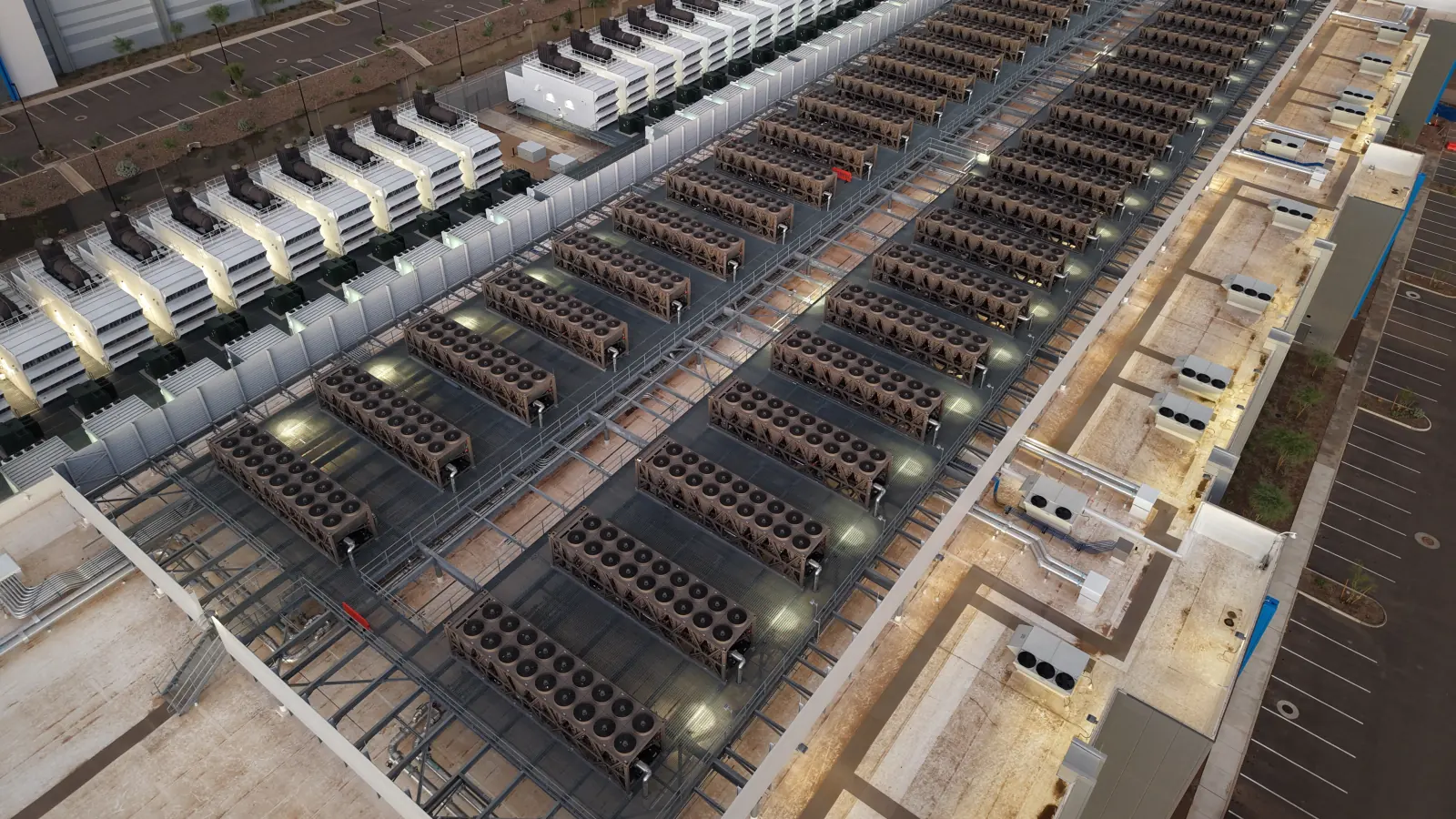

A data centre uses power day and night, all year, so a solar plant on its buildings or land covers only a small part of its use. Most of the power still comes through the grid. Long-term contracts to buy power from plants elsewhere, such as a power purchase agreement (PPA), can cover more, and they decide what the operator can report as renewable.
In short
- A plant on site covers a small share of a data centre’s round-the-clock use, and most of its power still comes through the grid.
- Contracts with plants elsewhere can cover more, and the certificates they carry decide what renewable use the operator may report.
- Check the grid connection, the space for a plant, how a battery stays apart from the backup systems and who retires each certificate.
How does a data centre use electricity?
Day and night, all year. Servers take around 60% of a modern data centre’s electricity, storage about 5% and network equipment up to 5%, says the International Energy Agency (IEA). Cooling takes from about 7% in the most efficient large sites to over 30% in less efficient ones (2025).
Cooling needs more power on hot days: on most nights and in mild winter weather, outside air is the cheapest way to cool a data hall, says the US Department of Energy’s design guide for data centres (2024).
Data centres used about 415 TWh in 2024, around 1.5% of the world’s electricity, and a far higher share where they cluster. In Ireland they used 23% of all metered electricity in 2025, and their use tends to rise quarter after quarter instead of peaking in winter like households’ use, according to the Central Statistics Office.
| Place | Year | Electricity used by data centres | Share of all electricity use |
|---|---|---|---|
| World | 2024 | about 415 TWh | about 1.5% |
| United States | 2023 | 176 TWh | about 4.4% |
| Ireland | 2025 | 7,663 GWh | 23% of metered use |
Can a data centre run on solar power from its own site?
Only in part. A plant on site produces in daylight: each kWp (kilowatt peak, the plant’s rated power) yields about 1,230 to 1,620 kWh a year near Milan, Lisbon, Madrid or Fresno in California, by our calculation from PVGIS, the EU Joint Research Centre’s solar data tool (modules tilted at 10 degrees, facing south, averages for 2005 to 2023). A load that never stops uses 8,760 kWh a year for each kW, so matching it would take about 5.4 to 7.1 kWp per kW, with far more output at midday than the site could use.
Space is the other limit. In an example in the US Department of Energy’s guide, a data centre of about 1,400 m² uses 13,140 MWh a year for its IT equipment alone, about 9,400 kWh per m². A square metre of modules yields about 230 to 340 kWh a year at those four places, by our calculation with the module efficiencies of 19% to 21% used in the System Advisor Model of the US National Renewable Energy Laboratory (NREL). That data centre uses about 28 to 40 times what modules over the same area could produce.
So a plant on the buildings, over the car park or on spare land covers a small share of the site’s use, in sunny hours, when cooling also works hardest. It does not shrink the grid connection either, since the site still draws its full power at night, and that connection is often the bottleneck: the IEA estimates that around 20% of planned data centre projects could face delays unless grid risks are addressed (2025).
Can UPS batteries and generators also cut the bill?
No: they have another job. The uninterruptible power supply (UPS), usually batteries, and the backup generators keep the servers running through a power cut. The IEA notes that they are rarely used, but needed for the very high reliability that data centres must meet.
A battery for the bill works every day, storing cheap power or the plant’s midday surplus for later. Doing that with the UPS batteries would draw down the reserve they hold for a power cut, so plan it as a separate system, or agree in writing how much of the UPS may ever be used for anything else, and who decides.
The IEA adds that running backup generators and storage more flexibly, to help the grid, is still underexplored. A solar plant replaces neither: a plant connected to the grid switches off when the grid fails, for safety.
How can a data centre buy power from plants elsewhere?
With long-term contracts. In a physical PPA, the power of a wind or solar farm elsewhere reaches the site through the grid. In a virtual PPA, the site keeps buying from its supplier, and the two sides settle the difference between the price set in the contract and the market price. What is a PPA? explains both. The IEA notes that technology companies already finance part of the world’s new wind and solar capacity this way (2025).
A solar contract delivers in daylight only; adding other plants, such as wind farms, spreads the power over more hours. For the plant on your own site, there are three ways to pay:
- Buy it, with your own funds or a loan, and keep the whole saving.
- Lease it, for a set instalment, often with maintenance included.
- Sign an on-site PPA, from 50 kWp: a financing partner pays for, owns and maintains the plant, and you pay only for its power, at a price per kWh set in the contract. That price starts below what you pay for grid power when you sign, and any yearly increase is written into the contract from the start.
Buying and leasing work at any size. Tax rules differ by country: see tax benefits of a solar PPA, and confirm them with your tax adviser.
How do data centres report the renewable power they use?
In the EU, data centres with at least 500 kW of installed IT power must publish key figures every year (article 12 of Directive (EU) 2023/1791 on energy efficiency) and report them to a European database by 15 May (Delegated Regulation (EU) 2024/1364). Renewable power counts in three parts: guarantees of origin (the EU certificates that show which plant power came from) bought and retired, PPAs, and plants on site. Power from a PPA or an on-site plant counts only if the data centre owns and retires the guarantees of origin it creates.
As of 18 November 2026, a common EU rating scheme for data centres, proposed by the European Commission on 21 September 2026, was before the European Parliament and the Council, and the first labels were expected in 2027.
Under the GHG Protocol’s Scope 2 Guidance (2015), a company with sites in markets that offer such contracts and certificates reports two emissions figures: a location-based one, from the grids they draw on, and a market-based one, from their contracts and certificates. Those count only if they meet the guidance’s quality criteria: among them, the certificates must be retired by or for the company and come from the same market as its sites. The GHG Protocol is revising these rules and plans a public consultation on a joint standard with ISO in the second quarter of 2027, so write into every contract who receives the certificates and who retires them.
What should you check before signing?
Settle these points before you commit:
- A year of consumption by the hour or quarter-hour, and the growth planned for the site.
- The space for a plant: the structure of the buildings, the car park and any spare land, with a design your insurer has seen.
- The grid connection: the capacity you need at full load, the timetable, and any limit on sending power to the grid.
- Any battery for the bill: how it is kept apart from the UPS, and who decides how it runs.
- Each PPA: the hours it covers, its term, the price set in the contract, any minimum purchase, and who receives and retires the certificates.
- What you must report, in the EU database or under the GHG Protocol, and whether each contract gives you the data in that form.
Your market
Rules on self-consumption, exports and grants are set by each country, and in the United States by each state. Read the page for your market:
- Spain: autoconsumo y contratos de energía para centros de datos, in Spanish.
- Portugal: commercial solar in Portugal, with the rules, the registration and what surplus earns.
- United States: commercial solar in the United States, with prices, export rules and tax, state by state.
- Colombia: commercial solar in Colombia, with the self-generation rules, surplus credits and tax incentives.
- Prices across Europe: business electricity prices in the EU in 2026.
How Aeternus helps
Aeternus Power is an independent energy company. We originate, qualify, structure and finance energy projects, solar-led and with storage: we study a year of your consumption and your site, size the plant that fits it and any battery for the bill, and bring in a vetted builder and the financing partner. We never own the plants. A commission is paid by whoever builds or finances the project, never by you, and only when the project goes ahead.
We work with businesses in Spain, Portugal and Colombia today; in Spain and Portugal you can buy the plant, lease it or, from 50 kWp, take a PPA. Our office in California opens on 1 December 2026, and we cannot yet say which of these we will arrange there. For a first figure, use the preview on our business page, or tell us about your data centre: we reply within two working days.
Questions
Can a data centre run entirely on solar power?
Not from its own site. It uses power around the clock, while a plant on site produces only in daylight and on far less space than it would need. Most of the power comes through the grid, and long-term contracts with plants elsewhere can cover more of it.
Does solar reduce the grid connection a data centre needs?
No. At night and on dark days the site draws its full power from the grid, so the connection is sized for that. A plant reduces the energy you buy, not the capacity you need.
Will solar keep a data centre running in a power cut?
No. A plant connected to the grid switches off when the grid fails, for safety, and it produces nothing at night. The UPS and the backup generators keep the servers running, and a solar plant does not replace them.
What is the difference between a physical and a virtual PPA?
In a physical PPA, the power of a specific plant reaches your site through the grid. In a virtual PPA, you keep buying from your supplier, and you and the plant settle the difference between the price set in the contract and the market price. What is a PPA? explains both.
Which data centres must report their energy use in the EU?
Those with an installed IT power demand of at least 500 kW, under article 12 of the Energy Efficiency Directive. They report every year to a European database, including how much renewable power they use from guarantees of origin, PPAs and plants on site.
Sources
- International Energy Agency: Energy and AI, special report, executive summary and chapters on energy demand and supply (April 2025): https://www.iea.org/reports/energy-and-ai
- US Department of Energy: Lawrence Berkeley National Laboratory’s 2024 report on US data centre energy use (20 December 2024): https://www.energy.gov/articles/doe-releases-new-report-evaluating-increase-electricity-demand-data-centers
- Central Statistics Office, Ireland: data centres metered electricity consumption 2025, key findings (7 July 2026): https://www.cso.ie/en/releasesandpublications/ep/p-dcmec/datacentresmeteredelectricityconsumption2025/keyfindings/
- EUR-Lex: Directive (EU) 2023/1791 on energy efficiency, article 12 and annex VII on data centres (13 September 2023): https://eur-lex.europa.eu/legal-content/EN/TXT/?uri=CELEX:32023L1791
- EUR-Lex: Commission Delegated Regulation (EU) 2024/1364 on the first phase of a common Union rating scheme for data centres (14 March 2024): https://eur-lex.europa.eu/legal-content/EN/TXT/?uri=CELEX:32024R1364
- European Commission: making data centres energy efficient thanks to a new EU rating system (21 September 2026): https://commission.europa.eu/news-and-media/news/making-data-centres-energy-efficient-thanks-new-eu-rating-system-2026-09-21_en
- GHG Protocol: Scope 2 Guidance (2015), quality criteria and public consultation of 20 October 2025 to 31 January 2026: https://ghgprotocol.org/scope-2-guidance
- GHG Protocol: announcement of key standard development updates (29 July 2026): https://ghgprotocol.org/blog/ghg-protocol-announces-key-standard-development-updates
- US Department of Energy, Federal Energy Management Program: best practices guide for energy-efficient data center design (revised July 2024): https://www.energy.gov/sites/default/files/2024-07/best-practice-guide-data-center-design.pdf
- EU Joint Research Centre: PVGIS 5.3, monthly output of a solar plant (averages for 2005 to 2023): https://re.jrc.ec.europa.eu/pvg_tools/en/
- National Renewable Energy Laboratory: System Advisor Model help, PVWatts system design and module types: https://samrepo.nlr.gov/help/pvwatts_system_design.html
- Southern California Edison: solar technology FAQs, outages and grid-tied systems: https://www.sce.com/customer-service-center/help-center/solar/getting-started-with-solar/solar-technology-faqs
Latest
Europe’s power prices in early November 2026: from €184/MWh in Spain to €347/MWh in Ireland