Solar for ceramics and building materials: what a plant on site covers when the kilns never stop
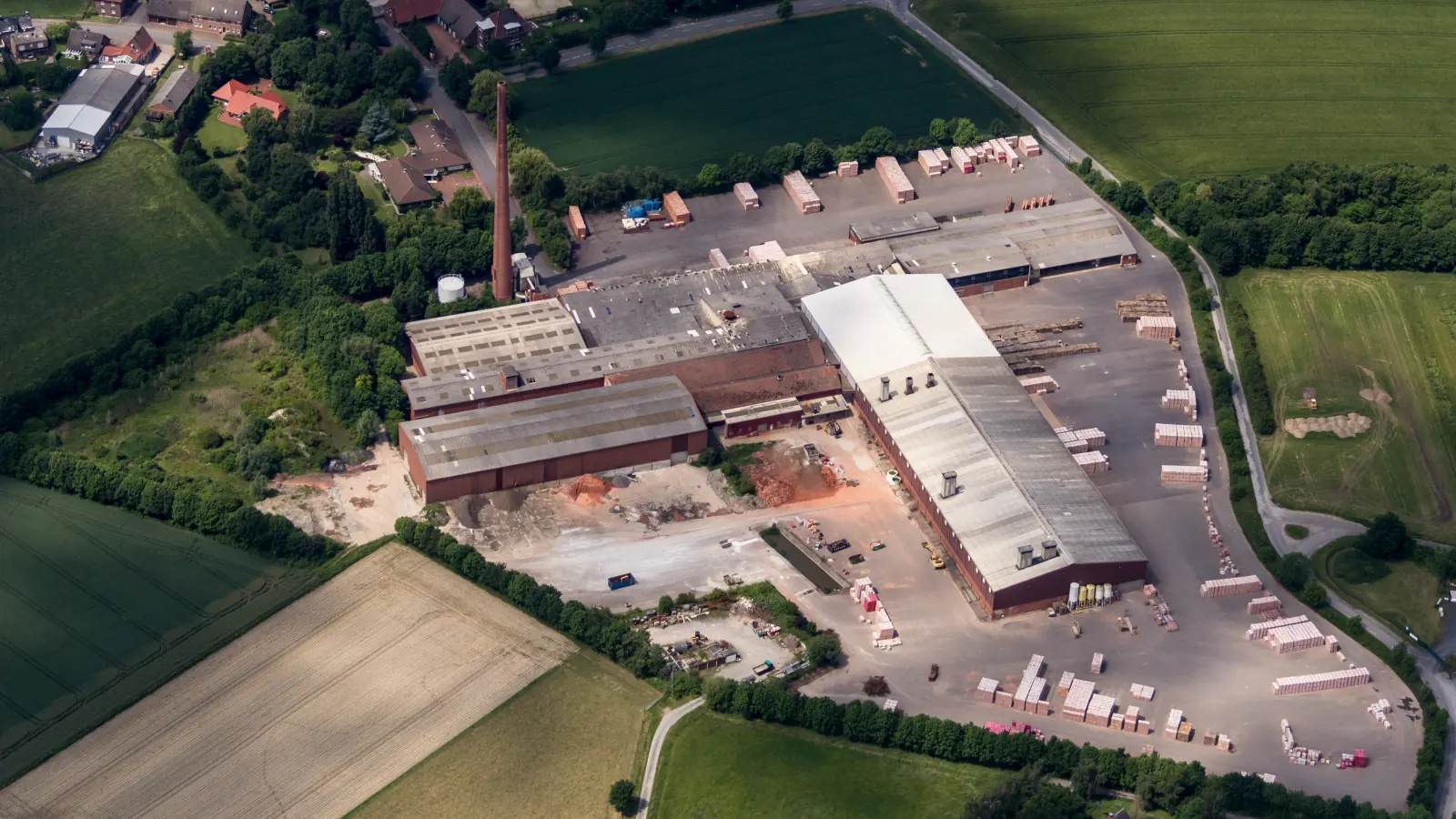

In tile, brick, cement and glass plants, most of the energy is heat from gas and other fuels: electricity is about a sixth of it, in the EU and in the United States. A solar plant on site covers part of that electricity, which drives mills, presses and fans, and a large one fits on the land many of these sites have. The kilns keep their fuel.
In short
- Electricity is about a sixth of the energy building materials plants use; most of the rest is heat from gas and other fuels.
- A solar plant covers part of the electricity for mills, presses and fans, never the fuel a kiln burns.
- Check the land, the dust and heat near the kilns, the buildings, the grid connection and your carbon costs.
How much of a ceramics or cement plant’s energy is electricity?
About a sixth. In 2024, electricity was 17% of the energy used by the EU industry that makes glass, cement, lime, plaster, ceramics and other mineral products, by our calculation from Eurostat data; natural gas was 38%, and petroleum coke and other oil products, waste, coal and biomass most of the rest. In the United States, it was 18% in 2022, by our calculation from the survey of manufacturers of the US Energy Information Administration (EIA).
Electricity drives the machines: in US plants making these products, motors took 56% of it in 2022. In cement, the mills and the exhaust fans use more than 80% of the electricity, which comes to 90 to 150 kWh per tonne of cement, says the EU’s reference document on best available techniques for the sector (2013). In ceramics, the machines that crush, mix and shape the clay run on electricity, while natural gas, liquefied petroleum gas (LPG) and fuel oil fire most dryers and kilns, says the final draft of the EU’s reference document for ceramics (April 2026).
| Industry and place | Electricity | Natural gas | Other fuels and heat |
|---|---|---|---|
| All building materials, EU, 2024 | 17% | 38% | 45% |
| All building materials, United States, 2022 | 18% | 36% | 46% |
| Ceramics, bricks and other products, Spain, 2024 | 15% | 78% | 6% |
| Ceramics, bricks and other products, Portugal, 2024 | 20% | 60% | 20% |
| Clay bricks, tiles and refractories, United States, 2022 | 13% | 79% | 8% |
| Glass containers, United States, 2022 | 22% | 78% | under 1% |
| Cement, lime and plaster, Spain, 2024 | 12% | 6% | 82% |
| Cement, United States, 2022 | 12% | 25% | 63% |
| Plasterboard and other gypsum products, United States, 2022 | 8% | 91% | 1% |
Eurostat’s ceramics, bricks and other products cover every mineral product except glass, cement, lime and plaster. The EIA counts power that plants make on site from fuel as fuel. Rows may not add up to 100% because of rounding.
How much of that electricity can a solar plant cover?
Kilns such as tunnel kilns run continuously. Where a plant draws about the same power every hour, a solar plant no larger than that demand is used in full on site, and its size decides how much it covers. For a site drawing the same power around the clock, a plant on the ground with modules tilted at 30 degrees and facing south, near Madrid, Lisbon, Milan or Fresno in California, would have covered this in 2023, by our calculation from PVGIS, the EU Joint Research Centre’s solar data tool:
- 1 kWp (kilowatt peak, the plant’s rated power) for each kW of steady demand: 16% to 20% of the year’s electricity, all of the output used on site.
- 1.5 kWp per kW: 23% to 29%, with 2% to 4% of the output left over at midday.
- 2 kWp per kW: 27% to 33%, with 13% to 17% left over.
- 3 kWp per kW: 31% to 37%, with about a third left over.
That is electricity only: with electricity at 17% of the sector’s energy, the EU figure for 2024, a plant of 1.5 kWp per kW covers about 4% to 5% of all the energy a site uses. Space sets the size: the System Advisor Model of the US National Renewable Energy Laboratory (NREL) gives typical values of about 2 to 4 hectares (5 to 10 acres) per MW of inverter capacity. A cement works making one million tonnes a year draws about 10 to 17 MW on average, so a plant of 1 kWp per kW would need roughly 20 to 60 hectares, by our calculation.
Where can the plant go on a ceramics, cement or glass site?
Often on the land around it. Most brick and roofing tile works in Europe sit near the quarries that supply their clay, and most have their own, says the draft reference document for ceramics; in cement, the quarry is close to the plant in most cases, says the reference document for cement and lime. Worked-out areas, spare land and storage yards can carry a large plant on the ground, if the quarry’s permit and restoration plan allow it. On and around the buildings, check:
- Dust. Industry and mining raise dust, including particles of concrete and brick, that settles on modules and cuts their output, says a report of the International Energy Agency’s (IEA) photovoltaic research programme (2022). Site the plant with the main wind direction in mind, away from mills, silos and stockpiles, and plan regular cleaning.
- Heat. Crystalline silicon modules lose about 0.35% to 0.37% of their output for each degree Celsius they warm up, in NREL’s System Advisor Model, so keep them clear of kiln exhausts and hot vents.
- The buildings. Factory buildings may need strengthening to carry a solar plant, the draft reference document for ceramics notes. Have a structural engineer survey older halls and check how many years the roofing has left; solar for factories covers these checks in more detail.
- The grid connection: how much the local network can take and whether exports are limited. A plant no larger than the steady demand rarely sends power to the grid.
What covers the evening, the night and the power you still buy?
The grid, a contract or, in part, a battery. A solar plant produces nothing at night, and the kilns keep running. A battery has little to store unless the plant is larger than the daytime demand: at twice that size, 13% to 17% of the output is left over at midday. Some tile plants also make their own power in gas turbines whose exhaust heats the spray dryers, the most common cogeneration units for spray drying, says the draft reference document: size the solar plant to the power you still buy.
For the night, a long-term power purchase agreement (PPA) with plants elsewhere, such as wind farms, can deliver power through the grid, or settle the difference with the market price in a virtual PPA. What is a PPA? explains both. For the plant on your own site, there are three ways to pay:
- Buy it, with your own funds or a loan, and keep the whole saving.
- Lease it, for a set instalment, often with maintenance included.
- Sign an on-site PPA, from 50 kWp: a financing partner pays for, owns and maintains the plant, and you pay only for its power, at a price per kWh set in the contract. That price starts below what you pay for grid power when you sign, and any yearly increase is written into the contract from the start.
Buying and leasing work at any size. Tax rules differ by country: see tax benefits of a solar PPA, and confirm them with your tax adviser.
Can kilns and dryers run on electricity?
Some already do, and only then can a solar plant cover part of their heat. Electric kilns are used for certain tableware and technical ceramics, and electric firing is being tested at plant scale for clay blocks, sanitaryware and brick slips, says the draft reference document for ceramics. It lists electric and hybrid kilns and heat pumps for dryers as emerging techniques: at one Austrian clay block plant, heat pumps cut the energy used for drying by up to 80%. In glass, half of the electricity used in US glass container plants in 2022 went into process heat, by our calculation from EIA data.
Heat is most of the energy, so electrifying it raises a plant’s power demand far above today’s. The same document notes that the nearby grid may not deliver that much power, so new lines and transformers may be needed, and that electric kilns suit new kilns and major upgrades. Plan the grid connection, the kilns and any solar plant together.
What does carbon pricing add for kilns in the EU?
A cost per tonne of CO2. The EU Emissions Trading System (ETS) covers plants making cement clinker in rotary kilns above 500 tonnes a day, lime above 50 tonnes a day, glass and mineral wool above 20 tonnes a day of melting capacity, ceramic products such as bricks, roofing tiles and tiles above 75 tonnes a day, and plasterboard and other gypsum products above 20 tonnes a day. By 30 September each year, their operators must surrender one allowance for each tonne of CO2 they emitted the year before (Directive 2003/87/EC, annex I and article 12).
Cement makers still receive part of their allowances free. But since 1 January 2026, the carbon border adjustment mechanism (CBAM) has put a carbon price on imported cement in its definitive regime, and free allowances for cement shrink as it phases in: to 97.5% of the full amount in 2026 and 14% in 2033, with none from 2034, under the rules in force. A Commission proposal of 17 July 2026 would keep 15% from 2034 to 2037; as of 18 November 2026, it was before the European Parliament and the Council. CBAM certificates, priced from ETS auctions, cost between €75.28 and €82.32 per tonne of CO2 in the first three quarters of 2026.
A solar plant does not reduce these costs: about 62% of a cement kiln’s CO2 comes from the limestone itself as it is heated and the rest from the fuel, says the reference document for cement. Less fuel burned lowers them, for example where part of the heat runs on electricity.
Your market
Rules on self-consumption, exports and grants are set by each country, and in the United States by each state. Read the page for your market:
- Spain: autoconsumo en cerámica y materiales de construcción, in Spanish.
- Portugal: commercial solar in Portugal, with the rules, the registration and what surplus earns.
- United States: commercial solar in the United States, with prices, export rules and tax, state by state.
- Colombia: commercial solar in Colombia, with the self-generation rules, surplus credits and tax incentives.
- Prices across Europe: business electricity prices in the EU in 2026.
How Aeternus helps
Aeternus Power is an independent energy company. We originate, qualify, structure and finance energy projects, solar-led and with storage: we study a year of your consumption, your land, your buildings and your grid connection, size the plant to the power your site draws day and night, and bring in a vetted builder and the financing partner. We never own the plants. A commission is paid by whoever builds or finances the project, never by you, and only when the project goes ahead.
We work with businesses in Spain, Portugal and Colombia today; in Spain and Portugal you can buy the plant, lease it or, from 50 kWp, take a PPA. Our office in California opens on 1 December 2026, and we cannot yet say which of these we will arrange there. For a first figure, use the preview on our business page, or tell us about your site: we reply within two working days.
Questions
Can a solar plant power a kiln?
Only an electric one. A solar plant makes electricity, so it can feed electric kilns, such as those used for some tableware and technical ceramics, but not a kiln that burns gas or other fuels. In most brick, tile and cement plants, it covers part of the power for mills, presses and fans.
How much electricity does a cement plant use?
Between 90 and 150 kWh per tonne of cement, according to the EU’s reference document for the sector (2013), and the mills and exhaust fans use more than 80% of it. In US cement plants, electricity was 12% of the energy used in 2022; coal, natural gas and other fuels made up the rest, by our calculation from EIA data.
Is solar worth it for a brick or tile factory?
Often, for its electricity: where the kilns and machines run around the clock, a plant no larger than that steady demand is used in full on site. Whether it pays depends on your power price, the land and buildings available and the way you pay. A year of meter readings, by the hour or quarter-hour, settles it.
Can a solar plant be built on a quarry?
Check first. The quarry’s permit and restoration plan may set what the land can be used for, and the ground must be stable enough for the structures. Worked-out areas, storage yards and spare land close to your connection point are the places to study.
Do brick and tile makers pay for carbon in the EU?
Those with a production capacity above 75 tonnes a day do, under the EU Emissions Trading System: each year they surrender one allowance for every tonne of CO2 they emitted. A solar plant does not reduce that on its own, because the CO2 comes from the kilns.
Sources
- Eurostat: complete energy balances, final energy use of the non-metallic minerals industry, dataset nrg_bal_c (updated 27 August 2026): https://ec.europa.eu/eurostat/databrowser/view/nrg_bal_c/default/table?lang=en
- Eurostat: industry energy consumption by NACE Rev. 2 activity, dataset nrg_d_indq_n (updated 27 August 2026): https://ec.europa.eu/eurostat/databrowser/view/nrg_d_indq_n/default/table?lang=en
- US Energy Information Administration: 2022 Manufacturing Energy Consumption Survey, tables 3.2 and 5.2, fuel consumption and end uses (2025 and 2026): https://www.eia.gov/consumption/manufacturing/data/2022/
- EU Joint Research Centre: final draft of the best available techniques reference document for the ceramic manufacturing industry (April 2026): https://bureau-industrial-transformation.jrc.ec.europa.eu/reference/ceramic-manufacturing-industry
- EU Joint Research Centre: best available techniques reference document for the production of cement, lime and magnesium oxide (2013): https://bureau-industrial-transformation.jrc.ec.europa.eu/index.php/reference/production-cement-lime-and-magnesium-oxide
- EUR-Lex: Directive 2003/87/EC on the EU Emissions Trading System, consolidated text of 1 March 2024, annex I and articles 10a and 12: https://eur-lex.europa.eu/legal-content/EN/TXT/?uri=CELEX:02003L0087-20240301
- EUR-Lex: European Commission proposal to amend Directive 2003/87/EC, COM(2026) 616 (17 July 2026): https://eur-lex.europa.eu/legal-content/EN/TXT/?uri=CELEX:52026PC0616
- European Commission: Carbon Border Adjustment Mechanism, definitive regime from 1 January 2026: https://taxation-customs.ec.europa.eu/carbon-border-adjustment-mechanism_en
- European Commission: price of CBAM certificates, quarterly prices in 2026: https://taxation-customs.ec.europa.eu/carbon-border-adjustment-mechanism/price-cbam-certificates_en
- EU Joint Research Centre: PVGIS 5.3, hourly output of a solar plant (data for 2023): https://re.jrc.ec.europa.eu/pvg_tools/en/
- National Renewable Energy Laboratory: System Advisor Model help, PVWatts system design, module types and land area: https://samrepo.nlr.gov/help/pvwatts_system_design.html
- IEA Photovoltaic Power Systems Programme: soiling losses, impact on the performance of photovoltaic power plants, report T13-21:2022 (December 2022): https://iea-pvps.org/wp-content/uploads/2023/01/IEA-PVPS-T13-21-2022-REPORT-Soiling-Losses-PV-Plants.pdf
Latest
Europe’s power prices in early November 2026: from €184/MWh in Spain to €347/MWh in Ireland