Solar for car and parts plants: large halls, short peaks and the heat that stays on gas
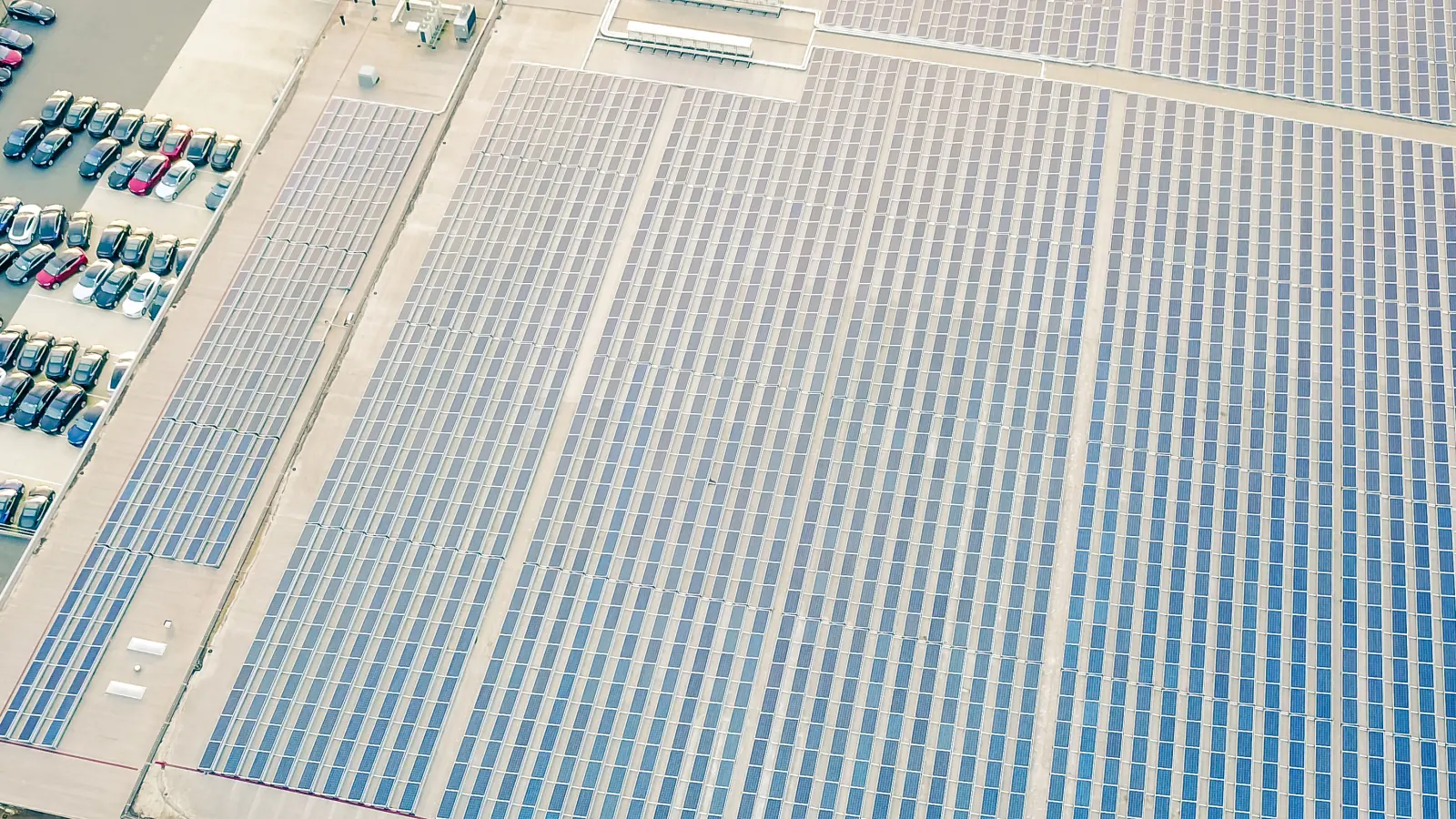

Car and parts plants run presses, welding robots, compressed air and paint shops, often across several shifts, and much of their heat still comes from gas. A solar plant on the halls and car parks covers part of the electricity, mostly in daylight on working days. It does not replace the gas in paint ovens. A battery can trim the short peaks that raise the bill.
In short
- Electricity was about 35% of the energy US car assembly plants used in 2022; most of the rest was gas, largely for heat.
- A solar plant on the halls and car parks covers part of the electricity, and a battery can trim short, costly peaks.
- Check each hall’s structure, a year of quarter-hour meter data, who keeps the plant’s certificates and what your customers ask you to report.
How does a car or parts plant use energy?
Electricity drives the lines: presses, welding robots, conveyors, compressed air, lighting and the fans that move and condition the air in the paint shop. In studies of assembly plants in the United States, Belgium, Sweden and Germany between 1989 and 2001, around 70% of the electricity went to motors, paint systems took from 27% to 50% of it and compressed air from 9% to 14%, according to a guide written by Lawrence Berkeley National Laboratory for the US Environmental Protection Agency’s ENERGY STAR programme (2008).
Heat is another matter. Fuels heat the paint lines’ curing ovens, condition the air in the paint booths and heat the halls, says the same guide. In US plants building cars and light trucks in 2022, electricity was about 35% of the energy used and natural gas about 52%; some 60% of that gas went to process heat, such as ovens, and a quarter to heating and ventilating the buildings, by our calculation from the US Energy Information Administration’s (EIA) survey of manufacturers. ACEA, the European carmakers’ association, notes that keeping paint hot can take up to 40% of gas demand (2022).
A solar plant covers electricity only. It does not replace the gas in ovens, booths or boilers: only heat that already runs on electricity, such as infrared paint curing where a line uses it, can take its output.
| Industry | Electricity | Natural gas |
|---|---|---|
| Cars and light trucks | 35% | 52% |
| Plastics and rubber products | 68% | 30% |
| Foundries | 39% | 49% |
| Fabricated metal products | 34% | 65% |
| All manufacturing | 17% | 45% |
Parts makers work across these and other industries, so the mix of electricity and heat varies widely from one parts plant to the next.
How much of the electricity can a plant on the halls cover?
Part of it, and only in daylight. In 2022, US plants building cars and light trucks used about 380 kWh of electricity a year for each square metre of floor space, by our calculation from the EIA survey. A square metre of modules produces about 230 to 340 kWh a year near Milan, Lisbon, Madrid or Fresno in California, by our calculation from PVGIS, the EU Joint Research Centre’s solar data tool (modules tilted at 10 degrees, facing south, 19% to 21% efficient).
So even modules over an area as large as all the floor space would produce about 60% to 90% of what such a plant uses in a year. In practice fewer fit, with skylights, ducts, stacks, shade and weak structures in the way; car parks and spare land can add more.
The solar plant produces every day, most of all around midday, and on working days a plant sized to the daytime load uses all of it. When production stops, the assembly plants in the ENERGY STAR guide still drew from 20% to as much as 50% of their working demand, which takes part of the weekend output; the rest flows to the grid, as the guide for factories explains.
Can the halls and car parks carry a solar plant?
Check each hall first. Modules and frames add about 15 kg for each square metre of module area, and 20 to 30 kg with ballast, according to a planning guide from the US National Renewable Energy Laboratory (NREL, 2009, our conversion from pounds per square foot). The guide adds that racks can increase the wind load significantly and that drifting snow can add many times the modules’ own weight. Have a structural engineer survey each hall, and check how many years its roofing has left, before the design is fixed.
Where a hall cannot take the load, use the car parks: canopies over staff and vehicle parking carry modules without touching the buildings, and shade the cars. Spare land can take a ground plant.
In the EU, the recast buildings directive asks member states to ensure suitable solar installations, where technically suitable and economically and functionally feasible, on new non-residential buildings over 250 m² by 31 December 2026; on existing ones over 500 m² from 31 December 2027, when they undergo a major renovation, or renovation, roof or building-system works that need a permit; and on new roofed car parks next to buildings by 31 December 2029 (Directive (EU) 2024/1275, article 10).
The same directive asks member states to ensure, by 1 January 2027, at least one charging point for every 10 parking spaces, or ducting for at least half of them, at non-residential buildings with more than 20 car parking spaces (article 14). Cars charging during the day shift use the plant’s output, and managed charging can keep them from adding to the peaks. Each country sets the details of both rules in its own law.
Can a battery cut what short peaks cost?
Often, where the bill charges for peaks. In the United States, demand charges are typically based on the highest average power drawn over a short interval, usually 15 minutes, in the billing period, and NREL notes that high demand charges are often cited as a critical factor in whether a battery pays (2017).
In Spain, a business pays for the power it contracts in each tariff period, and at sites with quarter-hourly metering every quarter hour above that power is billed as an excess (article 9 of CNMC Circular 3/2020). The guide to lowering contracted power, in Spanish, shows how a battery and a solar plant help.
Size the battery to how long the peaks last, not only to how high they go: trimming 500 kW for a quarter of an hour takes 125 kWh of stored energy, and for an hour 500 kWh, before losses. Cheaper steps come first: control when large machines start, as the ENERGY STAR guide describes, and fix compressed-air leaks.
The guide to battery storage for businesses in Spain works through when a battery pays and when it does not.
Why do carmakers ask suppliers about renewable power?
Because their climate targets reach into the supply chain. The guiding principles for suppliers released in June 2022 by two industry groups, the Automotive Industry Action Group (AIAG) and Drive Sustainability, say suppliers should set science-based, time-bound emission reduction goals and renewable energy objectives, and pass the principles on to their own suppliers. Drive Sustainability is also working on a common tool to collect emissions data from the supply chain.
A plant on your site gives a measured figure. Under the GHG Protocol’s Scope 2 Guidance (2015), power from an on-site plant or a power purchase agreement (PPA) counts in your market-based emissions figure only if its certificates go to you and no one else, so if a financing partner owns the plant, write into the contract who receives and retires them. The GHG Protocol consulted on revising these rules from October 2025 to January 2026: check which version your customers use.
What should you check before signing?
Settle these points before you commit:
- A year of consumption by the quarter hour or hour, shift by shift, and any plans for new lines, more shifts or heat moving to electricity.
- A structural survey of each hall, how many years its roofing has left, and a design your insurer has seen.
- The grid connection: how much the network can take, how long approval takes and whether exports are limited.
- How long your peaks last and what they cost, before you size a battery.
- Who receives the certificates for the plant’s power, and what your customers’ questionnaires ask for.
- How you pay. You can buy or lease the plant at any size. With a PPA, from 50 kWp (kilowatts peak, the plant’s rated power), a financing partner owns the plant and you pay for its power at a price per kWh set in the contract; that price starts below what you pay for grid power when you sign, and any yearly increase is written into the contract from the start. What is a PPA? explains it.
Tax rules differ by country: see tax benefits of a solar PPA, and confirm them with your tax adviser.
Your market
Rules on self-consumption, exports and grants are set by each country, and in the United States by each state. Read the page for your market:
- Spain: autoconsumo en automoción y componentes, in Spanish.
- Portugal: commercial solar in Portugal, with the rules, the registration and what surplus earns.
- United States: commercial solar in the United States, with prices, export rules and tax, state by state.
- Colombia: commercial solar in Colombia, with the self-generation rules, surplus credits and tax incentives.
- Prices across Europe: business electricity prices in the EU in 2026.
How Aeternus helps
Aeternus Power is an independent energy company. We originate, qualify, structure and finance energy projects, solar-led and with storage: we study a year of your consumption, your halls and your car parks, size the plant to your shifts and any battery to your peaks, and bring in a vetted builder and the financing partner. We never own the plants. A commission is paid by whoever builds or finances the project, never by you, and only when the project goes ahead.
We work with businesses in Spain, Portugal and Colombia today; in Spain and Portugal you can buy the plant, lease it or, from 50 kWp, take a PPA. Our office in California opens on 1 December 2026, and we cannot yet say which of these we will arrange there. For a first figure, use the preview on our business page, or tell us about your plant: we reply within two working days.
Questions
Can a car factory run on solar power?
Only in part. A plant on the halls and car parks covers some of the electricity, mostly in daylight on working days; night shifts and dark days still need the grid. It does not replace the natural gas for paint ovens and heating, which gave US car and light truck plants more energy than electricity did in 2022.
Can solar replace gas in a paint shop?
No. A solar plant produces electricity, and ovens, booths and boilers that burn gas keep burning it. Only heat that already runs on electricity, such as infrared paint curing, can use the plant’s output; converting gas-fired equipment is a separate investment and decision.
How do you reduce demand charges at a manufacturing plant?
Start with a year of quarter-hour or hourly meter data to see how high and how long the peaks are. Controlling when large machines start and fixing compressed-air leaks lower them, and a battery sized to their length can trim what is left. A solar plant alone helps less, because a peak can come when it is cloudy or dark.
Do car manufacturers require suppliers to use renewable energy?
The industry’s common guiding principles for suppliers, released by AIAG and Drive Sustainability, ask them to set renewable energy objectives and emission reduction goals. Individual carmakers may set firmer terms in their own contracts and questionnaires, so check what each customer asks for, and in what form.
Do I need charging points in my company car park?
In the EU, the recast buildings directive asks member states to ensure, by 1 January 2027, at least one charging point for every 10 parking spaces, or ducting for at least half of them, at non-residential buildings with more than 20 car parking spaces. Each country sets the details in its own law, so check yours.
Sources
- US Energy Information Administration: 2022 Manufacturing Energy Consumption Survey, tables 3.2, 5.1, 5.2 and 9.1 (August 2025 and March 2026): https://www.eia.gov/consumption/manufacturing/data/2022/
- EUR-Lex: Directive (EU) 2024/1275 on the energy performance of buildings (recast), articles 10 and 14 (24 April 2024): https://eur-lex.europa.eu/legal-content/EN/TXT/?uri=CELEX:32024L1275
- BOE: CNMC Circular 3/2020 on the method for electricity transmission and distribution tolls, consolidated text, article 9 (updated 5 February 2025): https://www.boe.es/buscar/act.php?id=BOE-A-2020-1066
- Lawrence Berkeley National Laboratory for the US Environmental Protection Agency: energy efficiency and cost saving opportunities for the vehicle assembly industry, an ENERGY STAR guide (March 2008): https://escholarship.org/uc/item/33x4p6p9
- US National Renewable Energy Laboratory: Solar Ready Buildings Planning Guide, NREL/TP-7A2-46078 (December 2009): https://www1.eere.energy.gov/femp/pdfs/46078.pdf
- NREL and Clean Energy Group: identifying potential markets for behind-the-meter battery storage, a survey of US demand charges (August 2017): https://www.osti.gov/biblio/1374803
- EU Joint Research Centre: PVGIS 5.3, yearly output of a solar plant (averages for 2005 to 2023): https://re.jrc.ec.europa.eu/pvg_tools/en/
- National Renewable Energy Laboratory: System Advisor Model help, PVWatts system design and module types: https://samrepo.nlr.gov/help/pvwatts_system_design.html
- GHG Protocol: Scope 2 Guidance (2015), quality criteria and public consultation of 20 October 2025 to 31 January 2026: https://ghgprotocol.org/scope-2-guidance
- AIAG and Drive Sustainability: Automotive Industry Guiding Principles to Enhance Sustainability Performance in the Supply Chain, version 4.0 (June 2022): https://www.drivesustainability.org/wp-content/uploads/2023/03/Automotive-Sustainability-Guiding-Principles-4.0v2-Final.pdf
- Drive Sustainability: carbon neutrality, corporate carbon accounting and product carbon footprint workstreams: https://www.drivesustainability.org/carbon-neutrality-2/
- ACEA: energy crisis, automakers’ plans to cut gas consumption (25 October 2022): https://www.acea.auto/news/energy-crisis-automakers-plans-to-cut-gas-consumption/
Latest
Europe’s power prices in early November 2026: from €184/MWh in Spain to €347/MWh in Ireland