Commercial solar in Brazil in 2026: how a business plant pays under Law 14.300
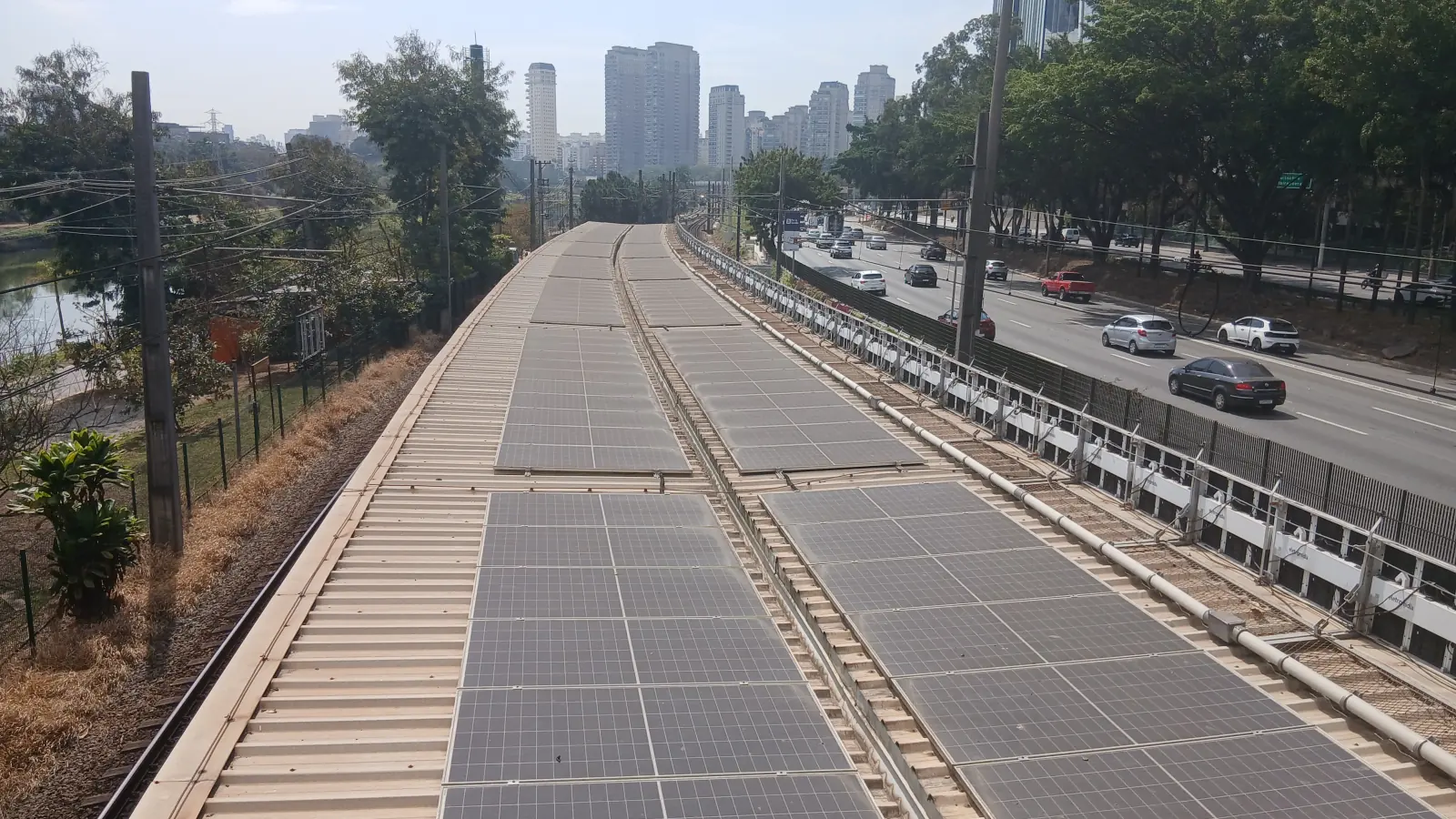

Under Law 14.300/2022, a business in Brazil can connect a solar plant of up to 3 MW at its site, or elsewhere in its distributor’s area, and offset its bills with energy credits that last 60 months. Plants that applied for connection after 7 January 2023 pay a share of the distributor’s network charge, called Fio B, on that energy: 60% in 2026, rising to 90% in 2028.
In short
- A solar plant of up to 3 MW, at the site or elsewhere in its distributor’s area, offsets the bills through credits lasting 60 months.
- New plants pay a share of the distributor’s network charge on offset energy: 60% in 2026, 90% in 2028, then rules ANEEL sets.
- Before signing, check your tariff group, the distributor’s connection opinion, your state’s ICMS treatment and who owns and insures the plant.
What counts as distributed generation in Brazil?
Law 14.300, signed on 6 January 2022 and published the next day, sets the rules for small plants that connect to a distributor’s grid through a consumer’s connection, which Brazil calls micro and mini distributed generation. Its updated text, as amended up to Law 15.269 of 24 November 2025, is the one in force as of 17 November 2026. The National Electric Energy Agency (ANEEL) applies it through Normative Resolution 1.059 of 7 February 2023, which moved the detailed rules into its general conditions of supply, Normative Resolution 1.000/2021.
A plant counts as microgeneration up to 75 kW of installed capacity in alternating current (AC), and as minigeneration above that: up to 3 MW for sources that cannot be dispatched on demand, such as solar, and up to 5 MW for dispatchable ones, such as hydro, biomass, biogas and qualified cogeneration. Solar with batteries able to dispatch at least 20% of the plant’s monthly output counts as dispatchable, but its limit stays at 3 MW. Splitting one plant into smaller ones to fit under a limit is not allowed (article 11).
Energy the plant sends to the grid is lent to the distributor free of charge and later offset against the consumption of the units in the compensation system (Sistema de Compensação de Energia Elétrica, SCEE). In 2024, distributed generation produced 5.6% of Brazil’s electricity and about 13% of the electricity used by customers who buy from their distributor, according to the Energy Research Company (EPE).
| Class | Installed capacity (AC) | Sources |
|---|---|---|
| Microgeneration | Up to 75 kW | Renewable sources and qualified cogeneration |
| Minigeneration, non-dispatchable | Over 75 kW, up to 3 MW | Sources that cannot be dispatched on demand, such as solar |
| Minigeneration, dispatchable | Over 75 kW, up to 5 MW | Hydro, biomass, biogas and qualified cogeneration; solar with enough batteries counts here but stays capped at 3 MW |
| Plants under the earlier rules | Up to 5 MW until 31 December 2045 | Plants that existed in January 2022 or applied for connection by 7 January 2023 |
How do energy credits work?
In each billing cycle the distributor measures, for each time band, the energy the unit with the plant used and the energy it sent to the grid. The surplus is set first against consumption in the same time band, then in the unit’s other bands; what remains becomes a credit for later months or goes to other units that the plant’s holder names (article 12).
Credits are counted in kWh, not in money, so tariff changes do not shrink them, and the oldest are used first. They expire 60 months after the bill in which they arose, and expired credits go towards lower tariffs for all consumers (article 13). The holder sets each receiving unit’s share or order of priority, and the distributor has up to 30 days to apply a change (articles 12 and 14).
Tariff flags, the monthly surcharges explained below, apply only to the energy billed after compensation, not to the energy the plant offsets (article 19). A business that buys its power in the free market cannot join the compensation system (article 9), a trade-off set out in Brazil’s free energy market. The credits can go to:
- Local self-consumption: the unit where the plant is installed.
- Remote self-consumption: other units of the same legal entity, head office and branches included, served by the same distributor.
- Multi-unit developments: units on the same property or on adjoining ones, where the common areas to which the plant connects form a separate unit.
- Shared generation: businesses or people who join through a consortium, cooperative, condominium or other civil association set up for the purpose, all served by the same distributor.
What do new plants pay for the distribution network?
Plants that already existed when the law was published, or whose holders applied to the distributor within 12 months, by 7 January 2023, keep the earlier rules until 31 December 2045: every tariff component is charged only on the energy used beyond what the plant injected and the credits drawn (article 26).
All other plants pay, on all the energy they offset, a rising share of the tariff components that pay for the distributor’s own service: the return on its assets, their depreciation, and operation and maintenance (article 27). The Ministry of Mines and Energy (MME) calls this part of the network tariff (TUSD) Fio B. The share is 60% in 2026, 75% in 2027 and 90% in 2028.
Two groups differ. Until 2028, a non-dispatchable plant over 500 kW in remote self-consumption, or in shared generation where one holder takes 25% or more of the surplus, pays 100% of Fio B, 40% of the components for transmission and other networks (Fio A) and all of three sector charges (research and development, energy efficiency, and ANEEL’s inspection fee) on the energy it offsets. Plants that applied in the 13th to 18th month after the law’s publication move to the new rules in 2031 instead of 2029 (article 27).
Under the new rules of article 17, plants are billed for all the tariff components not tied to the cost of energy on the energy they draw from the grid, minus the benefits they bring to the system. The National Council for Energy Policy (CNPE) set the guidelines for valuing those benefits in Resolution 2 of 22 April 2024, and ANEEL calculates them; its consultation on how to apply article 17 took contributions until 4 March 2026. EPE noted in 2025 that the rule for energy injected from 2029 was still uncertain, so a study for a new plant should test more than one outcome after 2028.
| Year | Share of Fio B |
|---|---|
| 2023 | 15% |
| 2024 | 30% |
| 2025 | 45% |
| 2026 | 60% |
| 2027 | 75% |
| 2028 | 90% |
| 2029 onwards | The rule of article 17, with values set by ANEEL |
As of 17 November 2026. Plants under the earlier rules keep them until 31 December 2045.
How are business electricity tariffs set in Brazil?
Distributors bill businesses in two groups. Group A covers sites connected at high or medium voltage, and its tariffs have a price for energy and a price for power demand: under the blue option both vary by time of day, and under the green option, available at medium voltage and on underground networks, energy varies by time of day and demand has one price. Group B covers low-voltage sites, which pay one price per kWh or can choose the white tariff, priced by time of day.
With a plant in the compensation system, ANEEL explains the effect. In Group A, the energy part of the bill can fall to zero in a month when the plant injects at least as much as the site uses, but the contracted demand is billed as normal. In Group B, the bill does not fall below the cost of availability, the price of 30, 50 or 100 kWh for single-phase, two-phase or three-phase connections, even when the plant injects more than the site uses.
Each month ANEEL also sets a tariff flag for customers who buy from their distributor. Green adds nothing; yellow adds R$ 0.01885 per kWh, red level 1 adds R$ 0.04463 and red level 2 adds R$ 0.07877. The flag was green in November 2026, as in October.
In May 2026, the average tariff on billed consumption was R$ 885.15 per MWh (about R$ 0.89 per kWh, our conversion) for commercial customers and R$ 840.76 per MWh for industrial ones across Brazil, according to ANEEL data published by the MME. Taxes come on top on the bill: PIS/COFINS, ICMS and the municipal public lighting contribution, says ANEEL.
| Region | Commerce, services and others | Industry |
|---|---|---|
| Southeast | 964.04 | 951.49 |
| North | 893.97 | 869.30 |
| Brazil | 885.15 | 840.76 |
| Centre-West | 872.08 | 914.12 |
| Northeast | 817.28 | 773.65 |
| South | 734.49 | 720.19 |
Averages for one month across all tariffs in each class, not your price: work from your own bills. ANEEL consulted until 8 September 2026 on replacing the low-voltage minimum with a flat monthly charge; for plants in the compensation system, it proposes applying it only after the transition of Law 14.300.
What taxes apply to the energy a plant offsets?
Two federal contributions, PIS and COFINS, have a zero rate on the energy the distributor supplies in an amount equal to what the unit injected plus the credits it used, from the same unit or another of the same holder (Law 13.169/2015, article 8).
ICMS is the state tax on electricity. CONFAZ Agreement ICMS 16/2015, between the states, authorises them to exempt from ICMS the electricity billed under the compensation system, so the treatment depends on your state’s own rules.
The tax reform replaces these taxes over the coming years. The federal contribution on goods and services (CBS) is charged in full from 2027, when PIS and COFINS end, and ICMS is reduced between 2029 and 2032 and replaced by the tax on goods and services (IBS) in 2033, says the Ministry of Finance. Complementary Law 214/2025 keeps offset energy out of the base of both new taxes for plants up to 1 MW, and only for the energy itself: not for the cost of availability, reactive energy, demand, network charges or other components not tied to the cost of energy (article 28).
A summary as of 17 November 2026, not tax advice. Confirm the treatment of your own plant with your accountant (contador).
How can a business pay for a plant in Brazil?
Only consumers who qualify for the free market may choose who sells them electricity; the others buy it from their distributor at the regulated tariff. That shapes the ways to pay. The plant can be the same in each case; what changes is who owns it, what you pay and how the saving reaches you.
If you buy, your business owns the plant and pays for it from its own funds or a loan, and the energy it injects comes back as credits. If you lease (locação), a company owns the equipment and you pay a set rent. The law bars a distributor from including in the compensation system a consumer who rents the land or property for the plant at a price per unit of energy (article 10).
In shared generation, you join a consortium or cooperative that holds a plant elsewhere in your distributor’s area and receive part of its credits on your bill. In remote self-consumption, your company holds a plant at another of its sites in the same area and sends the credits to its own units.
A power purchase agreement (PPA), in which you pay for each MWh a plant produces at a price set in the contract, is a free-market contract in Brazil: a Group A business that has moved to the free market can sign one with a solar or wind plant, but then cannot use the compensation system. The same applies to a plant on your own site owned by another company: selling you its output by the MWh needs the free market. For a business that buys from its distributor, the closest arrangement is a lease at a set rent, with the plant in the compensation system. Brazil’s free energy market explains the move, and what is a PPA? how such contracts work.
| What differs | Buy | Lease (locação) | Shared generation | Free-market PPA |
|---|---|---|---|---|
| Who owns the plant | Your business | The leasing company | As the consortium or cooperative sets it | The generator or its financing partners |
| What you pay | The plant and its upkeep | A set rent | Your share, on the consortium’s or cooperative’s terms | Each MWh at the contract price, plus network charges to your distributor |
| How the saving reaches you | Credits on your distributor’s bill | Credits on your distributor’s bill | Credits on your distributor’s bill | The contract price replaces the regulated energy tariff |
| Compensation system | Yes | Yes | Yes | Not available to free-market consumers |
| Who can use it | Any consumer | Any consumer | Members served by the same distributor | Group A today; low-voltage industry and commerce from 25 November 2027 |
Review the tax and accounting treatment of each option with your contador, and the contract with a Brazilian lawyer, before you sign. That only the free market allows buying a plant’s output by the MWh is our reading of Law 14.300 (articles 9 and 10) and of the rules on who may sell electricity.
What should you check before signing?
Before you sign with a builder, a leasing company or a consortium, ask for these points in writing:
- The distributor’s connection opinion (parecer de acesso): what grid works it requires, who pays and by when. The distributor pays in full for grid reinforcements needed solely to connect microgeneration; for minigeneration, it calculates its share and yours (article 8). Access opinions may not be sold (article 6).
- For minigeneration over 500 kW, the performance guarantee the law requires: 2.5% of the investment below 1,000 kW and 5% from 1,000 kW, unless the plant is in shared generation through a consortium or cooperative or serves a multi-unit development (article 4).
- Who owns, insures and maintains the plant, and who is the holder named in the access opinion: the holder and its control cannot change until the inspection of the connection is requested (article 5).
- The price and any yearly increase, written into the contract from the start, the term, and what happens to the plant at the end.
- Which units receive the credits, and what happens if the business moves: credits stay in the holder’s name for 60 months after the contract with the distributor ends, and can be moved to another unit of the same holder served by the same distributor (article 13).
- If the site already has a plant under the earlier rules, whether they still apply: they pass to a new holder of the unit, but end if the contract with the distributor is terminated, and do not cover capacity added later (article 26).
- How much of a Group A bill is demand, which the plant does not offset, and whether your site may choose low-voltage billing: a Group A unit with local generation whose transformers add up to no more than one and a half times the low-voltage connection limit may (article 11).
- Your state’s ICMS treatment and the tax position of each way to pay, with your contador.
How Aeternus helps
Aeternus Power is an independent energy company based in Madrid. We originate, qualify, structure and finance energy projects, solar-led and with storage, and bring in the builders and financing partners for each one. We never own the plants. A commission is paid by whoever builds or finances the project, never by you, and only if the project goes ahead.
We do not work in Brazil today. Our markets are Spain, Portugal and Colombia (commercial solar in Colombia); our office in California opens on 1 December 2026, Türkiye is launching, and talks are under way in Serbia and Croatia. If you are planning a project in Brazil, tell us about it and we will say within two working days whether we can help. How we work with businesses is on our business page.
Questions
Is commercial solar still worth it in Brazil after Law 14.300?
It depends on your tariff, how much of the output your site uses and when your plant applied for connection. New plants pay 60% of Fio B on offset energy in 2026, rising to 90% in 2028, and from 2029 they move to rules whose values ANEEL sets under article 17. Ask for a study built on your own bills that tests more than one outcome after 2028.
What is Fio B in Brazil?
Fio B is the part of the network tariff (TUSD) that pays for the distributor’s own service, as the Ministry of Mines and Energy defines it. Under Law 14.300, plants that applied for connection after 7 January 2023 pay a share of it on the energy they offset: 60% in 2026, 75% in 2027 and 90% in 2028.
How long do solar energy credits last in Brazil?
Credits expire 60 months after the bill in which they arose, and expired credits go towards lower tariffs for all consumers. They are counted in kWh, so tariff changes do not reduce them, and the oldest are used first.
Can a company use solar credits at another branch in Brazil?
Yes, through remote self-consumption, if the units belong to the same legal entity, head office and branches included, and are served by the same distributor. The plant’s holder sets the share or order of priority for each unit, and the distributor has up to 30 days to apply a change.
What is the maximum size of a distributed solar plant in Brazil?
3 MW of installed capacity in alternating current, for solar with or without batteries. Dispatchable sources such as hydro or biomass may reach 5 MW, and plants under the earlier rules keep a 5 MW limit until 31 December 2045.
Do tariff flags apply to solar credits in Brazil?
No. Under Law 14.300, flags apply only to the energy billed after compensation, not to the energy the plant offsets. In November 2026 the flag was green, so it added nothing.
Sources
- Câmara dos Deputados: Law 14.300 of 6 January 2022, legal framework for micro and minigeneration, updated text with amendments up to Law 15.269 of 24 November 2025: https://www2.camara.leg.br/legin/fed/lei/2022/lei-14300-6-janeiro-2022-792217-normaatualizada-pl.html
- ANEEL: Micro e minigeração distribuída, rules, modalities and billing in Group A and Group B (updated 9 June 2026): https://www.gov.br/aneel/pt-br/assuntos/geracao-distribuida
- ANEEL: Modalidades tarifárias, tariff options for Group A and Group B: https://www.gov.br/aneel/pt-br/assuntos/tarifas/entenda-a-tarifa/modalidades-tarifarias
- ANEEL: Bandeiras tarifárias, what each flag adds per kWh (updated 12 November 2026): https://www.gov.br/aneel/pt-br/assuntos/tarifas/bandeiras-tarifarias
- ANEEL: green flag for November 2026 (30 October 2026): https://www.gov.br/aneel/pt-br/assuntos/noticias/2026/aneel-anuncia-bandeira-verde-para-vigorar-em-novembro
- ANEEL: Custo da energia que chega aos consumidores, what the tariff covers and the taxes on the bill: https://www.gov.br/aneel/pt-br/assuntos/tarifas/entenda-a-tarifa/custo-da-energia-que-chega-aos-consumidores
- MME: Informativo Tarifário do Setor Elétrico, first half of 2026, average tariffs by class and region (May 2026) and glossary: https://www.gov.br/mme/pt-br/assuntos/secretarias/secretaria-nacional-energia-eletrica/informativo-tarifario-do-setor-eletrico/informativo-tarifario-do-setor-eletrico-semestral-ano-2026.pdf
- CNPE: Resolution 2 of 22 April 2024, guidelines for valuing the costs and benefits of distributed generation (Diário Oficial, 7 May 2024): https://www.gov.br/mme/pt-br/assuntos/conselhos-e-comites/cnpe/resolucoes-do-cnpe/2024/Res_2_2024publicada.pdf
- ANEEL: consultation on valuing distributed generation and applying article 17 of Law 14.300, open until 4 March 2026 (4 December 2025): https://www.gov.br/aneel/pt-br/assuntos/noticias/2025/aneel-abre-tomada-de-subsidios-sobre-experiencias-internacionais-em-valoracao-de-custos-e-beneficios-de-mmgd
- ANEEL: proposal to change the cost of availability, Public Consultation 16/2026 (2 June 2026): https://www.gov.br/aneel/pt-br/assuntos/noticias/2026/aneel-propoe-mudar-cobranca-pelo-custo-de-disponibilidade
- EPE: PDE 2035, Micro e Minigeração Distribuída e Baterias Atrás do Medidor (July 2025): https://www.epe.gov.br/sites-pt/publicacoes-dados-abertos/publicacoes/PublicacoesArquivos/publicacao-894/Caderno_MMGD_Baterias_2035_v2025.07.31.pdf
- Câmara dos Deputados: Law 13.169 of 6 October 2015, article 8, PIS/COFINS on compensated energy (updated text): https://www2.camara.leg.br/legin/fed/lei/2015/lei-13169-6-outubro-2015-781720-normaatualizada-pl.html
- Secretaria de Estado de Fazenda de Minas Gerais: CONFAZ acts of 2015, including Agreement ICMS 16/2015 on the compensation system: https://www.fazenda.mg.gov.br/empresas/legislacao_tributaria/atos_confaz/atos_confaz_ano_2015.html
- Câmara dos Deputados: Complementary Law 214 of 16 January 2025, article 28, CBS and IBS on compensated energy (updated text): https://www2.camara.leg.br/legin/fed/leicom/2025/leicomplementar-214-16-janeiro-2025-796905-normaatualizada-pl.html
- Ministério da Fazenda: tax reform timetable for CBS and IBS (9 October 2026, updated 26 October 2026): https://www.gov.br/fazenda/pt-br/assuntos/noticias/2026/outubro/reforma-tributaria-86-dos-documentos-fiscais-de-empresas-obrigadas-ja-trazem-destaque-da-cbs
- Ministério da Fazenda: tax reform questions and answers, which taxes CBS and IBS replace (August 2023): https://www.gov.br/fazenda/pt-br/acesso-a-informacao/acoes-e-programas/reforma-tributaria/arquivos/perguntas-e-respostas-reforma-tributaria_.pdf
Latest
Europe’s power prices in early November 2026: from €184/MWh in Spain to €347/MWh in Ireland