Commercial solar in Colombia in 2026: self-generation rules, surplus power, tax incentives and how to pay
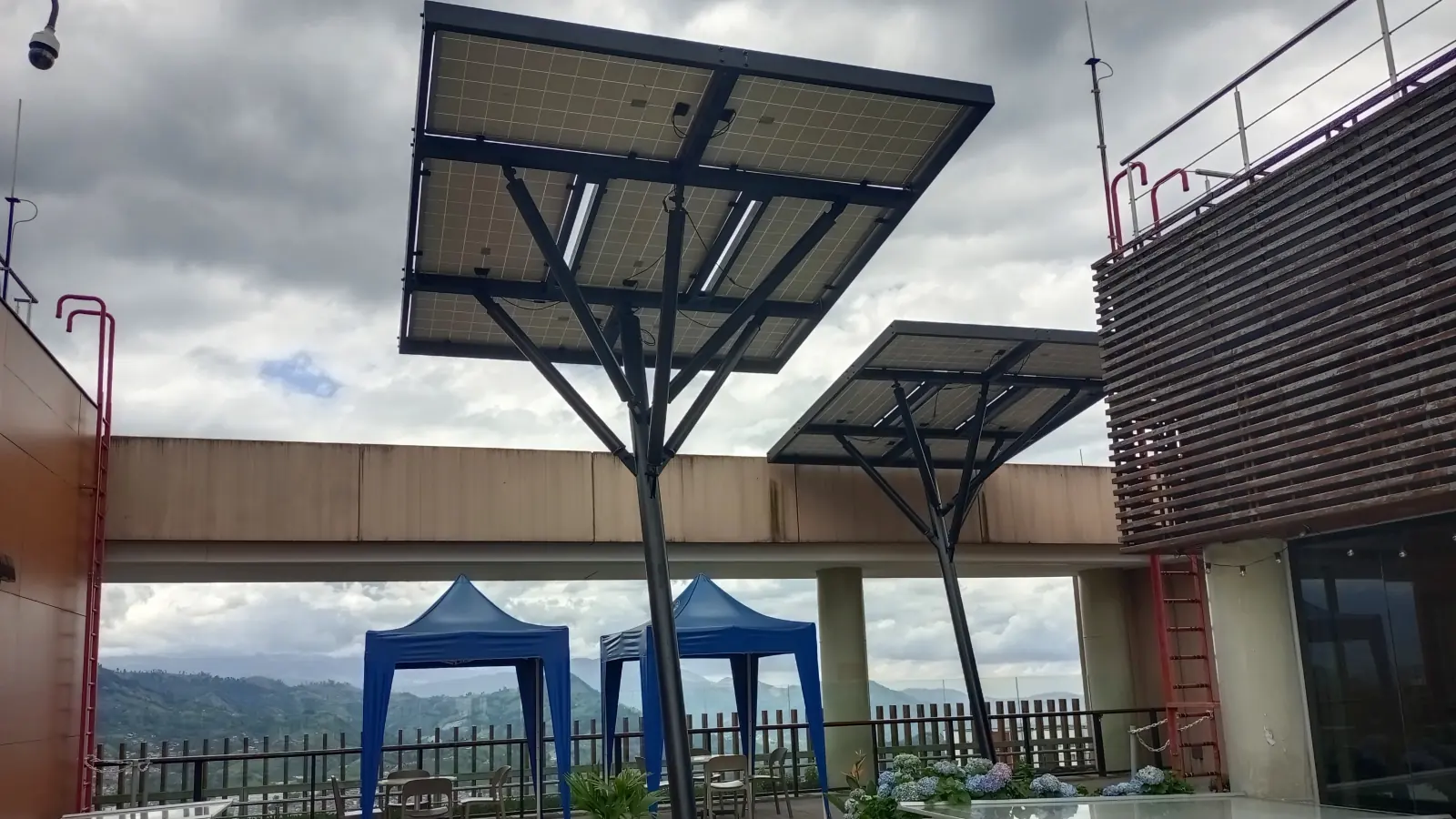

In Colombia a business can produce its own electricity with a solar plant on its site as a self-generator. Up to 1 MW it is small scale (AGPE), and unused power earns energy credits on its bill or is sold. If the Mining and Energy Planning Unit (UPME) certifies the investment, it can be deducted from income tax and the equipment can be free of VAT and import duty.
In short
- A business can self-generate with a solar plant on its site; up to 1 MW, connection is simplified and surplus power earns credits.
- With a UPME certificate, the investment can be deducted from income tax, bought free of VAT and duty, and depreciated faster.
- Before signing, check grid capacity, how surplus is paid, who owns the plant and what happens if your business moves.
What is self-generation, and when is it small or large scale?
Colombia's Law 1715 of 2014 defines self-generation (autogeneración) as producing electricity mainly to meet your own needs. Any surplus can go to the grid on terms set by the Energy and Gas Regulation Commission (CREG), the sector's regulator. Power your site takes from its own plant does not travel over the distribution grid.
For the CREG, the self-generator is the electricity user, whether or not it owns the equipment (CREG Resolution 174 of 2021, article 3). Size sets the rules. Up to 1 MW of installed capacity, the limit set by the UPME, a government agency, a business is a small-scale self-generator (AGPE); above it, a large-scale self-generator (AGGE). For a solar plant, what counts is the inverters' combined AC rating, not the modules'.
CREG Resolution 174 of 2021 governs how AGPEs connect and how their surplus is paid. It also sets the connection procedure for AGGEs with a declared maximum power below 5 MW, and for self-generators of any size that send no power to the grid. An AGGE that wants to sell surplus must be represented by a generator in the wholesale market and sign a backup contract with its network operator (CREG Resolution 024 of 2015).
The CREG has amended Resolution 174 several times, most recently in June 2026 to bring in batteries (CREG Resolution 101 113 of 2026). This guide follows the text in force on 17 November 2026.
How does the plant connect to the grid?
Connection is approved by the network operator (operador de red, OR), the company that plans, runs and maintains the distribution grid in your area. If the plant will send power to the grid at voltage level 1, the lowest on the distribution grid, first check the availability map on the OR's website: it must be free to use and show in colours how much capacity is left at each transformer. Plants that send no surplus to the grid are not bound by these limits.
You apply online, through the OR's system or, once it is available, through a single window run by an entity the Ministry of Mines and Energy designates, and the application is free. The OR may not ask for anything beyond what the rules require, and its deadlines are short: 2 to 5 working days to check that the file is complete and 3 to 10 for the technical review, depending on size and voltage level.
If the plant exports power and is larger than 100 kW, a simplified connection study is also needed: the applicant has five months to submit it and the OR 20 working days to review it. If the grid needs reinforcing, the applicant pays. Once the connection is approved, an AGPE has six months to connect, which it can extend by three months at no cost. The usual documents are:
- The simplified connection form designed by the National Operation Council (CNO).
- A certificate of at least one year of experience for whoever installs the plant, or of training for their staff, in that type of installation.
- Certificates for the inverters, the single-line diagram and the protection scheme, as the Technical Regulation for Electrical Installations (RETIE) requires.
- If the plant sends no power to the grid, the manual for the device that prevents export.
- If there are batteries, their test information. Batteries do not increase the capacity applied for, which depends on the generating plant (CREG Resolution 174 of 2021, article 14, as amended by CREG Resolution 101 113 of 2026).
If the OR misses its deadlines, the rules tell the applicant to report it to the Superintendency of Residential Public Utilities (Superintendencia de Servicios Públicos Domiciliarios).
What happens to the power your site does not use?
Each kWh the plant produces while your site is using power cuts the power you buy. Whatever is left over at that moment goes to the grid as surplus (excedentes). An AGPE using renewable sources can deliver its surplus to the retailer (comercializador) that sells it power, which must accept it, or sell it at a freely agreed price to a generator or retailer that supplies non-regulated users, the customers who agree the cost of service with their retailer.
With your retailer, the account is settled at the end of each billing period. Surplus up to the amount of power your site took from the grid in that period becomes energy credits (créditos de energía), swapped kWh for kWh against the power you bought. For each credited kWh, the retailer charges part of the tariff, depending on the plant's size, as the table shows.
Surplus above the power taken from the grid is paid at a market price. CREG Resolution 101 072 of 2025 changed that price from the spot price (precio de bolsa) to MCm, the average cost of the contracts that supply regulated customers. But, as the CREG confirmed in April 2026, MCm does not apply yet: the spot price is still paid until the commission sets out how that purchase cost passes into tariffs.
So it usually pays to size the plant so that your site uses almost all of its output: a kWh used on site saves its full variable cost, while a kWh exported is worth less.
| Installed capacity | Surplus up to the power taken from the grid | Surplus above that amount |
|---|---|---|
| Up to 100 kW | Energy credit, kWh for kWh. The retailer charges only its retail margin (Cv) on each credited kWh | Spot price, until the CREG applies MCm |
| Over 100 kW and up to 1 MW | Energy credit, kWh for kWh. The retailer charges transmission, distribution, retail, losses and restrictions on each credited kWh, so in practice the credit saves the energy purchase component (G) | Spot price, until the CREG applies MCm |
On 9 November 2026 the CREG published for comment a draft resolution (701 160 of 2026) that, to soften the effects of El Niño, would give new AGPEs of 0.1 to 1 MW the same credit as plants of up to 100 kW for 24 or 12 months, if they start operating within 36 months. As of 17 November 2026 it is only a draft.
What tax incentives does Law 1715 offer, and who certifies them?
Law 1715 of 2014, as amended by Law 2099 of 2021, offers four incentives to those who invest in generation from non-conventional energy sources such as solar. None is automatic: each requires the UPME to assess and certify the investment, and the tax and customs authority (DIAN) can later check that the conditions are met.
The certificate is requested through the UPME's online application between 1 February and 15 December each year. Once the application is complete, the UPME has up to 30 working days to decide, and it certifies only goods and services on its list, so a turnkey contract must be broken down item by item. The fee ranges from 1.2 to 275 tax value units (UVT), depending on the investment, and the certificate does not expire (UPME Resolution 563 of 2026, in force since 7 August 2026). Above 1 MW, the project must also, with some exceptions, be on the UPME's register of generation projects.
The list includes batteries and battery storage systems when they complement the generating project. If the certificate arrives after the equipment is bought or imported, the VAT paid can be reclaimed. A business that keeps accounts can take the deduction and accelerated depreciation together.
The benefits come with conditions: if the business sells the assets before they are fully depreciated, it must add back what it deducted as recovered income. The incentives apply for 30 years from 1 July 2021.
| Incentive | What it allows | Main conditions |
|---|---|---|
| Income tax deduction | Deduct 50% of the investment over up to 15 years, starting the tax year after the plant starts operating | For taxpayers who invest directly; each year, at most 50% of their taxable income (renta líquida) |
| VAT exclusion | Buy equipment, machinery and services, Colombian or imported, without VAT | Only goods and services on the UPME's list that appear in the certificate |
| Import duty exemption | Import machinery, equipment, materials and inputs free of customs duty | Only items not produced in Colombia; request it at least 15 working days before importing, with a prior licence through the Foreign Trade Single Window (VUCE) |
| Accelerated depreciation | Depreciate machinery, equipment and civil works at up to 33.33% a year | The rate can change each year, after notifying the DIAN |
A summary as of 17 November 2026, not tax advice. Check with your accountant (contador or revisor fiscal) whether your investment and your situation qualify for each incentive.
What are energy communities, and can a business join one?
Yes. Energy communities are regulated by Decree 2236 of 2023, in force and now part of Decree 1073 of 2015, which develops article 235 of Law 2294 of 2023, the National Development Plan for 2022 to 2026. They are agreements between individuals or companies, public or private, that cooperate through a contract or partnership agreement to generate, sell and use energy from renewable sources efficiently. They can self-generate collectively, mainly for their own use, or run collective distributed generation.
To receive the benefits set out for them, a community must register in the Ministry of Mines and Energy's Register of Energy Communities. CREG Resolution 101 072 of 2025 sets how its members connect and how its surplus is shared and paid. The UPME caps a community at under 5 MW, with the plant and all members in the same retail market and on the same local distribution grid (UPME Resolution 501 of 2024).
For a business, a community can be a way to share a plant with other businesses or neighbours in the same area. Public funding for energy communities is aimed at those formed by individuals or by the self-government structures of Indigenous, peasant, Black, Afro-Colombian, Raizal and Palenquero peoples and communities, according to targeting criteria set by the Ministry of Mines and Energy.
What do businesses pay for electricity in Colombia?
A business on the regulated market pays the unit cost of service (costo unitario, CU). CREG Resolution 119 of 2007 builds it as a per-kWh sum of energy purchases (G), transmission (T), distribution (D), retail (Cv), losses (PR) and restrictions (R), plus a fixed charge per bill. Your retailer publishes its tariffs, with the value of each component, before applying them and whenever it adjusts them.
A commercial user also pays a contribution of 20% of the cost of service; industrial users, as the government defines them, have not paid it since 2012 (Tax Statute, article 211). Every kWh the plant saves also avoids that contribution.
The G component reflects what your retailer pays for energy under long-term contracts and, for whatever contracts do not cover, on the spot market (article 6 of the same resolution). The spot price is published by XM, which runs the national grid and administers the wholesale market, and it has soared since May 2026: in October it averaged 600.65 COP/kWh, against 170.90 COP/kWh in October 2025, and from January to October 492.34 against 238.47 COP/kWh (our calculation from XM's hourly prices).
When it proposed a temporary incentive for self-generation on 9 November 2026, the CREG cited El Niño and lower water inflows to the power system. The spot price matters to a plant in two ways: it feeds into the G component of retailers that buy part of their power on the spot market, and it is currently the price paid for surplus above the credit.
| Month | 2026 (COP/kWh) | 2025 (COP/kWh) | Change |
|---|---|---|---|
| January | 212.39 | 519.66 | -59.1% |
| February | 124.42 | 428.73 | -71.0% |
| March | 220.20 | 228.48 | -3.6% |
| April | 269.01 | 140.63 | +91.3% |
| May | 504.99 | 126.70 | +298.6% |
| June | 546.31 | 112.51 | +385.6% |
| July | 789.80 | 134.93 | +485.3% |
| August | 943.55 | 241.39 | +290.9% |
| September | 676.95 | 293.74 | +130.5% |
| October | 600.65 | 170.90 | +251.5% |
These are wholesale prices, not tariffs: what your business pays depends on its retailer, its voltage level and its contract.
How can a business pay for the plant?
The plant can be the same whichever way you pay. What changes is who owns it, who claims the incentives and who carries the risk if it produces less than expected.
If you buy, your business pays for the plant from its own funds or a loan, owns it and, if the UPME certifies the investment, claims the Law 1715 incentives.
With financial leasing (leasing financiero), a financial company acquires the plant and your business pays for it in instalments. The income tax deduction also applies if the contract has an irrevocable purchase option: it starts the year after signing, provided your business exercises the option at the end; if it does not, it must declare what it deducted as income. It does not apply to sale and leaseback or to arrangements in which ownership does not pass at the end (Decree 1625 of 2016, article 1.2.1.18.72).
With a power purchase agreement (PPA) or a rental agreement, a third party owns the plant on your site, maintains it and charges you for the power or a set fee. The CREG has explained that you remain the self-generator even if you do not own the equipment, and that your relationship with whoever supplies it is bilateral, governed by civil and commercial law and outside its regulation. But it also warns that sales of power to a user by a third party that is not a retailer are not regulated, and that such contracts must respect Laws 142 and 143 of 1994 on who may sell electricity (CREG concept 4230 of 2021). So have a lawyer review how the contract is structured.
Under a PPA, the Law 1715 incentives belong to whoever makes the investment directly, normally the plant's owner. How PPAs work, their types and how their price is set is explained in what is a PPA?.
| What differs | Buy | Financial leasing | PPA or rental |
|---|---|---|---|
| Who owns the plant | Your business | The financial company, until your business exercises the purchase option | The third party that finances it |
| What your business pays | The plant and its upkeep | The lease instalments | Each kWh at the contract price, or a rental fee |
| Law 1715 income tax deduction | Yours, with the UPME certificate | Yours, if you exercise the irrevocable purchase option | Whoever makes the investment |
| Surplus sent to the grid | Your business delivers it as the self-generator | Your business delivers it as the self-generator | Your business delivers it as the self-generator, even if it does not own the plant |
Review the accounting and tax treatment of each option with your accountant, and the contract with a lawyer, before you sign.
What should you check before signing?
Before you sign with whoever builds or finances the plant, get these points in writing:
- Connection: whether the network operator's map shows capacity, who files the application, whether a connection study is needed and who pays for any grid reinforcement.
- Surplus: who receives it, how it is settled and what happens if the CREG changes the price paid for it.
- Ownership and insurance: who owns the plant, who insures it against damage and who is liable if it damages the building.
- Price: under a PPA, the price per kWh set in the contract and any yearly increase written into the contract from the start; when buying or leasing, what maintenance includes and for how long.
- Term and end: how many years the contract runs and your options at the end, such as buying the plant, renewing or having it removed.
- If your business moves or sells the site: whether the contract can pass to the next occupant, what ending it early costs and whether the plant can be moved. If your business owns the plant and sells it before it is fully depreciated, it must give back the income tax benefits it took.
- Incentives: who requests the UPME certificate and when, because the import duty exemption must be requested before importing.
How Aeternus helps
Aeternus Power is an independent energy company based in Madrid, and we work in Colombia. We study your site and a year of its consumption, work out what a plant can produce and the best way to pay for it, bring in a vetted builder and the financing partner, and oversee the work until the plant is switched on.
We never own the plants. A commission is paid by whoever builds or finances the project, never by you, and only if the project goes ahead. To start, send us a bill or tell us about your project: we reply within two working days. How we work with businesses is on our business page.
Questions
How much are you paid for surplus solar power in Colombia?
Up to the amount of power your site took from the grid in the month, surplus becomes energy credits swapped kWh for kWh, with a charge that depends on the plant's size. Anything above that is currently paid at the spot price, which averaged 600.65 COP/kWh in October 2026 (our calculation from XM data). The CREG plans to replace it with MCm once it sets out how that cost passes into tariffs.
How much can a business deduct from income tax for a solar investment in Colombia?
50% of the investment, spread over up to 15 years from the year after the plant starts operating, and each year no more than 50% of taxable income. It requires the UPME certificate and investing directly or through financial leasing with an irrevocable purchase option. Confirm your case with your accountant.
How long does the UPME take to issue the tax incentive certificate?
Up to 30 working days from when the application is complete in its online system; if it asks for clarification, the clock stops until you reply. Applications are accepted from 1 February to 15 December each year. It is best to apply before buying or importing the equipment.
Do I have to own the solar plant to be a self-generator?
No. The CREG defines the self-generator as the user carrying out the activity, whether or not it owns the equipment. Your relationship with whoever supplies the plant is a private contract, so have a lawyer review how it is structured.
Do batteries qualify for tax incentives in Colombia?
They can. The UPME's list of eligible goods includes batteries and battery storage systems when they complement a generation project using non-conventional sources. Like the rest of the equipment, they need the UPME certificate.
How long does the network operator take to approve a solar plant's connection?
For an AGPE, the operator has 2 to 5 working days to check that the file is complete and 3 to 10 for the technical review, and 20 working days to review a connection study where one is needed. Once approved, the connection is valid for six months, extendable by three.
Sources
- Secretaría del Senado: Ley 1715 de 2014, current text with the amendments of Ley 2099 de 2021 (articles 5, 8, 11 to 14 and 14-1): http://www.secretariasenado.gov.co/senado/basedoc/ley_1715_2014.html
- Secretaría del Senado: Ley 2099 de 2021, the energy transition law (article 43, UPME certificates for tax benefits): http://www.secretariasenado.gov.co/senado/basedoc/ley_2099_2021.html
- DIAN, Normograma: Decreto 1625 de 2016, the single tax regulation, articles 1.2.1.18.71 to 1.2.1.18.77, 1.3.1.12.24 and 1.3.1.12.25 as worded by Decreto 895 de 2022: https://normograma.dian.gov.co/dian/compilacion/docs/decreto_1625_2016.htm
- UPME: Resolución 563 de 2026 (5 August 2026), requirements, procedure and fees for the Law 1715 tax incentive certificate (CREG legal database): https://gestornormativo.creg.gov.co/gestor/entorno/docs/resolucion_upme_0563_2026.htm
- UPME: Resolución 563 de 2026, annex 1, list of goods for non-conventional energy projects (Diario Oficial 53.579, 6 August 2026): https://normograma.com/documentospdf/PDF/R_UPME_0563_2026_ANEXO.pdf
- CREG: Resolución 174 de 2021, small-scale self-generation and distributed generation, consolidated text with amendments up to Resolución 101 113 de 2026: https://gestornormativo.creg.gov.co/gestor/entorno/docs/resolucion_creg_0174_2021.htm
- CREG: Resolución 101 072 de 2025, energy communities and changes to how AGPE surplus is credited: https://gestornormativo.creg.gov.co/gestor/entorno/docs/resolucion_creg_101-72_2025.htm
- CREG: Concepto 3018 de 2026 (6 April 2026), spot price and MC for an AGPE's surplus: https://gestornormativo.creg.gov.co/gestor/entorno/docs/concepto_creg_0003018_2026.htm
- CREG: draft resolution 701 160 de 2026, temporary El Niño incentive for small-scale and collective self-generation (published 9 November 2026): https://gestornormativo.creg.gov.co/gestor/entorno/docs/originales/Proyecto_Resoluci%F3n_CREG_701_160_2026/index.htm
- CREG: Resolución 024 de 2015, large-scale self-generation on the national grid: https://gestornormativo.creg.gov.co/gestor/entorno/docs/resolucion_creg_0024_2015.htm
- CREG: Concepto 4230 de 2021 (28 September 2021), sale of equipment or power between a third party and a self-generating user: https://gestornormativo.creg.gov.co/gestor/entorno/docs/concepto_creg_0004230_2021.htm
- Ministry of Mines and Energy: Decreto 2236 de 2023, energy communities (CREG legal database): https://gestornormativo.creg.gov.co/gestor/entorno/docs/decreto_2236_2023.htm
- UPME: Resolución 501 de 2024, size and dispersion limits for collective self-generators: https://gestornormativo.creg.gov.co/gestor/entorno/docs/resolucion_upme_0501_2024.htm
- XM: hourly national spot price, January 2025 to November 2026 (XM API, metric PrecBolsNaci, retrieved 17 November 2026): https://sinergox.xm.com.co/
- CREG: Resolución 119 de 2007, general tariff formula and unit cost of service: https://gestornormativo.creg.gov.co/gestor/entorno/docs/resolucion_creg_0119_2007.htm
- Secretaría del Senado: Estatuto Tributario, article 211, contribution in the electricity sector: http://www.secretariasenado.gov.co/senado/basedoc/estatuto_tributario_pr008.html
Latest
Europe’s power prices in early November 2026: from €184/MWh in Spain to €347/MWh in Ireland