Solar for warehouses and cold storage: large buildings, round-the-clock cooling and how to pay
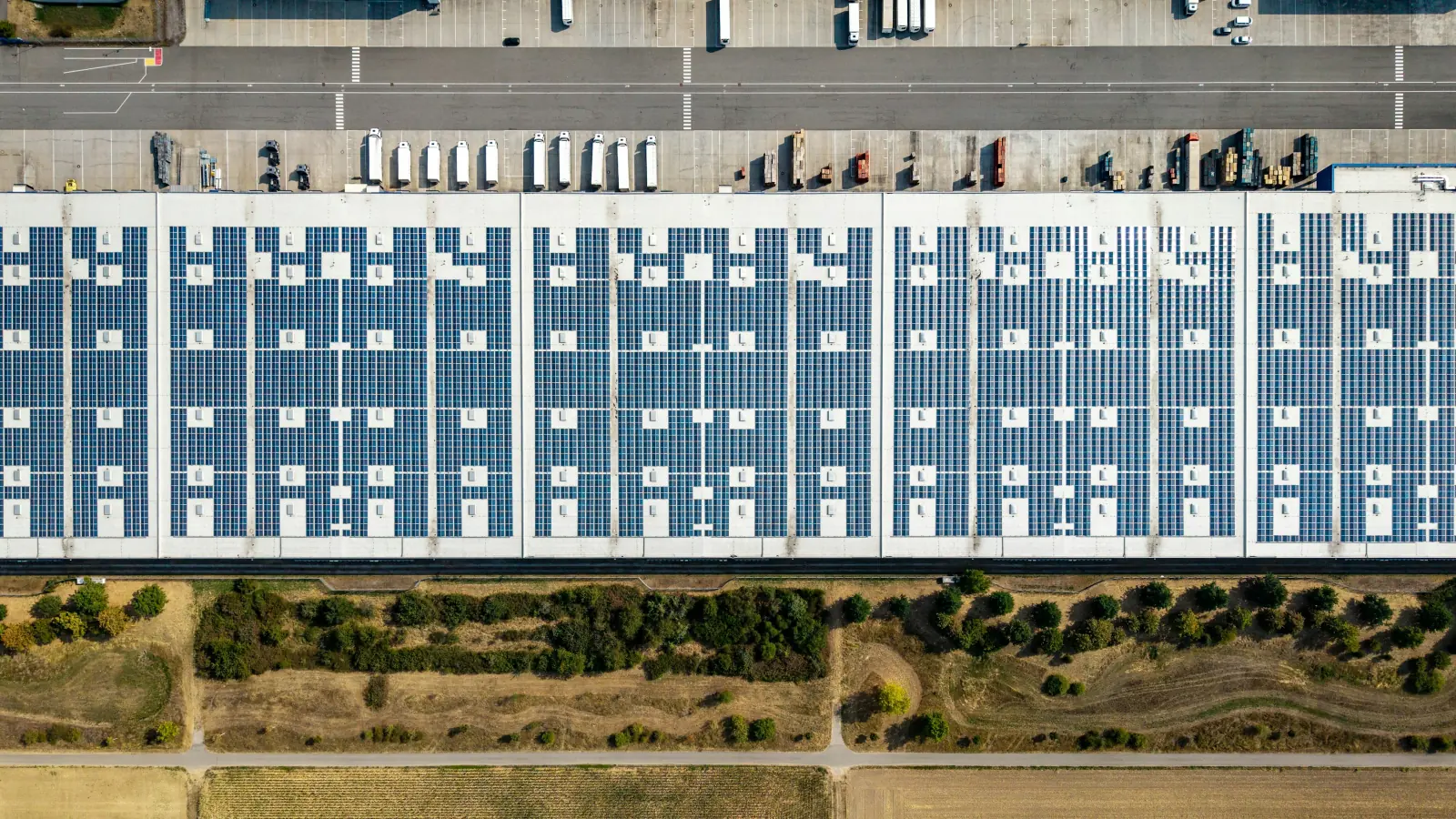
A cold store refrigerates day and night and works hardest in summer, so the output of a solar plant sized to its daytime use is used almost as it is produced. A dry warehouse uses little power for its size, so much of a large plant’s output may go to the grid. Size the plant to use, consider pre-cooling or a battery, and agree terms with the building’s owner.
In short
- Cold stores use power day and night all year, most in summer, so most of a well-sized plant’s output is used on site.
- Dry warehouses use little power for their size, so size the plant to use and plan what the surplus earns.
- Check the structure and cladding with your insurer, the grid connection, product temperature limits and the lease before signing.
How do warehouses and cold stores use electricity?
A warehouse without refrigeration uses power for lighting, ventilation, heating or cooling, doors, conveyors, IT and charging electric forklifts. It needs little for its size: in the United States in 2018, such warehouses used about 57 kWh per square metre of floor a year, less than half the average for commercial buildings, by our conversion from the US Energy Information Administration’s (EIA) survey of commercial buildings.
A cold store is different. Compressors and evaporator fans run day and night, all year, with regular defrost cycles. In the same survey, refrigerated warehouses used about 320 kWh per square metre, more than five times as much as warehouses without refrigeration. Research by the Lawrence Berkeley National Laboratory found that refrigeration takes over half of a typical refrigerated warehouse’s energy, with electric defrost adding a significant share (2011).
Heat drives the load. The warmer it is outside, the harder the compressors work, so a cold store uses more in summer, when a solar plant produces most.
How much of a solar plant’s output can a warehouse use?
In a cold store, most of it. Refrigeration runs every day, weekends included, so the output of a plant sized to the store’s daytime use is used almost as it is produced. The seasons help too. Our calculation from PVGIS, the EU Joint Research Centre’s solar data tool, for 2005 to 2023 shows that a plant tilted at 10 degrees near Madrid, Lisbon, Milan or Fresno in California produces between 63% and 69% of its year’s output from April to September, and 2.4 to 4.1 times as much in July as in December.
A dry warehouse is the opposite case: a large building with low use, often quiet at weekends. A plant covering the whole building may produce more than the site uses. Size it to daytime use, or plan from the start what the surplus will earn, since each market pays for exported power in its own way (see the region pages below). Charging electric forklifts, vans or lorries during the day, where shifts and routes allow, keeps more of the output on site.
What should you check on the building?
Logistics buildings and cold stores raise four questions before any design.
- Structure. Modules and frames add about 15 kg per square metre of module area, and 20 to 30 kg where weights called ballast hold them down (US National Renewable Energy Laboratory, 2009, our conversion), plus wind and snow loads. The UK code of practice for commercial rooftop plants, written with insurers, warns that modern lightweight designs have little spare capacity and older ones may have deteriorated, and calls for a structural survey (RC62, 2023).
- Cladding and fire. If the building is clad in insulated sheeting with a core that can burn, take particular care: RC62 recommends roofing that does not burn, and a fire-resistant covering where a combustible one cannot be avoided. Agree the design with your insurer before you sign.
- Access. Leave clear routes between groups of modules for maintenance, cleaning and firefighting. RC62 also warns that dense coverage can stop firefighters from venting a fire inside the building.
- Other places. Canopies over loading yards and car parks add space and shade without loading the building.
Can a battery, or the cold itself, store solar power?
A battery can carry midday surplus into the evening, when a cold store keeps running, and trim the short peaks that some tariffs charge for through a demand charge, based on the highest power drawn. It can pay where evening power costs much more than midday power, or where peaks are expensive, and it loses part of what it stores: the large batteries on the US grid returned about 82% in 2019, according to the EIA.
The cold itself can work as a store. Within the limits the products allow, a store can run its compressors harder while the plant produces and coast for a while later. Research by the Lawrence Berkeley National Laboratory found that most processes in refrigerated warehouses are not sensitive to two to four hours of lower power (2011). In one test at a frozen-food distribution centre in California, cutting power use for six hours warmed the air near the doors by up to almost 5 °C, against under 1 °C at the far walls, while the products stayed within limits; the researchers suggested shorter pauses of about two hours.
The products set the limit. In the EU, quick-frozen food must be kept at minus 18 °C or colder, with only brief rises of up to 3 °C during transport (Directive 89/108/EEC). Test any plan with your quality team before relying on it.
Backup is a separate design. A plant connected to the grid switches off when the grid fails, for safety, so keeping cold rooms running in a power cut needs a battery and equipment able to run isolated from the grid.
How do you pay for a plant on a leased warehouse?
The same three ways work whether you own the building or rent it. If you rent, any of them needs the owner’s written consent, and the contract should say who owns the plant, what happens when the lease ends (the next tenant takes it over, the owner buys it or it is removed) and who pays to remove and refit it if the building needs work.
- Buy the plant, keep the whole saving and carry the investment and the upkeep.
- Lease it, for a set instalment, often with maintenance included.
- Sign a power purchase agreement (PPA), from 50 kWp (kilowatts peak, the plant’s rated power). A financing partner pays for, owns and maintains the plant, and you pay only for the power it supplies, at a price per kWh set in the contract. It starts below what you pay for grid power when you sign, and any yearly increase is written into the contract from the start. What is a PPA? explains the contract.
Buying and leasing work at any size. The tax treatment differs between the three and from country to country: tax benefits of a solar PPA sets out the main rules, and your tax adviser should confirm them for your company.
What should you check before signing?
Settle these points before you commit:
- A full year of consumption by the hour or quarter-hour, including the summer peak and the weekends.
- A structural survey, and your insurer’s view of the cladding, the access routes and the isolation switches.
- The grid connection: how much the local network can take, how long approval takes and whether exports are limited.
- Your products’ temperature limits, if you plan to pre-cool.
- Who maintains and cleans the plant: insurers expect regular cleaning, according to RC62.
- The lease: the owner’s consent, the options when it ends, and whether a PPA sets a minimum purchase.
Your market
Rules on self-consumption, exports and grants are set by each country, and in the United States by each state. Read the page for your market:
- Spain: autoconsumo en logística y frío industrial, in Spanish.
- Portugal: commercial solar in Portugal, with the rules, the registration and what surplus earns.
- United States: commercial solar in the United States, with prices, export rules and tax, state by state.
- Colombia: commercial solar in Colombia, with the self-generation rules, surplus credits and tax incentives.
- Prices across Europe: business electricity prices in the EU in 2026.
How Aeternus helps
Aeternus Power is an independent energy company. We originate, qualify, structure and finance energy projects, solar-led and with storage: we study a year of your consumption, your building and your lease, size the plant and any battery to your cold rooms and shifts, and bring in a vetted builder and the financing partner. We never own the plants. A commission is paid by whoever builds or finances the project, never by you, and only when the project goes ahead.
We work with businesses in Spain, Portugal and Colombia today; in Spain and Portugal you can buy the plant, lease it or, from 50 kWp, take a PPA. Our office in California opens on 1 December 2026, and we cannot yet say which of these we will arrange there. For a first figure, use the preview on our business page, or tell us about your warehouse: we reply within two working days.
Questions
Is solar worth it for a cold storage warehouse?
Cold stores suit solar well: refrigeration runs every day and works hardest in summer, when output is highest, so most of a well-sized plant’s output is used on site. Whether it pays depends on your power price, the building and the way you pay. A year of hourly meter readings answers the question for your site.
Can solar power a cold store at night?
Not directly: the plant produces only in daylight. A battery can carry midday surplus into the evening, and pre-cooling lets the store coast for a few hours, but most night-time use still comes from the grid.
Can I put solar on a warehouse I lease?
Yes, with the owner’s written consent. Agree who owns the plant, what happens when the lease ends and who pays to remove and refit it if the building needs repairs. Keep the contract’s term in line with your lease, or agree in advance what happens if you leave.
Should electric forklifts charge from solar?
Where shifts allow, charging forklifts, vans or lorries during the day keeps more of the plant’s output on site. Charging overnight still needs grid power or a battery. Plan the charging points with the plant, since they add to the site’s peak demand.
Will solar keep my cold rooms running in a power cut?
Not on its own. A plant connected to the grid switches off when the grid fails, for safety. Backup for cold rooms needs a battery and equipment that can run isolated from the grid, sized for the compressors you want to keep running.
Sources
- US Energy Information Administration: 2018 Commercial Buildings Energy Consumption Survey, table C22, electricity use by building activity (December 2022): https://www.eia.gov/consumption/commercial/data/2018/index.php?view=consumption
- EUR-Lex: Council Directive 89/108/EEC on quick-frozen foodstuffs, article 5 (in force, consolidated version of 1 July 2013): https://eur-lex.europa.eu/legal-content/EN/ALL/?uri=CELEX:31989L0108
- EU Joint Research Centre: PVGIS 5.3, monthly output of a solar plant (averages for 2005 to 2023): https://re.jrc.ec.europa.eu/pvg_tools/en/
- US Energy Information Administration: utility-scale batteries and pumped storage return about 80% of the electricity they store (12 February 2021): https://www.eia.gov/todayinenergy/detail.php?id=46756
- US Energy Information Administration: glossary, demand charge: https://www.eia.gov/tools/glossary/index.php?id=D
- Lawrence Berkeley National Laboratory (ACEEE Summer Study 2011): demand response opportunities in industrial refrigerated warehouses in California: https://www.aceee.org/files/proceedings/2011/data/papers/0085-000052.pdf
- US National Renewable Energy Laboratory: Solar Ready Buildings Planning Guide, NREL/TP-7A2-46078 (December 2009): https://www1.eere.energy.gov/femp/pdfs/46078.pdf
- Fire Protection Association and RISCAuthority: RC62, joint code of practice for fire safety with photovoltaic installations on commercial buildings, version 2 (2023): https://solarenergyuk.org/wp-content/uploads/2023/02/RC62-Recommendations-for-fire-safety-with-PV-panel-installations-3.pdf
- Southern California Edison: solar technology FAQs, outages and grid-tied systems: https://www.sce.com/customer-service-center/help-center/solar/getting-started-with-solar/solar-technology-faqs
Latest
Europe’s power prices in early November 2026: from €184/MWh in Spain to €347/MWh in Ireland